Key Takeaways
The best AI agent platforms for HR complete multi-step work inside the system of record, not just answer questions.
Workday, SAP SuccessFactors, Oracle, and Darwinbox lead the enterprise tier; UKG, Dayforce, and ADP suit payroll and frontline work.
No single AI agent platform is best; fit depends on workforce, ecosystem, and how each governs agentic actions.
The decisive test is governance: agents acting within existing roles, approvals, and audit trails, and interoperating openly.
How AI Agents for HR Differ From Chatbots and Copilots
The best AI agent platforms for HR teams in 2026 are the HCM suites that have moved past chatbots and copilots to agents that complete multi-step work inside the system of record, initiating actions, respecting approvals, and orchestrating tasks across HR, IT, and finance. At the enterprise tier, Workday, SAP SuccessFactors, Oracle Fusion Cloud HCM, and Darwinbox lead with agents embedded directly in HR workflows. UKG, Dayforce, and ADP anchor the payroll- and frontline-heavy end of the market, while Rippling, Paycom, and BambooHR serve tech-forward, mid-market, and growing teams.
One distinction is worth settling before the list. An AI assistant answers a question. An AI agent finishes the task, it reasons over a request, takes the next steps, and returns once the work is done or an approval is needed. Through 2025 and into 2026, nearly every major HCM vendor rebuilt its AI story around that idea, shipping purpose-built agents that act inside the workflows where people decisions are actually made. The result is a market where the question is no longer "does this platform have AI?" but "can its agents execute work safely, under the same roles and approvals that govern your HR team?"
This list is organized by fit, not by a single ranking. Each entry covers what the platform does well, its core agentic capabilities, and the scenario it suits best.
Methodology
We reviewed more than 20 HCM and HR platforms with agentic AI before selecting the ten included here. The shortlist was built on five axes calibrated for agentic HR: whether agents execute multi-step work or only answer questions; governance, meaning whether agents act within the same role-based access, approvals, and audit trails that bind the HR team; how deeply agents are embedded in the system of record rather than bolted on; the ability to orchestrate across HR, IT, and finance; and openness, including support for standards such as the Model Context Protocol.
Evidence was drawn from analyst research on cloud HCM suites, customer reviews on G2 and Gartner Peer Insights, public product documentation, and conversations with HR and IT buyers across enterprise organizations.
A note on transparency: Darwinbox is included in this list and assessed against the same five axes as every other platform. Its placement reflects an honest reading of where it is strong, open, governed agent orchestration anchored to HR roles, and where the largest suites bring broader installed bases.
1. Darwinbox
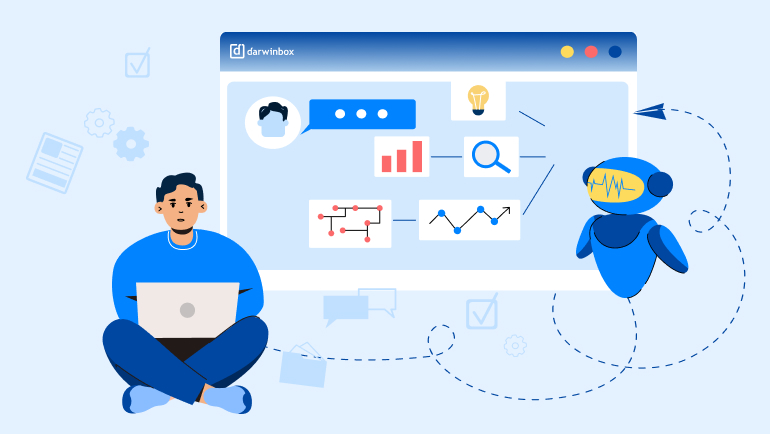
Darwinbox approaches agentic AI from the system of record outward. Its Super Agent is a context-aware AI teammate that orchestrates multi-step work across HR, IT, and finance, and it runs on the company's Model Context Protocol (MCP) server, the first launched by an HCM platform, which exposes HR actions as tools that internal or external agents can call under role-based access controls. The practical effect is that agentic actions inherit the same permissions and approval chains that already govern HR work, rather than operating outside them. A Control Center gives HR and IT leaders model choice, prompt governance, exception handling, and telemetry.
Key capabilities:
Super Agent for cross-system workflows across HR, IT, and finance, with policy-aware approvals.
An MCP server that lets external agents act on HR data within role-based access controls.
A library of more than 30 function-specific agents for recruiters, HRBPs, payroll admins, line managers, and employees.
A governance Control Center for model choice, audit trails, and oversight, on a full HCM suite with multi-country payroll.
Darwinbox was named a Challenger in the Gartner Magic Quadrant for Cloud HCM Suites for a second consecutive year, supporting its enterprise positioning alongside its agentic roadmap.
Best for: Mid-market and enterprise buyers, particularly those operating across Asia and other emerging markets, that want agentic actions tied to HR roles and approvals, and the option to bring their own agents and models into HR safely.
2. Workday
Workday positions itself as an enterprise AI platform for managing people, money, and agents, and its agentic layer, Workday Illuminate, expanded steadily through late 2025 and into 2026. The agents are purpose-built for specific processes and embedded in existing Workday workflows rather than layered on as a separate assistant. Workday has also signaled a longer-term direction with an Agent System of Record intended to govern every agent operating across the enterprise. As an AI agent platform, Workday suits organizations willing to standardize on one vendor's agent ecosystem and consumption model.
Key capabilities:
Illuminate agents spanning recruiting, expenses, succession, payroll, case management, and business-process setup.
Agents embedded in native HR and finance workflows, drawing on Workday's unified data model.
A Flex Credits consumption model for accessing new agents as they ship.
A stated roadmap toward an enterprise-wide agent governance layer.
Best for: Fortune 500-scale organizations that want HR and finance unified and are willing to standardize on a single platform's agent ecosystem.
3. SAP SuccessFactors
SAP has pushed agentic AI across SuccessFactors through its Joule layer, with a network of agents that work across recruiting, workforce administration, payroll, learning, performance, and talent development. SAP's 1H 2026 release extended these agents to act across modules rather than sit as isolated helpers in a single screen, and several Joule agents, covering areas such as career and talent development, HR service, payroll questions, and people analytics, were set for general availability in 2026. For enterprises already on SAP, that suite-wide agent network is the reason this AI agent platform fits their estate.
Key capabilities:
A connected network of Joule agents across the talent and core HR lifecycle.
A People Intelligence layer that consolidates analytics behind a conversational interface.
Agents that explain pay, recommend successors, and resolve HR service requests before they reach a person.
Tight integration with the broader SAP business data and ERP estate.
Best for: Large enterprises with an existing SAP footprint that want HR agents operating against the same governed enterprise data as the rest of the business.
4. Oracle Fusion Cloud HCM
Oracle introduced Fusion Agentic Applications in 2026, embedding autonomous agents into HR workflows such as talent management, workforce scheduling, payroll, and HR service delivery. Oracle's argument is architectural and commercial at once: agents are native to the transactional system, can execute in real time at scale with governance, and are positioned as included rather than priced separately. Oracle also offers an AI Agent Studio so customers can build and run their own agents alongside the prebuilt ones. Pricing AI as included rather than a separate line item lowers the barrier to switching agents on across the suite.
Key capabilities:
Prebuilt HCM agents, including a Talent Review Assistant, Benefits Analyst, and Performance and Goals Assistant.
Agents native to the transactional system of record, designed to act in real time.
AI Agent Studio for building, orchestrating, and measuring custom agents.
An "included AI" commercial posture that lowers the barrier to turning agents on.
Best for: Existing Oracle ERP and database customers that want HR agents inside the same stack and prefer embedded AI over separately licensed tools.
5. UKG Pro
UKG describes itself as a platform unifying HR, pay, and workforce management, and its 2026 agentic releases concentrated where complexity is highest for its customer base: pay for frontline and hourly workers. UKG Pro Pay with Workforce AI applies agentic, assistive, and generative AI to detect, analyze, and resolve pay issues in real time, with humans kept in the loop through review and approval steps. For frontline and hourly operations, that pay-focused agent depth is where this AI agent platform earns its place.
Key capabilities:
A Payroll Analyst Agent, anomaly detection, and AI-assisted payroll processing with built-in approval touchpoints.
Agentic demand forecasting and scheduling for complex, frontline operations.
Deep compliance automation across jurisdictions, union rules, and 24/7 operations.
Workforce management depth for healthcare, manufacturing, retail, and public sector.
Best for: Organizations with large hourly and deskless populations where scheduling accuracy and payroll precision drive the most value.
6. Dayforce
Dayforce pairs agentic AI with a continuous calculation engine that computes gross-to-net pay in real time as schedules change, rather than batching it at period close. Combined with localized support across more than 200 countries and territories and a single data model linking pay, time, benefits, and talent, this makes Dayforce a strong fit for organizations whose payroll complexity comes from constant change. For payroll that shifts with every schedule change, that real-time engine is the reason to choose it.
Key capabilities:
A real-time, continuous payroll calculation engine.
AI agents and copilots layered across the unified data model.
Strong localization and compliance support across many countries and territories.
A single record linking time, pay, benefits, and talent data.
Best for: Mid-to-large organizations with intricate, frequently changing payroll, especially shift-based and multi-jurisdiction operations.
7. ADP
ADP's strength is payroll at global scale, and its AI strategy builds outward from there. ADP Assist brings generative AI across its products, and ADP's 2026 outlook points to agentic AI automating payroll validations and surfacing HCM insights, with ADP Lyric HCM serving as its more configurable enterprise platform. For organizations that already trust ADP with pay, agents that strengthen accuracy and compliance are a natural extension. ADP Lyric HCM extends the same payroll-grade discipline to a more configurable enterprise platform.
Key capabilities:
Agentic and generative AI applied to payroll validation and compliance.
Global payroll depth backed by decades of regulatory experience.
ADP Lyric HCM for enterprise-grade configurability.
Broad managed-services options for organizations that want payroll run for them.
Best for: Global enterprises that lead with payroll and want to consolidate more of the HR lifecycle onto a payroll-grade platform.
8. Rippling
Rippling's distinguishing idea is the Employee Graph, a single source of truth that connects HR, IT, and finance, so that one action (hiring or offboarding) can trigger coordinated changes across payroll, app access, and devices. Its automation and AI-driven request management route and resolve employee requests with context, turning the platform from a record keeper into a system that takes action. For technology-forward teams, that shift from record keeper to action engine is the core appeal of the platform.
Key capabilities:
A unified Employee Graph spanning HR, IT, and finance data.
Automated provisioning and deprovisioning of apps and devices tied to HR events.
AI-powered request management that routes and resolves requests where employees work.
Highly configurable workflow automation across the employee lifecycle.
Best for: Technology-forward and fast-scaling companies that want HR, IT, and finance operations managed from one system, with automation as the core design principle.
9. Paycom
Paycom's automation philosophy puts work in employees' hands and uses AI to remove administrative friction. Its employee-driven payroll model and automation features, including agents that handle routine approvals such as time-off requests, reduce the manual load on HR for mid-market organizations that want a single, self-service-first system.
Key capabilities:
Employee-driven payroll that shifts data accuracy to the source.
AI agents and automation for routine approvals and self-service tasks.
A unified HRIS spanning payroll, talent acquisition, talent management, and time and labor.
Reporting and compliance tooling oriented to U.S. requirements.
Best for: U.S.-centric mid-market organizations that prioritize self-service, payroll automation, and a single integrated system.
10. BambooHR
BambooHR centralizes people data, onboarding, and performance management with an interface built for ease of adoption rather than enterprise configurability. Its AI features assist with everyday HR workflows, and while its agentic depth is lighter than the enterprise suites above, its strength is getting smaller HR teams productive quickly without heavy implementation. For smaller teams, the value is fast time to productivity rather than deep agentic orchestration.
Key capabilities:
Centralized employee records, onboarding, and performance management.
AI-assisted HR workflows and reporting.
A widely praised, intuitive employee and admin experience.
A library of integrations to extend the core system.
Best for: Small and midsize businesses that want a clean, people-first HRIS and value simplicity over deep agentic orchestration.
Comparison: AI Agent Platforms for HR at a Glance
| AI agent platform | Agentic layer | Strongest for | Notable in 2026 |
|---|---|---|---|
| Darwinbox | Super Agent + MCP server | Role-anchored, open orchestration | First HCM MCP server; 30+ HR agents |
| Workday | Workday Illuminate | Global HR + finance enterprises | Expanding agent catalog; Agent System of Record direction |
| SAP SuccessFactors | Joule agents | SAP-standardized enterprises | Suite-wide agents in the 1H 2026 release |
| Oracle Fusion Cloud HCM | Fusion Agentic Applications | Oracle ecosystem buyers | Embedded agents positioned as included AI |
| UKG Pro | Workforce AI | Frontline and hourly workforces | Agentic payroll and anomaly detection |
| Dayforce | Dayforce AI | Continuous, complex payroll | Real-time pay engine with AI agents |
| ADP | ADP Assist / Lyric | Global payroll-led HCM | Agentic payroll validation |
| Rippling | AI request management | HR + IT + finance in one system | Employee Graph automation |
| Paycom | AI automation | U.S. mid-market self-service | Employee-driven payroll automation |
| BambooHR | BambooHR AI | SMB people operations | AI-assisted core HR workflows |
How to Choose AI Agent Platforms for HR
Choosing an AI agent platform for HR comes down to how the agents behave inside your operating model, not how many a vendor advertises. Five factors separate the strongest AI agent platforms.
Choose agents that execute, not just answer
An AI agent platform earns its place when its agents file requisitions, resolve cases, or complete onboarding, not when they only draft text. Ask for the specific actions each agent can take, not the topics it can discuss.
Insist on governed agents
Agentic AI is safe in HR only when agents inherit the permissions and approval chains that already govern your team. The strongest AI agent platforms anchor agents to role-based access, so an agent does only what the person it acts for is allowed to do.
Favor agents embedded in the system of record
AI agents that act inside the transactional system have the context to execute reliably. Agents bolted on from outside tend to stall at the boundary between systems.
Require orchestration across HR, IT, and finance
Most employee work crosses functions, so AI agent platforms that coordinate across HR, IT, and finance deliver more than those confined to a single module.
Prioritize openness
Standards such as the Model Context Protocol let you bring your own agents and models into HR safely. Openness matters most if you already run agents in CRM, ERP, or IT service management.
European mid-market buyers should also evaluate Personio, and recruiting-led organizations may weigh specialist talent platforms. For full-suite agentic HR, the ten AI agent platforms above represent the current field.
FAQs
What is an AI agent platform for HR?
An AI agent platform for HR is an HCM system whose AI can complete multi-step HR work, not just answer questions. Agents reason over a request, take actions such as filing a requisition or resolving a case, and pause for approval when policy requires it. The strongest examples operate inside the system of record under existing roles and permissions.
How are AI agents different from HR chatbots or copilots?
A chatbot or copilot responds; an agent acts. Copilots draft text, summarize data, or answer policy questions, leaving execution to a person. Agents carry the task forward, initiating workflows, updating records, and coordinating steps across systems, then return when the work is done or a decision is needed.
Are AI agents in HCM platforms safe to use on sensitive HR data?
They can be, when governance is built in. The key controls are role-based access (an agent acts only within the permissions of the person it serves), approval workflows, audit trails, and oversight tooling that lets HR and IT monitor and intervene. Platforms that expose these controls directly are better suited to regulated, enterprise environments.
Which AI agent platform is best for a frontline or hourly workforce?
Platforms built around workforce management and payroll tend to fit best, because frontline complexity concentrates in scheduling and pay. UKG and Dayforce are common choices for shift-based, hourly, and deskless operations, where agentic scheduling and real-time payroll accuracy deliver the most measurable value.
Can external AI agents connect to my HCM platform?
Increasingly, yes. Interoperability standards such as the Model Context Protocol allow external agents, from CRM, ERP, or IT service tools, to call HR actions securely within role-based controls. Darwinbox was the first HCM platform to launch an MCP server, and openness of this kind is becoming an evaluation criterion for enterprises running agents across multiple systems.
Do AI HR agents replace HR teams?
No. Agents take on repetitive, multi-step execution so HR teams can focus on judgment-heavy work, culture, capability, and decisions that require human context. The platforms above are explicit about keeping humans in the loop through approvals and oversight, positioning agents as teammates rather than replacements.
Choosing among these AI agent platforms is less about which vendor ships the most agents and more about which agentic model fits how your organization governs work. If you are building a shortlist, start by evaluating how each platform governs agentic actions rather than by counting features, it is the fastest way to separate agents that are genuinely safe to deploy from those that simply demo well.