Most AI agents in hiring aren’t paying off yet. Here’s where hiring stalls, and how to fix it.
Hiring gets the AI budget first in almost every organization today. Gartner found that 64% of HR leaders have AI agents live or scheduled in recruiting, more than in any other part of HR. Boards are waiting for the return, too. In another Gartner study, 77% of board members said they expect AI to deliver productivity gains and cost savings.
So far, the return hasn’t shown up. Only 14% of HR AI agent initiatives are fully or highly successful. Most of the agents behind those numbers are standalone tools: a screening agent here, a scheduling agent there, a chatbot for candidates. Each one works without your roles or hiring rules, runs up costs you have little say over, makes decisions that are hard to trace, and follows a process someone else designed. That’s the gap an agent platform closes. Agents on a shared platform know your hiring context, follow your workflow from end to end, and work within the cost and oversight controls you set.
What is an agent platform in hiring?
An agent platform for hiring is a single layer where AI agents work from an organization’s full hiring context: its data and workflows, and also how hiring decisions actually get made there, including the exceptions and approvals that never make it into a written policy. It comes with shared controls for cost, auditability, and human oversight. It’s the next step forward for single-task agents, each of which works on its own.
AI agents have taken a lot of the grunt work out of recruiting. They write job descriptions, parse resumes, rank applicants, schedule interviews, and answer candidate questions at 2 AM. For a recruiter juggling 40 open roles, that is real support.
But look at how most of them work. Each one handles a single task, and that’s usually where it stays. There’s little room to use it any other way. However, hiring has a lot of steps: sourcing, screening, interviews, offers, background checks, onboarding. When each step gets its own agent, the handoffs between them start to matter as much as the work itself. Every agent makes decisions along the way. If the next one picks up without the full context of what came before, every decision after that gets a little worse.
Why do AI agents in hiring stall?
When agent projects in hiring fall short, it’s rarely for one reason. Four come up repeatedly, and each cuts into what most TA leaders are optimizing hiring for: turnaround time, quality of hire, and cost of hire. Each one also has a clear answer.
The agent doesn’t know your organization
An agent that doesn’t know your roles, pay bands, or hiring rules will get things wrong in ways that look right at first glance. It shortlists against a generic version of the job. It drafts an offer that sits outside the band. It books a final round with an interviewer who isn’t on the panel for that grade. A recruiter catches it, fixes it, and runs it again. The task got automated. The rework didn’t.
What fixes it: Agents that work with your context. An agent that knows your roles, bands, and rules gets more right the first time. That means better quality of hire and far less rework.
A bill nobody can forecast
Every one of those re-runs costs something and most teams have no say in where that money goes. They can’t put a lighter model on routine work and save the stronger one for decisions that matter. They can’t decide who gets premium model access and who doesn’t need it. Usage climbs, the bill climbs with it, and nobody can say what the next quarter will cost. For a function being asked to bring down cost per hire, that’s the wrong direction.
What fixes it: Costs you can see and control. The right model for each job, premium access only where it’s needed, and a clear view of what agents spend. That’s what brings cost of hire down instead of up.
Explainability behind every move
When a candidate gets rejected, a start date slips, or an offer goes out wrong, someone has to answer for it. That means knowing what the agent did behind the scenes, which data it used, and why it acted the way it did. Without that, nobody can explain the decision, and nobody owns it.
So, people end up stepping in for the wrong reasons. Not for the judgment calls that should stay with them, like choosing between two strong finalists or deciding how far to stretch on an offer, but to trace and patch work that happened out of sight. If trust drops, adoption stalls with it. And with rules on AI in hiring tightening across markets, a black box is quickly becoming a compliance problem too.
What fixes it: Every action on record. What the agent did, which tools and data it used, and why it acted the way it did. When something goes wrong, there’s a record to check and a clear owner.
It runs the vendor’s playbook, not yours
Hiring a branch teller, a plant supervisor, and a product manager are three different processes. Onboarding is even more particular. It’s a workflow where HR, IT, facilities, payroll, and the hiring manager each own a piece, and half the steps can’t start until another one finishes. An agent designed to run one generic version of that can’t be reshaped to match yours. So, teams either bend their process to fit the tool or quietly work around it.
What fixes it: Agents shaped to how you hire. Your steps, your approvals, and your dependencies, run end to end. That’s where turnaround time comes from, all the way from an approved requisition to day one.
Where does an agent platform pay off most? Frontline hiring
If these gaps slow corporate hiring down, they cost far more on the frontline. Banks, insurers, manufacturers, and retailers hire in volume, often for the same few roles, across branches and plants spread over entire regions, and they lose people fast. In India, the central bank has flagged attrition of around 25% at private sector banks as an operational risk, and TeamLease reports turnover of 103% across the more than 80,000 frontline sales and service staff it manages for lenders. Manufacturers are fighting the other side of the same problem. In an ACMA and BCG analysis of 450 companies, 61% of Indian auto parts suppliers were facing a critical shortage of workers.
Volume makes quality harder to maintain, too. When a branch network needs a few hundred relationship managers by the end of the quarter, the pressure is to fill seats, and screening gets thinner as the numbers go up.
Slow hiring costs just as much. Frontline candidates often apply to several jobs at once and take whichever offer comes first, so every extra day in the process loses people. In manufacturing, an empty seat on the line means the line runs below capacity. In the US Census Bureau’s plant survey for Q2 2026, 22.2% of plants that gave a reason for running below full capacity cited a shortage of labor.
At that volume, every stall multiplies. An agent that misreads a role once misreads it across hundreds of requisitions. Every re-run lands on the bill hundreds of times over. And frontline hiring is where one-size-fits-all breaks first. A bank’s branch hires and a plant’s shift workers need different checks, different approvals, and different things done before day one, and neither looks much like corporate hiring.
It’s also where the case for agentic hiring is the easiest to make. When the same steps repeat hundreds of times a month, every gap an agent closes pays back hundreds of times too.
How does the Darwinbox Agent Platform address this?
The Darwinbox Agent Platform is a low-code, no-code platform for putting agents to work on your terms. Darwinbox has carried context from one hiring stage to the next from the start, because recruitment, onboarding, and core HR have always run on one platform. Agents on the platform inherit all of it, so they start with the context a single-task agent has to go looking for. The platform has four parts.
A library to start from. Pre-built agents cover common work across recruitment, onboarding, and employee support. A recruiting team can switch on a screening agent or an onboarding agent on day one, without waiting on a build.
Customize any of them. This is where your own hiring context comes in. If you screen sales candidates on a structured call with five set questions and a hard cutoff on notice period, you can tweak the pre-built screening agent to run calls exactly that way for that role, and differently for the next one.
Build your own. Some hiring tasks won’t match anything in a library, like a campus drive with college-specific schedules and multiple assessment rounds. In such cases, users can describe what they need, and an agent helps them build it. Teams with developers can use coding tools to go further.
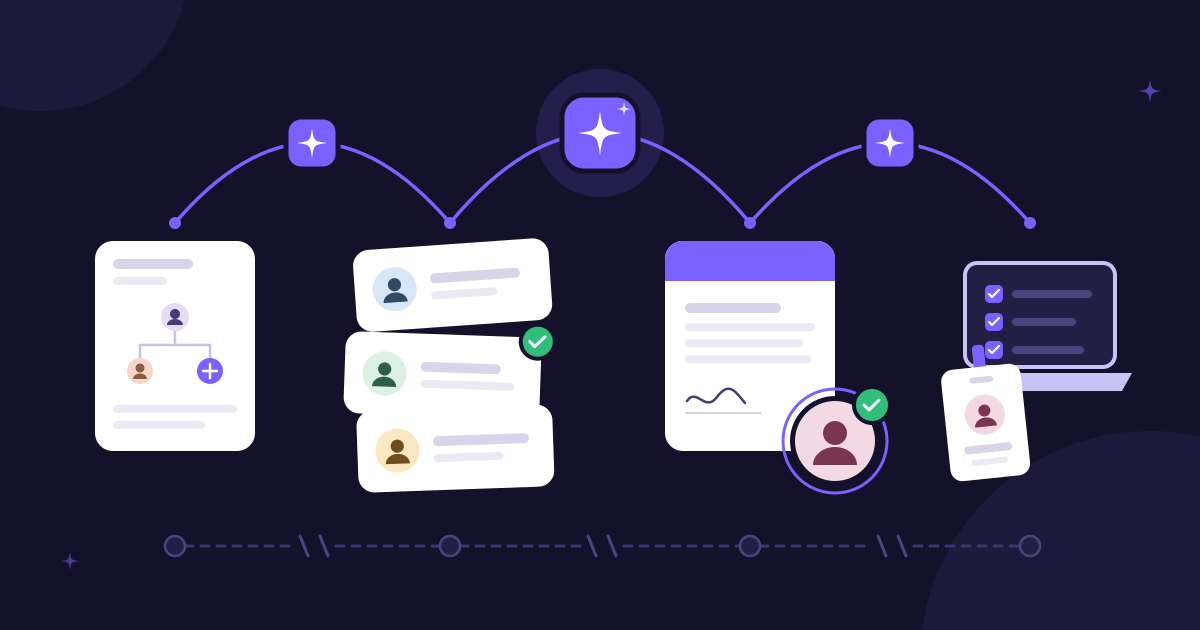
A visual flow builder. Users can lay out multi-step work end to end. Say an offer gets accepted: one agent kicks off background verification, another raises the laptop and access request with IT, and the hiring manager gets a day-one plan, with each step waiting on the one it depends on.
Around all of it are the controls HR and IT leaders keep asking for. Every agent action is auditable, down to which tools an agent picked. Decisions are explainable. Teams choose which models their agents use and who gets premium access, which keeps token costs in check, and people stay in the loop wherever judgment is needed. Every AI feature also goes through Darwinbox’s Responsible AI Council, with ongoing bias testing.
Darwinbox’s agents are already showing the results. At a 23,000-employee bank in the Philippines, agents handling screening, scheduling, and joining paperwork cut time to hire by 48%, from 33 days to 17. That’s more than two weeks back on every role.
Analysts are noticing too. Darwinbox was named a Leader in the 2026 Gartner Magic Quadrant for Talent Acquisition Suites, and had the highest product score of all evaluated vendors for the Extended AI use case in the companion Critical Capabilities report.
Hiring got the AI budget first. With the right platform underneath, it can be the first place that budget pays off.
FAQs
Why do most AI agents in recruiting fail to deliver ROI?
Most work as single-task agents, each automating one step on its own. They don’t have the organization’s roles, pay bands, or hiring rules, so their output needs rework. Their costs are hard to control, their decisions are hard to trace, and they can’t follow the organization’s own hiring workflow.
What is the difference between an AI agent and an agent platform in HR?
An AI agent performs a task, such as screening resumes or scheduling interviews. An agent platform is the layer those agents run on. It gives them shared hiring context, connects them into end-to-end workflows, and adds controls for cost, auditability, and human oversight.
How can HR teams control the cost of AI agents in hiring?
By matching the model to the task: a lighter model for routine work and a stronger one for decisions that matter. Teams can also limit premium model access to the people who need it and track what each agent spends. An agent platform puts these controls in one place.
How do you make AI hiring decisions explainable?
By recording every agent action: what the agent did, which tools and data it used, and why. That record lets a named owner review any decision and answer for it, which also matters more as rules on AI in hiring tighten across markets.