Talent risk extends far beyond attrition. It reflects whether the workforce can absorb market disruption, whether its capabilities align with strategic ambition, and whether its people practices can stand up to regulatory and reputational scrutiny. Leading C-suite discussions with talent risk represents a bold new frontier for HR leaders: one where they extend their influence to shaping the enterprise strategy.
CEOs today are making high-stakes decisions in volatile markets, with limited room for error. They rely on their executive team to help them navigate uncertainty. HR leaders have long been trusted partners in managing workforce programs, building skills and enabling strategy execution. But forward-looking CHROs aren’t content with just supporting strategy, they aspire to shape it.
The opportunity is real, but it requires a shift in posture in the boardroom. From reporting talent metrics to surfacing talent risks.
For years, HR has perfected the craft of measurement: engagement scores, attrition rates, headcount costs. So, what’s wrong with talent metrics? Nothing. They are essential to understand what is happening, but they rarely answer the question CEOs really care about – What could go wrong and are we prepared for it?
When CHROs lead C-suite discussions with talent risk, they point out areas that, if ignored, could derail business strategy. The language expands from engagement, attrition, and policy to resilience, predictability, and exposure.
When HR speaks in business terms, it becomes easier for the rest of the C-suite to see workforce issues as enterprise priorities.
Three Talent Risks That Shape Executive Decisions
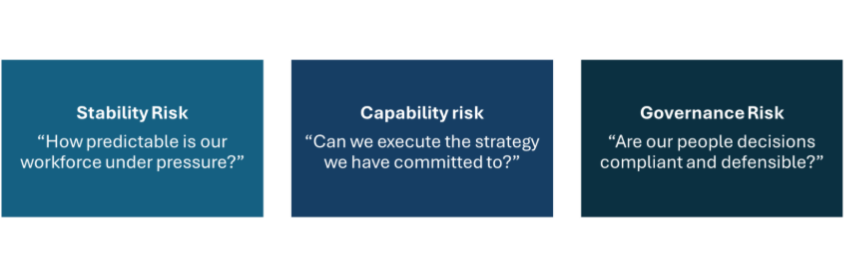
Stability Risk
This risk defines whether business is resilient to stress, such as the loss of key people.
| Risk Metric | Example |
|---|---|
| Succession Fragility How exposed is the business is if key people exit. | “Only 30% critical roles have a ready-now successor. The largest gaps sit in Product Management and Sales.” |
Capability Risk
This risk is not about generic skills shortage, but about specific strategic gaps.
| Risk Metric | Example |
|---|---|
| Capability concentration Overreliance on a few individuals creates single points of failure, exposing fragility (often masked as productivity). | “48% of model validation is currently handled by only two analysts.” |
| Critical skills gap Quantifying the gap makes the degree of risk evident. | “Only 3 of 7 product managers are proficient in AI product management. Hence, capability coverage stands at 40%, while next year’s roadmap is AI-heavy.” |
Governance Risk
Actively monitoring and sharing workforce governance (e.g. employee data exposure, pay equity and diversity) showcases risk-awareness and maturity. By removing blind-spots here, CHROs can protect the organization from legal, financial or reputational risks - elevating HR’s role from function management to enterprise risk management.
| Metric | Example |
|---|---|
| Employee data risk Current exposure and how it is being controlled. | “Employee data exposure is moderate due to legacy access and expanding integrations. We have reduced unrestricted data exports by 38% in two quarters.” |
When leaders see where the workforce is fragile or exposed, strategy becomes more grounded.
Visibility itself creates strong value, even before action is taken.
How to Start Leading with Talent Risks
Monday morning
Build a talent risk snapshot. Look for accessible data like
% of leadership roles with no defined successor.
Attrition in revenue-generating or transformation-aligned functions vs. the enterprise average
Promotion rates by gender or demographic group
Start drafting your one-page risk narrative by compiling broad areas of fragility and exposure.
First 30 days
Pressure-test the risk framing with CFO and COO. Surface potential pushbacks and build allies for the formal presentation.
Prepare one powerful insight per risk category, linking risk to business strategy.
First 90 days
Institutionalize thresholds and triggers.
E.g. Regretted attrition in critical function >1.5 X enterprise average for 2 consecutive quarters triggers retention conversations with top 20% performers.
Present talent risks in at least one operating review.
A Fair Warning
Leading with talent risk isn’t easy. It creates productive tension, surfaces fragility, introduces accountability and may challenge comfortable narratives.
But the payoff is real: CHROs who own visibility don’t need to fight for a seat at the table. They become impossible to exclude.
How Modern, AI-Native HCM Can Support This Shift
Advanced HCM support visibility by connecting workforce data that often sits in silos — performance, succession, hiring, pay, access controls — and surfacing patterns that may indicate emerging exposure. AI can identify clusters, outliers, or trend deviations, which allows HR leaders to ask better questions earlier. The goal is not automated decision-making, but earlier insight and clear intervention points.
Talk to us to find out how Darwinbox can help you lead with influence.