Darwinbox sat down with Jaime Roca, former Gartner HR Research leader and author of The Connector Manager, to break down the new struggles managers face in a rapidly advancing world, and how HR leaders can empower them to lead their people with foresight.
Most conversations about AI and managers start in the same anxious place: which parts of my job are about to be automated away? When Darwinbox hosted a fireside chat with Jaime Roca, we deliberately started somewhere else.
Roca is one of the more credible voices on this question. He spent more than a decade at Gartner leading global research and advisory work on management and talent, has advised Fortune 100 leaders, coauthored The Connector Manager, and has personally managed teams ranging from ten people to well over seven hundred across a 25-year career. His latest book, Standout: The Six Conversations Every Ambitious Leader Needs to Master, is the culmination of that work. In conversation with Opal Wagnac, Darwinbox's Global Head of Market Positioning, he made a case that runs against the prevailing narrative:
"AI is not primarily a threat to managers. The threat is a management system that was built for a slower world and never updated."
Why this matters now for HR leaders
The manager layer is where strategy either becomes real work or quietly dies. It is also the layer under the most strain. Spans of control have widened from six or seven direct reports to twelve or more. Priorities shift constantly. And the systems meant to help managers, goal-setting, performance reviews, engagement sensing, run slower than the change they are supposed to absorb.

For HR leaders, this is not a soft problem. When managers are stuck reacting, the signals that matter most e.g., disengagement, burnout, or emerging skills gaps, surface late or not at all. Manager capability is the multiplier on everything else HR invests in, and right now it is underleveraged. What follows are five insights from the conversation that reframe what it takes to fix that.
Insight 1: The problem isn't manager effort or skill. It's the system.
Wagnac opened by naming the usual explanation for struggling managers, work harder, try harder, work smarter, and asked Roca why his research points elsewhere. His answer started with context, and the numbers tell the story.
"That tells you we are in a world of a lot of reactive management," Roca said. And the deeper issue is structural. "The organizational systems that they've had in place are designed for a much slower world."
Goal-setting, performance reviews, and organizational sensing remain, in his words, "very opaque and slow." Managers are not failing a test of effort. They are operating inside a system that cannot keep pace with the conditions it was meant to manage.
Insight 2: Manager are drowning in information, but starving for context
If the systems can't keep up, why can't the flood of new dashboards and data close the gap? Wagnac pushed on exactly this point, noting that every tool managers are handed seems to add "more places to log things, more dashboards to check," without telling them what any of it means for the decision in front of them.
Roca agreed, and named the mechanism.
Organizations have invested heavily in data, "but there is lack of connection between the information that they're getting and the context of where the organization is going."
He frames this as the 60/40 rule: the strategy handed down from leadership is only ever 50 to 60 percent set. The remaining 40 percent, how the vision translates into daily priorities and coaching, is left for managers to design, usually without the context to do it well.
This is where Wagnac drew the line to how Darwinbox thinks about the problem. The gap isn't information; it's context. A system's job is to connect the two, to read what is happening across the organization and surface not just data but what the data means for where the business is heading. Information tells a manager what happened. Context helps them decide what to do next.
Insight 3: Doing MORE is the wrong instinct
Under pressure, managers reach for a familiar piece of advice: focus on what you can control. Roca called it "the wrong thing to do." The effect is that a manager's influence narrows to their immediate team while they lose sight of what's happening upstream and downstream.
He named the underlying reflex the Hero Hustle Trap: taking on more, doing more, and absorbing personal responsibility for everyone's success in an attempt to control a system that won't hold still.
Wagnac connected this to its human cost, describing what falls through the cracks when a manager is stuck reacting: someone starting to disengage unnoticed, a team member overloaded to the point of burnout, a skills gap forming because no one had the bandwidth to see it coming.
Then she posed the question Darwinbox has been building against:
"Should a system be doing that noticing in the background, surfacing the signal before it becomes a fire?"
Roca's answer was direct.
"As spans widen, and as remote work thins out informal awareness, it becomes nearly impossible to know how each person is performing, let alone how they are feeling or whether a wellness or performance risk is building."
Always-on signal detection, he argued, is precisely the kind of help that lets a manager redirect attention to the work only they can do. The point of catching the signal early is not to automate the manager's judgment. It is to give them the time to exercise it.
Insight 4: Fewer than 10% of conversations actually matter
Roca's central argument in Standout is that great managers don't add new activities; they manage inside the conversations they are already having. He counts roughly 800 scheduled conversations a year between a manager, their boss, their team, and their partners. Fewer than 10 percent of them genuinely move anything. "That should be liberating," he told the audience. The task is not to have more conversations but to get exceptionally good at the six that count.
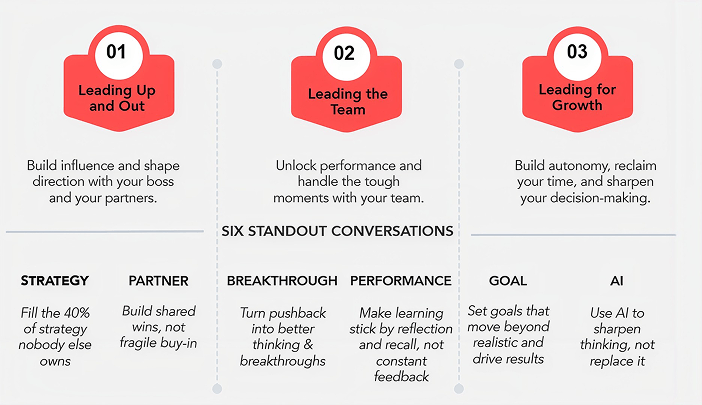
The breakthrough conversation was his worked example. Most managers treat tension as a threat to team harmony, something to smooth over. Roca argued the opposite: "creativity and breakthroughs happen when there's more time where you can let it sit." The discipline is learning to distinguish good pushback, which moves the strategy or the goal forward, from bad pushback rooted in ego or attachment to old ways of working.
"It takes pressure to create diamonds."
Wagnac turned this into a capability question for the HR leaders watching: would you even know which of your managers are having these conversations and which aren't? You can't log a breakthrough. But, as she noted, you can tell a lot about the root from the fruit, and HR's job is to give managers the permission and the room to have more of these moments.
Insight 5: AI makes the average manager more average
The sharpest line of the session.
"Having the crutch of starting with AI just makes you more average."
When everyone has access to the same tools, using them to move faster is no advantage. It just produces average output more quickly, and it produces it without the context only the manager holds.
His alternative is a discipline of sequence: think first, then use AI. He described three conversations every manager should have.
The first is with yourself, wrestling with the problem and forming a point of view before ever opening a tool, then using AI to crystallize thinking that is already 80 to 90 percent there.
The second is with the system you manage, using AI to surface patterns across your team and workflows, while pressure-testing what comes back against each tool's limitations.
The third is with people, rehearsing a difficult conversation or a partner negotiation so you bring your best self into the room.
Wagnac tied this directly to how Darwinbox built Cortex. "It isn't a tool that just hands managers an answer to go ahead and accept," she said. "It'll read the organization as it stands, it'll surface the patterns, and then it'll put it in front of the manager." The design intent is to provoke challenge, not compliance, because the manager holds the tacit knowledge the system doesn't. "The human is the one who still decides," she said.
Roca agreed, adding that the manager's role is increasingly that of a forecaster, using AI to work through second and third-order consequences of emerging change and to build workflows for scenarios no one designed for in advance.
That drew out the conversation's most forward-looking exchange.
Most systems, Wagnac observed, can only run workflows someone built. But managers keep hitting situations nobody designed for. The bet behind Cortex is that the system should be able to reason through a genuinely new situation and propose a way to navigate it, so a manager facing the unprecedented isn't starting from zero.
Roca reinforced the guardrail: trust should track the reversibility of a decision.
Reversible calls can be delegated to the tool; hard, irreversible ones warrant trust-and-verify.
Wagnac closed the loop on the principle that governs it: autonomy is earned, not assumed. Cortex shows its work, keeping every action traceable and reversible so a manager can see what it did, understand why, and pull it back if it's wrong. "Trust gets built really no different than the way you would do it with a person on your team," she said. The tool has to prove itself the way anyone new on a team does.
The one thing to do next
Asked where a manager should start with only an hour a week, Roca didn't hesitate: become a student of the strategy. Gather everything your leaders have said about where the organization is going, write it down, map it to your goals and your team's, and take your open questions to your boss. It is a half-day exercise that pays back in autonomy and confidence, because no one on a team should know the strategy better than the manager leading it.
The thread running through the entire session was a single word Roca returned to again and again: clarity. Clarity about what matters and what doesn't. Clarity about where the organization is going. Clarity that turns a manager stuck in hindsight into one operating with foresight. The tools are getting good enough to help with that shift. What they can't replace, and what makes a manager valuable, is the judgment that decides what to do with what they surface.
About Darwinbox Cortex
Darwinbox Cortex is first AI-native HCM built from the ground up on a context graph. The context graph connects information across the organization instead of keeping it locked inside separate modules. Cortex works through four capabilities:
Senses. Cortex keeps drawing signal from across the whole organization rather than one module at a time, so early signs of risk or opportunity show up without anyone having to search for them.
Reasons. Each signal is read against the organization's own policies, history, and people, so what Cortex surfaces reflects that specific company instead of a generic average.
Acts. Cortex takes defined actions inside boundaries the organization has explicitly set. Every action is scoped, logged, and reversible by design.
Meets. Cortex delivers what it senses, reasons, and does inside the tools people already use for their daily work.
Learn more about how Darwinbox Cortex can empower your leaders: Explore Darwinbox Cortex