Most HR systems capture an outcome. The real opportunity is capturing how and why behind those outcomes.
The traditional role of an HRIS has been that of a comprehensive and reliable system of record. It is the one place where the organization stores data related to its workforce. E.g. attendance gets recorded, performance ratings get logged, PIPs get filed, or engagement scores get documented. The organization gets a store to reference information about past actions and outcomes. However, what it does not get is intelligence behind why those actions were taken or how certain outcomes were received. That is the ‘context’ behind workforce decisions.
The outcome (performance rating, engagement score etc.) is a data point. The how and the why behind that data point turn it into something an organization, or an AI system, can learn from to take better decisions.
| Getting data from an HR system | Getting context from an HR system |
|---|---|
| Employee Name: Alex Performance Rating: Exceed Expectations Promotion in current cycle? No | Alex’s manager notes: “Strong performer, but no headcount budgets this cycle.” Two other managers, in different parts of the org, wrote the same justification this cycle for two other high performers. None of the three managers know about the other two decisions; each is only looking at their own team’s budget. Across the organization, a pattern appears: “no budget” has become a recurring reason strong performers aren’t advancing. |
What happens next?
The insight shows up to whoever has the authority and visibility to act on a cross-team pattern: an HRBP, a calibration committee, or whoever owns the promotion/comp cycle at the org level.
The calibration committee (or whoever owns the promotion budget conversation) now has visibility they didn’t have before, and can choose to:
Pool these three cases into one conversation instead of three isolated ones — e.g., “we have three strong performers being blocked by the same structural constraint, should we request one combined budget exception?”
Flag this as an input to next year’s headcount planning, since it’s a signal that budget allocation, not performance, is becoming a bottleneck for advancement
Have a retention conversation with Alex and other impacted employees
The system surfaces the pattern and proposes it as something worth a conversation. It doesn’t promote anyone, doesn’t override a manager’s budget call, and doesn’t make a comp decision. A person with the actual authority to solve a cross-team problem decides what to do with the visibility.
The first version (without context) is a sound piece of record. However, the second (with context) is something a manager, HRBP or an agent can act on: flag a retention risk, question a pattern, make a fairer call next cycle. Both use the same underlying data but drive completely different value.
How can this context be captured?
This is where context graphs come in.
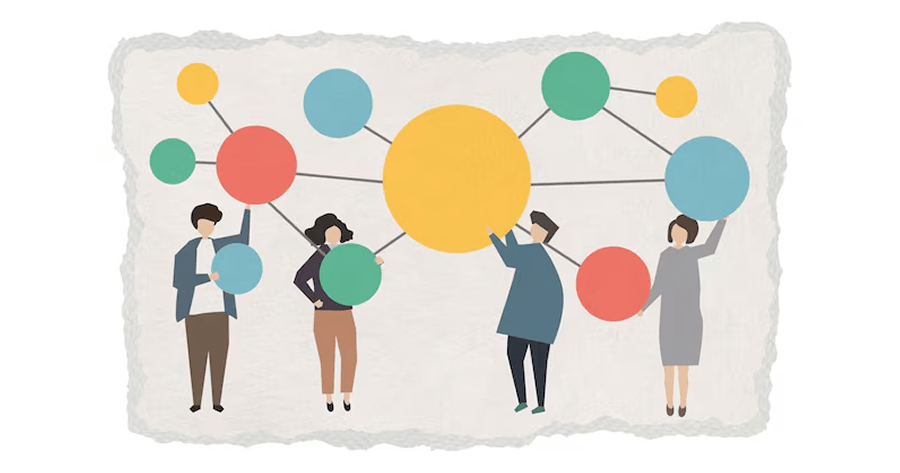
A context graph is a living, connected record of how decisions get made across an organization. It doesn’t just store what happened. It links the people, decisions, and data points involved in a decision, and the reasoning traces between them, so that pattern and precedent become visible over time.
Context graphs are built by observing decisions as they happen, across data points and domains that already exist inside HR workflows: approvals, ratings, promotions, comp changes, PIPs, manager notes, calibration outcomes. Individually, each of these is just a transaction. Observed together, over enough cycles, they start to form a pattern. That pattern is what a context graph captures, and what makes it possible to draw relationships and precedent from data that was never explicitly labelled as “reasoning” in the first place.
A good context graph has a few defining properties. It must be continuous, built from live decisions as they happen, not reconstructed later from logs. It must be connected, linking related decisions and entities to each other rather than storing them as isolated records. It must be governed, respecting the same access and confidentiality rules that already apply to the underlying data. And it must compound, meaning every new decision makes the graph a little more complete and a little more useful than it was before.
Why is capturing context so important?
Context is what allows both humans and AI agents to make better decisions, not just faster ones. An agent without context can execute a workflow. An agent with context can recognize when the workflow is wrong for the situation in front of it.
That distinction is exactly what’s holding agents back today. The value of an agent right now is limited by what it’s been preprogrammed to do. The standard processes in organizations are increasingly getting automated. However, most of the work is distributed, done by individuals and small teams, with the processes documented only as tribal knowledge.
Scenario: The company’s annual benefits re-enrolment reminder goes out on a fixed schedule to every employee’s work email. But for anyone on maternity leave, the reminder lands in an inbox nobody’s checking, and by the time she’s back and catching up on everything else, it’s easy to miss entirely. One HRBP learned this the hard way years ago, after an employee returned to find her coverage had defaulted to the base plan because the reminder went out while she was away and was never seen. Since then, she manually cross-checks maternity leave dates against the enrolment calendar every year, and flags anyone whose leave overlaps the reminder window. When this HRBP is out, or moves roles, people on leave during that window start slipping through again.
A context graph, reading leave dates and enrolment timing together over time, can surface this same pattern on its own, before coverage defaults incorrectly, no longer dependent on whether that one person is still doing the job
Since tribal knowledge lives only inside people’s heads, organizations need to combine human and machine intelligence and build organizational intelligence over time. That compounding intelligence, not any single tool or model, is what will let organizations take better people decisions and execute and adapt faster than their competitors.
This matters more than it might seem, because the model layer is no longer the differentiator. AI is generally available. When every company has access to the same underlying models, the thing that differentiates one organization from another is the organizational knowledge it can feed them. Context is that knowledge, made usable.
Why the HR context graph compounds
An HR context graph compounds because every cycle adds more decision traces. Past reasoning becomes searchable precedent, each new review makes the next one fairer and faster, and the record becomes a defensible answer to “why did we make that call?”, an asset competitors can’t copy.
None of this requires full autonomy on day one. It starts human-in-the-loop: the agent gathers context, proposes a draft, and records the reasoning while a manager makes the call. Every cycle, the graph grows, and the decisions get faster, fairer, and easier to defend. It behaves less like a static database and more like a living organism, built over time, on trust earned one decision at a time.
Why HR is the first system in your company that should have context digitally captured
HR data touches the entire workforce and every part of the organization. There is no better place for an AI system to learn how an organization makes decisions, because there is no function whose decisions run through more people, more often, with higher stakes attached.
People decisions are also uniquely nuanced. They aren’t governed purely by rules the way a finance approval or a procurement threshold might be. A rating, a promotion, a performance improvement plan, a stretch assignment: each of these touches someone’s livelihood and career trajectory. When the reasoning behind it isn’t captured, an organization can’t defend the decision later, can’t be consistent about it going forward, and can’t tell whether a pattern of similar calls adds up to something it should be worried about. The absence of context isn’t just an efficiency problem in HR. It’s a fairness and liability problem.
That combination, workforce-wide reach and high-stakes nuance, is exactly why HR is the function where a context graph earns its value first, and fastest.
Darwinbox Cortex: the first HCM built on a context graph
Most HR systems treat context as something to reconstruct after the fact, pulled together from outside by a separate tool layered on top. Darwinbox takes a different approach. The context layer isn’t a separate system bolted on afterward and synced back; it sits on the same underlying data foundation as the system of record itself. That matters because context stops being something reconstructed from outside and becomes something native to how the platform already stores and connects information.
As the system of record across the full employee lifecycle, Darwinbox already sees the decisions, approvals, and data points that most HR context lives in. Its context assembly layer is what turns that raw activity into a structured, connected record: capturing decision traces as they happen, linking them to the people and precedents they relate to, and governing access to that context under the same permission structure that already protects the underlying HR data.
Darwinbox the first HCM platform to build this layer natively rather than retrofit it. The context isn’t reconstructed from a separate tool watching the system from the outside. It’s assembled at the source, by the system that ran the decision in the first place, which is exactly what makes it usable, trustworthy, and safe to put in front of an agent.
Interested in learning more? Talk to us!
FAQs
What is a context graph in HR?
A context graph is a living, connected record that captures how workforce decisions get made — linking the people, data points, and reasoning traces involved so that pattern and precedent become visible and searchable over time. Unlike a traditional system of record, which stores outcomes, a context graph stores the how and why behind those outcomes.
How is a context graph different from a knowledge graph?
A knowledge graph captures relatively static domain knowledge — entities, relationships, and data lineage — and answers “what” and “who.” A context graph captures continuously evolving decision traces and answers “how” and “why.” Both are necessary. Context graphs build on top of knowledge graph infrastructure but serve categorically different purposes.
Why does HR need a context graph before other functions?
HR decisions run through more people, more often, and with higher personal stakes than most other business functions. When the reasoning behind a rating, promotion, or performance improvement plan is not captured, the organization loses the ability to defend those decisions, maintain consistency, and detect problematic patterns. Context in HR is not just an efficiency gain — it is a fairness and governance requirement.
What makes a context graph compound over time?
Every new decision cycle — performance reviews, calibrations, compensation changes — adds more decision traces to the graph. Past reasoning becomes searchable precedent, making each subsequent cycle fairer, faster, and easier to defend. The record grows more complete and more useful the longer it is maintained.
What is the difference between a system of record and a context graph?
A system of record stores outcomes: attendance records, performance ratings, engagement scores. A context graph stores the reasoning behind those outcomes: why a promotion was denied, what pattern led to a policy exception, how a manager justified a rating. Both use the same underlying data but serve fundamentally different purposes.