TL;DR
Automated employee onboarding transforms HR into a strategic and experience-based integration instead of paperwork.
AI onboarding assistants offer round-the-clock services, which means that managers do not have to be on call.
Automated systems with structures can enhance the retention of the majority of the new employees.
Onboarding is a lifecycle, and not a week-long orientation, which should be made future-ready.
Insight Global 2025 Employee Sentiment report says 4 in 5 employees would have stayed longer with a company had their onboarding experience been better. Gartner 2025 HR research says about 35% of candidates backed out after receiving their job offer. Candidates have options, and they leave a company fast with poor onboarding. This shows us that onboarding is more than a checklist of forms and paperwork in the contemporary business.
Enterprises now automate employee onboarding because they realize that it is now an all-inclusive intelligence layer enabling recruitment, IT provisioning, and cultural integration to become one cohesive and seamless process. Modern enterprises are moving away from these task-based approaches, which focus primarily on "filling out forms" toward experience-led onboarding.
This article discusses how businesses are using automation and AI to achieve day-one productivity and considers new hires' experience as a quantifiable business asset.
Why is Onboarding Automation Evolving?
The trend towards the automation of HR is due to the radicalization of the global labor force. The sheer volume and pace of business today make manual processes fail miserably. As the trend of distributed and global teams and always-on digital operation processes grows, the one-size-fits-all orientation day is in the past.
Conventional onboarding tended to be in-person and synchronous, and it could not easily fit across time zones or hybrid working arrangements.
Automated employee onboarding software establishes an instant emotional and cultural bond. This has evolved in response to an increasingly unstable talent market where the rate of integration dictates the rate of ROI. Companies are realizing that when a new employee wastes the first week of employment waiting for laptop authorizations or locating a training guide, the organizational brand perception takes a hit.
Why Do Enterprises Need Onboarding Automation?
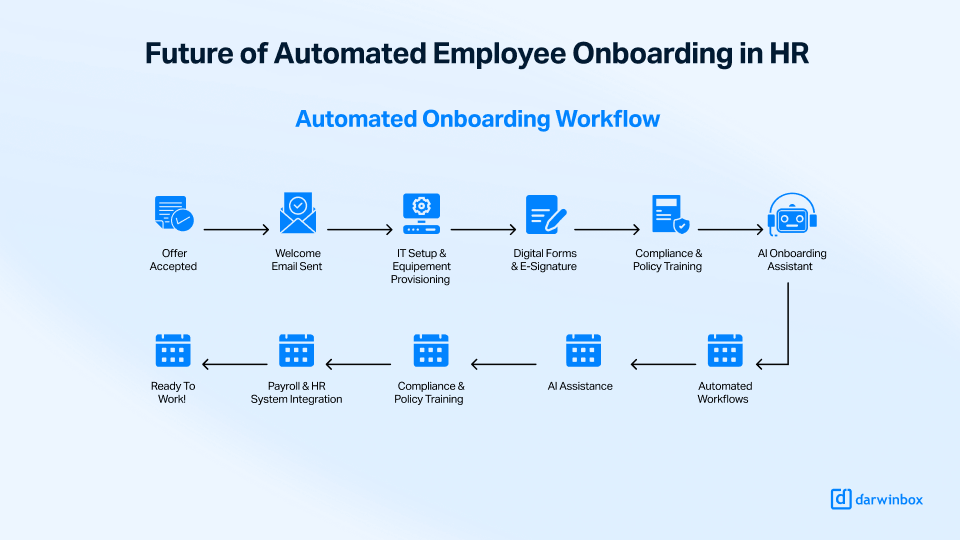
When dealing with large-scale organizations, onboarding is a logistical issue that involves thousands of moving parts. The volume hiring and international expansion demand consistency that cannot be upheld using spreadsheets. Without an automated onboarding system, HR teams face significant operational strain, often spending more on soft costs like manual data entry and follow-up emails as opposed to engaging in strategic activities.
Businesses have challenges like compliance across countries and cultures in a fragmented territory. Automation ensures that a hire in either London or Singapore has the same experience in terms of compliance and experience. It eliminates the human error aspect in critical activities such as background checks and payroll enrollment, and enables HR to concentrate on the human aspect of integration.
Manual Onboarding vs. Automated Onboarding
The process of manual onboarding is dependent on the recollection of the busy managers and the presence of HR personnel, making it a disjointed experience, with new hires trying to make sense of too much information that is scattered and not valuable. In contrast, an automated onboarding system is proactive, triggering workflows the moment a contract is signed.
| Dimension | Manual Onboarding | Automated Onboarding |
|---|---|---|
| Speed to Productivity | High lag; often takes weeks for full tool access | High lag; often takes weeks for full tool access Near-instant; IT and access are ready on Day 1 |
| Consistency | Highly variable; depends on the individual manager | Uniform; every hire receives the same quality experience |
| Compliance Risk | High manual filing leads to missing documents | Low; automated tracking and digital signatures |
| New Hire Experience | Transactional and paperwork-heavy | Immersive, personalized, and engaging |
| Scalability | Linear; the larger the number of hires, the greater the staffing of HR. | Exponential; handles thousands of hires seamlessly |
Effective platforms to automate employee onboarding can reduce the total time-to-productivity, making employees contribute to high-value projects in a much shorter period than in a traditional setting.
Role of AI in the Future of Onboarding
Traditional automation is based on a strict or fixed kind of logic that is based on if-this-then-that reasoning, whereas AI provides a decision intelligence layer. The smart nudges can be done by an AI onboarding assistant instead of merely sending a generic welcome email, depending on the real-time progress of both the manager and the new hire. For example, if a new employee does not finish their compliance training by Day 3, the AI can provide a contextual reminder, with a link to the particular module, instead of a generic reminder.
These assistants are 24/7 companions who can address a question about company policy, office addresses, or benefit packages within seconds. This will decrease the cases of digital fatigue as only relevant information is surfaced.
Gartner 2025 HR survey finds that 65% of workers are excited about using AI at work and that this trust is established on the very first day when an AI assistant guides them in their new workplace without the fear of posing excessive questions to a human manager.
Business Impact of Automating Employee Onboarding
Enterprises want to automate employee onboarding to improve long-term workforce resiliency. It is not merely just an operating solution; it is a risk avoidance and capital optimization plan. According to a Brandon Hall Group HCM Outlook 2024 report, 61% of employers are investing heavily in onboarding improvement. With automated onboarding, leaders can see how ready their teams are and know how long it will be before they can reach full capacity.
The strategic effects can be quantified at the following pillars:
Reduced attrition risk: Automated onboarding answers a new hire's early questions through structure rather than reassurance, building confidence that inconsistent manual processes cannot produce at scale.
Financial performance: Every day between offer acceptance and full productivity carries a cost. Automation compresses that ramp by ensuring systems, training, and introductions are ready before day one, and that compression compounds across a growing workforce.
Compliance confidence: Manual compliance fails because someone always assumes someone else handled it. Automation makes the required steps, gating conditions, so nothing gets skipped, and every hire leaves a documented audit trail.
Early engagement: A new employee who spends their first week waiting for access and chasing clarity does not arrive at the end of it feeling neutral. Automation ensures the organization visibly prepares for a hire's arrival, which is where genuine early loyalty begins.
What HR Teams Should Look for in Automated Onboarding Software?
When evaluating automated employee onboarding software, enterprise buyers must look beyond basic feature lists. This is aimed at identifying a platform that can expand with the complexity of a global organization. The choice should be made considering the following criteria:
Enterprise scalability: Think about whether the system handles thousands of concurrent onboardings across different legal entities and languages.
Configurability vs. customization: Find a low-code platform that lets HR teams create unique workflows for each department (e.g., Sales vs. Engineering) without always having to involve IT.
Deep integration: The employee onboarding software should work well within the existing ecosystem, and it must be able to integrate with ITSM and ESM systems.
AI-First capabilities: Ensure that there is an AI onboarding assistant on the platform that can process natural language queries and give predictive information on hire engagement.
Analytics and governance: The system must give a control tower view of all underway onboardings and see bottlenecks on their way to create a hire drop-off.
Automated Onboarding as a Continuous Experience
Onboarding no longer ends at the 30-day mark. The future of the employee journey is a continuous, lifecycle-based approach. Modern enterprises use their HR software platform to extend the onboarding mindset through internal mobility, promotions, and even re-boarding after a long leave of absence.
By treating onboarding as an ongoing engagement strategy rather than a one-time event, organizations build a workforce that is structurally harder to disrupt. The enterprises that are leading their industries in 2026 will be those that have substituted administrative friction with an automated, intelligence-driven coordination of the employee experience. Explore how Darwinbox can enable HR leaders to automate employee onboarding to improve talent retention, engagement, productivity, and experience.
References
FAQs
How does automated employee onboarding improve productivity?
Automation helps to remove the Day 1 Gap as IT assets, credentials, and training paths are prearranged before the new hire arrives. This helps eliminate administrative drag, which means that the employees can concentrate on their main tasks as quickly as possible, cutting down the time-to-productivity by half based on recent industry standards.
Is automated onboarding suitable for global enterprises?
Yes, automated systems allow HR to standardize the experience across different countries while automatically adjusting for local labor laws, languages, and compliance requirements, ensuring a "One Company" feel regardless of geography.
How is automated onboarding different from basic HR workflows?
Automated onboarding integrates IT, finance, and HR data dynamically based on new hire progress and role, unlike basic HR workflows, which handle isolated tasks without cross-system orchestration.
Can automated onboarding integrate with HR, payroll, and IT systems?
Enterprise-level automated onboarding systems are designed to be compatible with other stacks. This approach of having a single source of truth ensures that the data, which has been typed only once during pre-boarding, is properly transmitted to payroll and IT setup to avoid errors that might occur due to manual data entry.