Talent management software is no longer a “good to have.” For HR teams across industries, it has become a must-have for hiring, developing, and retaining the best people. As remote work, skill gaps, and shifting employee expectations reshape the workplace, organizations need systems that go beyond core HR.
It helps to separate two ideas up front: talent management is the practice of developing and retaining people, while a talent management system (TMS) is the software that runs it. The global talent management software market was valued at close to USD 10 billion and is projected to grow at a double-digit CAGR of about 12.5%, according to Grand View Research. This guide covers what talent management software is, how it supports the employee lifecycle, and how to implement it in your organization.
What Is Talent Management?
Talent management is much more than onboarding, recruiting, or payroll. It is a human capital strategy: putting the right people in the right place, at the right time, and for the right reasons, so they can grow. It spans recruitment, development, retention, engagement, and succession. Around 64% of organizations worldwide are investing in human capital management (HCM) platforms as they recognize the value of their people. That is the practice. The next section covers the software that runs it.
What Is a Talent Management System (TMS)?
A talent management system (TMS) is a specialized software solution built to manage and optimize each phase of the employee lifecycle, including recruitment, interview scheduling, performance measurement, talent development, and succession planning, all under one digital roof.
A TMS integrates multiple talent functions into a single platform that automates HR tasks, generates insights, and strengthens decision-making. It lets HR move away from heavy administration toward strategic workforce management.
Who Uses a TMS?
A talent management system can be a game-changer for several groups:
| User | Purpose |
|---|---|
| HR managers | Automate hiring, appraisals, and training. |
| Line managers | Track team performance, set goals, and approve development plans. |
| Executives | Access workforce analytics and succession planning. |
| Employees | View learning materials, share feedback, and track goals. |
Key Benefits of Talent Management Software
A well-implemented TMS pays off across the talent lifecycle. The core benefits:
Smarter hiring and onboarding. Structured, automated workflows cut time to hire and get new joiners productive faster.
Stronger performance. Continuous goals and feedback keep teams aligned to business priorities, not just annual reviews.
Skills-aligned learning. Development maps to real skill gaps, so learning spend turns into capability.
Fair, transparent compensation. Linking pay to performance and market data builds trust and reduces pay disputes.
Planned succession. Identifying high-potential employees early protects the business from key-role gaps.
Data-driven decisions. People analytics turn HR data into decisions leaders can act on.
Higher retention. Internal mobility and career visibility keep people engaged and reduce costly turnover.
Better employee experience. Self-service, recognition, and clear career paths lift day-to-day employee experience.
Key Features & Core Modules of Talent Management Software
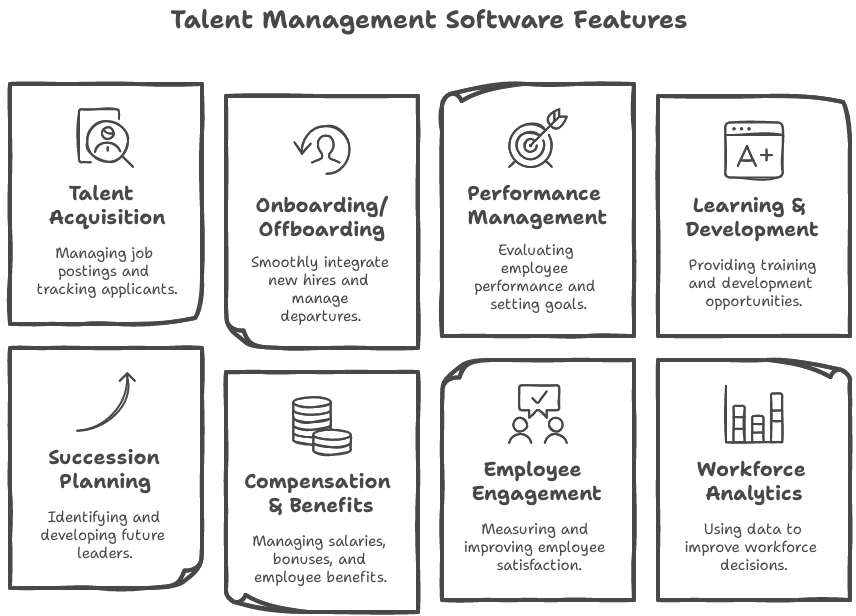
A TMS brings HR functions together on one platform. The core modules automate and connect information across the employee lifecycle, supporting ongoing feedback and faster, better-informed decisions.
Talent Acquisition & Applicant Tracking
What it saves you: less manual screening and faster shortlists. The software simplifies hiring through centralized resume tracking, algorithmic candidate ranking, and integrated scheduling, so recruiters focus on fit and closing rather than admin. Predictive analytics can identify the best sourcing channels and reduce screening time.
Onboarding & Offboarding
What it saves you: a clean first day and a compliant exit. Onboarding workflows make sure new employees have the documents, tools, and welcome steps they need before day one, with completion tracked on dashboards so nothing slips. Offboarding is equally smooth, with exit interview, handover, and compliance checklists.
Performance Management
What it saves you: less review-cycle overhead and clearer alignment. Employees set goals, track progress, and receive real-time feedback in one place, while managers see trends and align teams to business OKRs. Continuous review cycles keep engagement levels high and reduce the burden on HR.
Learning & Development
What it saves you: development that targets real gaps. Integrated or embedded LMS modules deliver personalized learning based on role and performance. Employees work through curated content, certifications, and micro-learning that support career growth, while managers track progress and spot skill gaps early.
Succession Planning & Career Pathing
What it saves you: fewer surprises when a key role opens. Talent management software surfaces high-potential employees and internal candidates for mobility. Dashboards help employees plan careers and give managers a view of bench strength, with skill gaps and readiness tracked in real time.
Compensation & Benefits Management
What it saves you: fairer, faster comp decisions. Compensation tools connect salary, performance, and market data in one transparent system, so managers budget with discipline and employees see how rewards are set. Benefits enrollment and changes are automated to reduce paperwork.
Employee Engagement & Experience
What it saves you: early warning before disengagement spreads. According to Gallup, global employee engagement fell to 21%, equal to about US$438 billion in lost productivity. Pulse surveys, real-time feedback, and peer recognition support morale and employee engagement, while wellness and DEI tools help leaders track inclusion and well-being.
Workforce Analytics & Predictive Insights
What it saves you: decisions backed by data, not hunches. Advanced analytics turn HR data into insight, with dashboards tracking leading indicators such as turnover, DEI, and training ROI. Models can identify flight risks, talent gaps, and hiring needs before they become urgent.
The Employee Lifecycle: How Talent Management Software Powers Every Stage
Talent management software does more than assist HR. It brings consistency, clarity, and control to every stage of the employee lifecycle, from hiring to retirement.
Strategic Talent Acquisition & Workforce Planning
Recruitment is not only about speed. It is about finding the right fit for the role and the company. Talent management software brings order, automation, and transparency to hiring. With AI-based talent acquisition as part of their strategy, businesses can reduce time to hire by up to 50%.
Candidate information, requisitions, interview ratings, and assessments are centralized, giving recruiters and hiring managers a single view of progress. Predictive workforce planning helps model future needs, forecast attrition, and avoid last-minute, expensive hiring. By linking scenario planning to skills inventories, HR teams can test “what if” situations, such as retirements or growth, and act ahead of talent gaps.
Empowering Employees Through Self-Directed Development
Employees no longer settle for annual training. They want ownership of their development. A TMS lets them find personalized learning paths based on their role, skill gaps, and goals.
Learning platforms recommend courses based on development level, performance, and business goals. Internal mentorship pairs learners with coaches, and mobile-first, bite-sized learning builds continuous-learning habits. Interactive dashboards visualize career paths within the organization, clearing up confusion about growth. Self-directed learning increases adoption, improves internal mobility, and builds a more agile, future-ready workforce.
Compensation, Benefits & Rewards: A Strategic View
Compensation is not only about figures. It signals fairness, trust, and long-term value. Talent management software brings discipline and transparency to rewards, letting managers link pay to performance, skills, and market data. Around 65% of employees are more likely to leave if they feel they are not paid fairly.
Dashboards help managers allocate budgets while showing employees how bonuses or raises are determined. Self-service simplifies benefits enrollment, reducing HR dependence and improving accuracy. From medical coverage to long-term rewards such as equity, employees gain a clearer view of total rewards. Automating this brings consistency, compliance, and fairness across the organization, all core retention drivers.
Boosting Engagement, Recognition & Experience
TMS platforms help build trust, motivation, and connection. Real-time feedback, recognition, and sentiment tools are now essential rather than optional.
Pulse surveys capture sentiment regularly, so leaders can act before discontent grows. Recognition tools let peers celebrate contributions publicly, adding energy to everyday wins. Personalized dashboards put goals, learning, and feedback front and center, encouraging ownership. Inclusion and well-being modules track burnout indicators, DEI progress, and psychological safety, giving leaders an integrated, fact-based view of engagement.
Retention Plans & Internal Mobility
Replacing an employee can cost 50% to 200% of their annual salary, and the bigger effect is on morale, productivity, and knowledge continuity. Talent management software helps by keeping people engaged, informed, and developing.
Internal mobility tools surface open roles and project opportunities employees might otherwise miss. Aligning internal talent with business needs lowers time to fill and lifts engagement. Career pathing shows employees vertical and lateral moves, while analytics identify flight risks from sentiment, engagement, or performance patterns, so managers can step in with recognition, development conversations, or new responsibilities before people leave.
Data-Driven Decision Making with Workforce Analytics
Most HR teams want to be strategic, but only 22% say their processes use people analytics effectively. A TMS with embedded analytics closes that gap.
Real-time dashboards show key metrics such as attrition, engagement, comp ratios, and learning progress, and leaders can slice by team, region, or tenure to make faster, better resource decisions. Predictive analytics flag who is likely to leave, which roles lack successors, and which skills will be needed. McKinsey found that organizations that manage performance well are 4.2 times more likely to outperform peers. Data should not just generate reports; it should inform decisions and drive results.
Step-by-Step Implementation, Integration & User Adoption Process
Talent management software will not deliver results if it is poorly deployed. A solid plan, system compatibility, and user readiness set up long-term success.
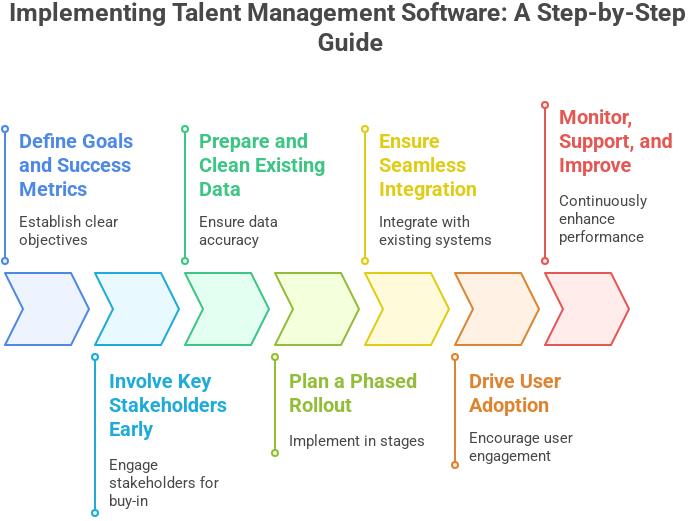
Step 1: Define goals and success metrics
Start with clarity. Set clear outcomes before the project begins, and tie success indicators such as reduced time to hire, improved engagement, or faster learning completion to broader business goals to secure leadership buy-in.
Step 2: Involve key stakeholders early
Bring in HR, IT, operations, and finance from day one. Establish a project committee for decisions, communication, and accountability, so everyone stays aligned.
Step 3: Gather and clean existing data
Clean data is essential. Audit employee records, remove duplicates, and standardize job titles, departments, and performance history. Test for accuracy before migrating to prevent downstream issues.
Step 4: Plan a phased rollout
Do not go live all at once. Launch first with small groups or departments so you can tune the implementation, use feedback loops to fix issues, and scale once the initial rollout goes smoothly.
Step 5: Ensure smooth integration
Make sure systems talk to each other. Integrate the TMS with your HRIS, payroll, CRM, LMS, and analytics tools using secure APIs or integration middleware to prevent data silos, so everything runs on a single source of truth.
Step 6: Drive user adoption
The software only works if people use it. Run role-based onboarding sessions, provide hands-on training, quick-reference guides, and support, and show early wins to build trust and habitual use.
Step 7: Monitor, support, and improve
Track adoption and improve continuously. Monitor login rates, feature adoption, and feedback, refresh training, keep the system compliant, and resolve pain points before they become roadblocks.
How to Choose the Right Talent Management System
The best talent management system is not the most feature-rich one. It is the one that fits your business objectives, integrates cleanly, and delivers real results. Here is how to choose without being overwhelmed by the hype.
1. Define clear objectives first
Start with the “why.” Are you addressing high attrition, leadership gaps, or broken hiring workflows? Every feature you consider should map back to a measurable business need, whether that is time to hire, engagement, or learning completion.
2. Prioritize integration over complexity
A TMS that does not integrate with your HRIS, payroll, or CRM creates data silos. Look for open APIs, native integrations, or middleware support. Real-time sync across systems cuts manual work and improves visibility.
3. Check for usability, not just features
Even the strongest platform fails if managers will not use it. Ask for a live demo, not a recorded one, and involve end users early. A clean, intuitive interface and mobile access are non-negotiable for adoption.
4. Test scalability and localization
Plan for the long term. Will the TMS still fit when your team triples or moves into new geographies? Look for multi-country capabilities, compliance support, and modularity, and avoid paying for things you do not need today.
5. Assess reporting and analytics depth
Metrics without analysis are static. The right system offers real-time dashboards, drill-downs, and predictive recommendations. Leaders expect HR to deliver strategic insight, not just reports, so make sure the TMS can communicate insight in plain language.
6. Verify vendor support and customer success
Consider what you get after the contract is signed: onboarding, training, SLAs, and access to user communities. Strong software needs strong support. Look at customer feedback, renewal rates, and response times, not just marketing claims.
7. Ask for real-world case studies
Request examples from companies of similar size, industry, or challenge, and check before-and-after metrics. Success stories show how the system holds up under pressure and whether the vendor delivers more than technology.
How Darwinbox TMS Makes Organizations Successful?
Darwinbox Talent Management System is built to deliver measurable results, combining intuitive functionality, robust automation, and useful analytics to improve HR efficiency and employee experience.
Streamlined recruitment and hiring
Darwinbox helped Bharti AXA cut time to hire by 25% and double requisition processing speed through workflow automation and algorithmic shortlisting. Centralizing candidate information and interview workflows improved hiring accuracy and lifted offer-to-joining rates by 20%.
Digital HR transformation and performance excellence
At professional services firm Nexdigm, Darwinbox automated 99% of key HR processes across recruitment, performance appraisal, and engagement. The performance module cut appraisal cycle time by 40% while supporting goal clarity and 360-degree feedback.
Better engagement and HR efficiency at scale
Physics Wallah, a 13,000-strong EdTech company, saw attendance requests rise 300% after deploying Darwinbox reminders and nudges. HR ticket resolution improved fourfold, and recognition nominations doubled through more interactive workflows and a mobile-first experience.
Challenges of a TMS
A TMS delivers value only when it is adopted and maintained well. The common challenges, and how to address them:
Low adoption. If managers and employees do not use the system, the investment stalls. Role-based training and early wins drive uptake.
Data silos. A TMS that does not connect to your HRIS, payroll, and LMS fragments data. Prioritize open APIs and native integrations.
Dirty data. Migrating duplicate or inconsistent records leads to poor decisions. Clean and standardize data before rollout.
Over-buying. Paying for features you will not use adds cost and complexity. Choose a modular platform and scale as needs grow.
Change fatigue. A big-bang rollout overwhelms teams. A phased rollout with feedback loops keeps change manageable.
Conclusion
Talent management software is no longer optional; it is foundational. It brings structure to chaos, clarity to decisions, and alignment across the employee lifecycle. Whether you are hiring at scale, reskilling teams, or building a diverse leadership pipeline, the right TMS keeps your people strategy in step with business growth.
The best talent management solutions do more than automate; they empower HR and employees, matching data with action, talent with opportunity, and people with purpose. Technology alone is not enough. Success also takes strategic deployment, ongoing optimization, and a human-first mindset. See how a unified talent management suite supports the full employee journey.
FAQs
How much does talent management software cost?
Cost varies by vendor, number of modules, employee count, and deployment model. Most enterprise TMS platforms are priced per employee per month, so the right way to compare is total cost against the outcomes you expect.
Is talent management software the same as an ATS or LMS?
No. An ATS handles recruiting and an LMS handles learning. A talent management system spans the wider lifecycle, including performance, succession, and analytics, and often integrates or includes ATS and LMS capabilities.
Is talent management software cloud-based, and how is it deployed?
Most modern talent management software is cloud-based (SaaS), which speeds up deployment and updates. Rollout usually runs in phases: data migration, integrations, configuration, and user onboarding, before scaling across the organization.
What should businesses look for when choosing talent management software?
Look for fit with your objectives, strong integrations, usability, scalability and localization, analytics depth, and reliable vendor support. Prioritize adoption and measurable outcomes over long feature lists.
How long does it take to implement a talent management system?
Timelines depend on scope, data quality, and integrations. A focused, phased rollout can go live in a few months, while a full enterprise deployment across modules and geographies takes longer.
To see how one platform can manage the full employee journey, explore the Darwinbox talent management suite.