TL;DR
HR software is a centralized platform that manages employee data, workflows, and workforce insights.
It automates onboarding, payroll, performance, time tracking, and compliance processes.
Cloud-based HR systems provide real-time visibility and enterprise scalability.
AI-driven analytics turn HR data into strategic decision support.
The right platform enables long-term workforce transformation, not just operational efficiency.
Introduction
HR software, also known as a Human Resource Management System (HRMS), is a digital solution that centralizes data, automates repetitive tasks, and provides real-time workforce insights.
In modern enterprises, it acts as the central hub for everything related to the HR department. They can manage hiring, onboarding, payroll, engagement, and exit. Put simply, it covers the entire employee lifecycle.
This centralization enables you to get a comprehensive view of the workforce and their data. Since the data no longer resides in silos, you can leverage HR software to generate insights that support decision-making.
That’s the reason why the global HR software market is expected to grow at a CAGR of 12.2% from 2024 to 2030. According to a Grand View Research market study, it could reach $36.62 billion by 2030.
Understanding what is HR software is important, but it is even more important to learn what it can do for your enterprise. In this HR software guide, we detail the use of SaaS HR software, processes it can automate, key capabilities to look for, its role in supporting enterprise transformation, and how to choose the right software.
How SaaS HR Software Solutions Work
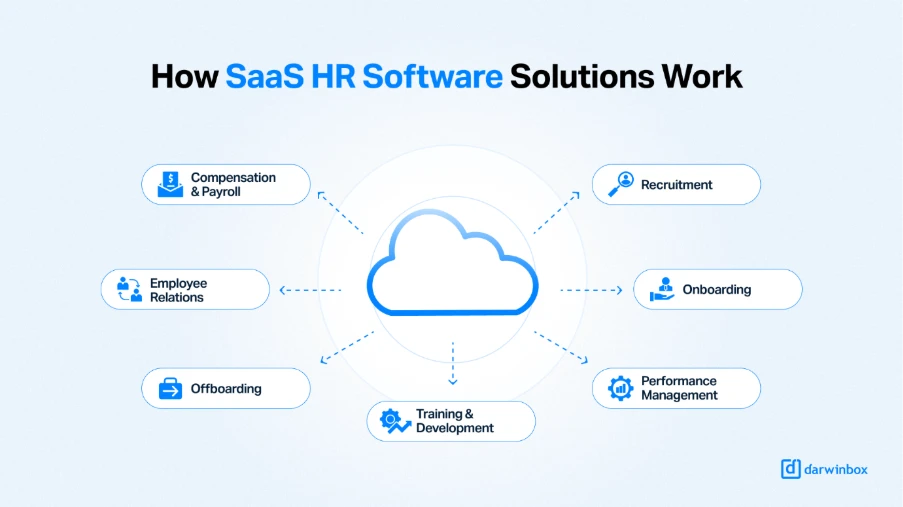
Unlike on-premises solutions, Software-as-a-Service (SaaS) HR software runs in the cloud. These solutions allow quick and secure access to employee data from anywhere and at any time.
Here’s how these solutions work:
Cloud hosting & access: One of the biggest benefits of SaaS HR software solutions is their deployment model. Since they are cloud-based, you don’t have to spend on IT infrastructure. Every user, including the HR team and employees, can access it remotely.
Subscription model: While some SaaS solutions offer a one-time pay model, most operate on a subscription model. This is another great advantage for scaling enterprises, as they only pay for the resources they use.
Automated maintenance & security: You won’t have to worry about updating the solution, as the provider handles it from their end. The same goes for implementing security practices.
Centralized data management: Unlike on-premise systems, all data in SaaS HR solutions is uploaded to the cloud. This offers a centralized view, regardless of whether your workforce is small or large, or how many different locations you operate from.
Integration & workflow automation: As most enterprise solutions now operate in the cloud, integrating HR software with other tools becomes easy. You can integrate them with accounting software, communication software, email, etc., for better interoperability.
Modern SaaS-based platforms like Darwinbox bring these capabilities together in one unified environment. Using artificial intelligence (AI), it aligns core HR, talent, and workforce operations.
What Are Common Workflows That HR Software Can Automate?
Data from SHRM shows that HR automation has increased by 599% over the past two years. HR bots are now included in 39% of employee automations, such as sourcing, recruitment, and more.
The numbers show that automation is a core driver of HR software. You can automate many repetitive tasks across all HR processes, including hiring, payroll management, compliance, documentation, performance management, and more. All these are highly time-consuming administrative tasks.
HR software automates them to mitigate human errors, delays, and limited visibility. Listed below are some common HR workflows you can automate using a rule-based approach in HR software.
Employee onboarding and lifecycle changes: You can automate preboarding and documentation to offer consistent employee onboarding experiences. Besides that, you can also automate basic training assignments that HR software can assign and grade.
Leave, attendance, and time tracking: HR software can be integrated with enterprise access systems to automate time and attendance management. To add to that, you can also leave the approval process, so employees don’t have to wait for hours to hear back from the HR team on their leave requests.
Payroll processing and compliance workflows: With global payroll functions within HR software, you can automate salary calculations, tax reductions, statutory compliance checks, and multi-country payouts automatically.
Performance reviews and goal management: HR software can be used by HR leaders to clearly convey employee expectations and monitor their performance to support organizational goal management.
Learning, skills, and development tracking: Continuous training and development are key factors in engaging today’s employees, especially millennials. With AI-enabled software solutions, you can create personalized skills and learning paths and automate their implementation.
Employee self-service and query management: Employees can update personal information, download payslips, raise HR tickets, and track requests without HR intervention.
Reporting and HR analytics: Centralized data can automate standard report generation, while enabling you to create custom reports, too. Use the insights generated by analyzing this data to make strategic decisions.
Key Capabilities to Look for in Modern HR Software
Now you know what is HR software, but do you know there are different types available? From on-premise and SaaS HR software to information management and capital management, there are various solutions available.
However, the best of these solutions share key capabilities that make them worth investing in.
One of them is core HR and workforce data management. It's all about gathering and using the right employee data to make the most of HR software. Centralizing data from appropriate sources across teams and regions enables core HR operations, such as onboarding, engagement, offboarding, and more.
Talent and performance management is another key capability, as the HR team needs to ensure employees are on track with their performance requirements. They need to make salary increments, retention decisions, and other decisions based on their performance.
How productive employees are at work depends on their engagement with their peers and the work. To ensure they have positive experiences with HR, the software needs to enable transparent communication through self-service. When the staff doesn’t have to wait hours for a response from human resources professionals to a simple request, their experience improves.
Advanced analytics and predictive insights are also essential to becoming proactive in managing resources. Consider a simple example of a widening skills gap. As enterprises scale, they need new employees with new skill sets. With people analytics, you can ensure employees have the right skills for optimal productivity and alerts when a gap arises.
You must also consider automation and integration capabilities. They will help simply scale your enterprise without putting a lot of strain on the HR department. Look for ways to automate the processes listed in the previous section.
How HR Software Supports Enterprise Transformation
Enterprise transformation depends on visibility, speed, and informed decision-making. Without a clear view of all available data in one place, meeting any of these key requirements for transformation is impossible.
HR software plays a central role in this shift by bringing fragmented, siloed data from different teams and locations into a single dashboard for AI to analyze. This brings intelligence into HR processes, helping the department move from being just a back-office system to a strategic layer.
This data-led approach positions HR as a strategic partner to the business. The table below reflects the business impact of the HR system in enterprises:
| Transformation area | HR software enabler | Business impact |
|---|---|---|
| Strategic decision-making | HR software offers real-time dashboards and predictive analytics | HR leaders can make data-backed hiring, budgeting, and expansion decisions |
| Workforce agility | It is done through skills mapping, internal mobility tracking, and automated role transitions | You can perform faster redeployment of talent during growth or change |
| Manager effectiveness | You can communicate and assign goals to employees and then keep track of them through AI-enabled performance insights and automated feedback cycles | This will add accountability on both the employee's and management’s ends to increase productivity |
| Employee experience | HR software can enable personalized employee experience based on data, such as how much time they have spent working in the field, their knowledge, and skills. It can also offer self-service and quick responses to enhance the experience throughout the employee lifecycle | It brings higher engagement, transparency, and retention |
Choosing the Right HR Software for Your Organization
There are hundreds of HR software solutions worldwide, but not all deliver the same results. Therefore, it is important that you choose the right tool for your enterprise, and this largely depends on accurately assessing your requirements.
The right platform will always align with your business goals today. But on top of that, it will also support growth, geographic expansion, and any added operational complexities.
Here are some evaluation factors you should consider and determine if they meet your business needs:
Organization size and complexity: Enterprises can have hundreds or even thousands of employees, all working across industries and locations. You would not want to have separate HR software for every other need, as it would only add to the complexity. Thus, look for a solution that aligns with your current organization's size and complexity, but also addresses your future needs.
Global and compliance requirements: Since enterprises work across different states or even countries, HR software should manage different compliance requirements. From local employment laws to payroll regulations, everything should be handled by a single HR system.
AI depth and analytics maturity: Evaluate whether you have advanced analytics, predictive insights, and automation features. While most solutions offer basic automation and reporting, the right HR software for enterprises should include AI capabilities for generating nuanced insights.
Ability to scale with business growth: When you plan to scale, HR software should support it without requiring additional HR professionals.
Now that you know the evaluation criteria, the next step is to start leveraging HR software to get a unified, analytical view of your workforce. AI-driven platforms like Darwinbox can bring all these capabilities together in a single system. You get global compliance, enterprise configurability, and advanced analytics within a single architecture.
References
FAQs
How Much Does HR Management Software Cost?
Pricing for HR management software varies by solution. SaaS HR software typically offers packages with varying features and capabilities. So, the pricing can also depend on what functions you require in the HR software you select.
How Is AI Used in HR Software?
AI can support HR processes across the entire employee lifecycle. For instance, you can get assistance with resume screening, attrition prediction, skills mapping, workforce planning, automated query resolution, performance insights, and much more. It helps the HR team move from a reactive to a predictive role in the business.
How Does HR Software Improve Employee Engagement?
HR software enables centralized communication, transparent goal setting, self-service, continuous learning, and ongoing feedback to improve employee engagement.
What Are the Main Types of HR Software?
Enterprises can choose from a range of HR software types, including standalone, unified, standard, AI-enabled, on-premises, cloud-based, and more. All these types offer varying benefits, and it's up to you to choose the best fit for your company.