A robust talent management approach is a crucial enabler of business growth, resilience, and sustained success. Firms that acquire, develop, and keep the best people routinely outperform others. However, many organizations find it challenging to link their talent planning to real business results.
While 86% of the talent leaders are aware of what critical roles are in their firm, only 50% of them accept that high performers occupy those roles. Additionally, only 25% of them had talent plans for those roles.
A talent management plan determines how an organization hires, develops, engages, and retains employees. It's not merely filling positions. It's about creating a team of people who are aligned with the organization's values, culture, and long-term strategy. From succession planning to employee development, every decision must have a clear business purpose.
In this guide, let's explore how to create a talent management strategy that really works.
What is a Talent Management Strategy?
Talent management strategy is a long-term framework to attract, develop, retain, and engage the workforce. Aligned to the broader objective of the business, it synergizes all talent decisions with that objective. It defines a coordinated effort from hiring through onboarding, leadership development, and succession planning.
A clear vision for organisations is implicit in any well-formulated talent management plan. Executed well, it reduces turnover and boosts engagement. More importantly, it addresses skill gaps before they affect performance.
How to Align Talent Strategy with Business Strategy?
A talent management strategy has to support the overall business goals that are in place. Otherwise, even the best efforts in hiring or development will be futile. Linking the workforce plans to company goals makes it easier to prioritize the right skills, roles, or capabilities.
Start by knowing a company's short-term goals and long-term objectives. Are you planning to enter new geographies? Launch new products? Moving to online operations? Each goal requires distinct skills, from digital readiness to leadership capacity. Aligning your talent strategy helps leaders understand what jobs are mission-critical, what skills are missing, and where needs will most likely be in the future.
Once clear goals have been set, HR leaders can develop talent pipelines, training programs, and leadership development initiatives tied directly to business growth. This means that every talent decision, from hiring to succession, points toward creating a workforce ready to deliver results.
What Are The Core Components of Talent Management
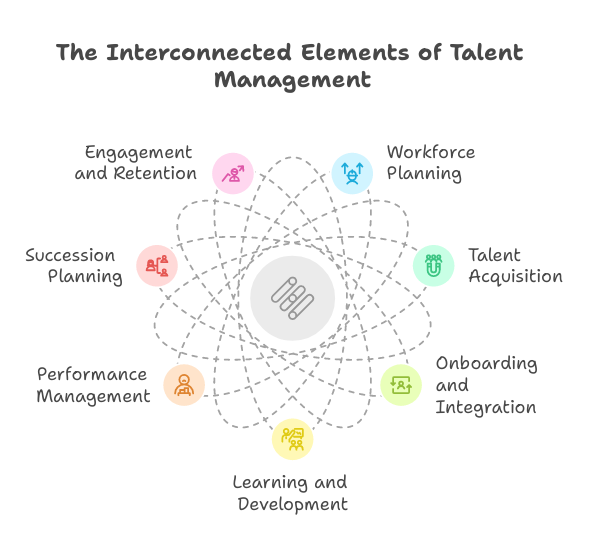
A strong talent management strategy includes several interconnected elements. Together, they create a continuous system that not only attracts top talent but also ensures long-term engagement, performance, and retention.
Workforce planning
Workforce planning guarantees your organisation has the right people, with the much-needed skills, at the appropriate time. It begins with an in-depth examination of business objectives and aligns talent requirements accordingly. This involves assessing existing staff capabilities, forecasting future role requirements, and filling skill gaps. It also takes into account attrition risks, retirements, and internal mobility potential.
Tips:
Move beyond headcount.
Create a dynamic skills inventory by department. Overlay this with workforce analytics to project seasonal surge periods, growth initiatives, or transformation projects.
Add scenario planning to account for market fluctuations or regulatory actions.
Talent acquisition
Successful talent acquisition aligns hiring with overall business objectives. This involves employer branding, pipeline creation, and assessment practices. Top companies also pay attention to diversity hiring, bias reduction, and inclusive job postings that appeal to a broader pool of talent.
Tips:
Employ structured interviews and AI-powered sourcing technology to eliminate bias.
Engage passive candidates through long-term connections via talent communities or alumni associations.
Monitor recruitment funnel metrics (sourcing success, drop-off rates) to optimize hiring strategies.
Onboarding and integration
Onboarding determines the employee's initial impressions and sustained performance. It must go beyond orientation to a formal 90-day+ integration process. Integrate team meet-and-greets, culture sessions, and live role shadowing.
Tips:
Enlist onboarding buddies, initiate cross-functional welcome sessions, and add a feedback loop for week 2, week 4, and month 3.
Monitor ramp-up times and early turnover to find and resolve integration bottlenecks.
Learning and Development (L&D)
Learning needs to be aligned with both employee aspirations and organizational objectives. High-impact L&D practices leverage modular learning paths, adaptive content, and real-time feedback. Programmes should respond to reskilling, upskilling, leadership development, and compliance.
Tips:
Align all training to measurable business outcomes.
Measure participation, completion, and transfer on the job.
Implement talent marketplaces that match employees to learning initiatives based on their skills and interests.
Performance management
New-generation performance management shifts away from the annual review. It incorporates continuous goal alignment, feedback cycles, and real-time mentoring. This helps keep employees on track with strategic goals and in their development.
Tips:
Establish OKRs (Objectives and Key Results) cascading from company-level to individual goals.
Roll out digital platforms that facilitate constant feedback, peer-to-peer recognition, and 360-degree reviews.
Offer skip-level meetings to bring up problems early.
Succession planning
Succession planning guards business continuity and fuels internal mobility. It consists of determining critical roles, screening internal candidates, and developing talent pools that can fill in the gaps when the time arises.
Tips:
Use data-driven evaluations such as psychometrics, performance records, and behavioural interviews.
Construct growth plans aligned to business-critical positions and reassess them annually to incorporate organisational changes.
Engagement and retention
Offering benefits is not enough to retain talent anymore. Employees today seek purposeful work, psychological safety, and recognition. Ongoing listening mechanisms ensure the employee's voice is heard and responded to.
Tips:
Create an engagement dashboard that combines pulse survey responses, manager effectiveness ratings, and turnover trends.
Break down data by team, function, and tenure to troubleshoot particular issues.
Align engagement results with manager KPIs to hold managers accountable.
Want to align your workforce with future business needs? See how Darwinbox supports agile, skills-first talent management.
What are the Pillars of Talent Management Strategy?
The best organisations don’t just hire well - they manage talent with intention. These core pillars support every stage of the employee journey. Strategic talent management planning must include the following:
Attracting and retaining top talent
Organisations in today's competitive environment need to do more than mere conventional approaches to attract leading talent and maintain their long-term commitment. Strategic talent attraction involves:
Employer Branding: Create an appealing employer brand that inspires potential hires. Emphasize organizational culture, values, career development opportunities, and employee satisfaction on multiple platforms.
Targeted Job Descriptions: Develop concise and compelling job postings that clearly define role duties and career advancement opportunities. Coordinate with hiring supervisors to align with team goals.
Varied Sourcing Methods: Use several sourcing channels, such as professional networks, social media, employee referrals, and recruitment agencies, to access a diverse pool of potential candidates.
Candidate Experience: Streamline the hiring process to ensure a positive candidate experience. Timely communication, feedback, and openness of the selection process can make your organization more reputable.
Competitive Compensation and Benefits: Benchmark salaries and benefits on a regular basis in relation to industry standards to stay competitive and attract existing and potential employees.
Work-Life Balance: Encourage flexible work arrangements and wellness programs to enhance employees' personal and professional lives.
Real-World Example
Brillio, a technology firm specializing in digital transformation, has put in place a multilateral talent acquisition approach to address the changing needs of its customers. Some of the major initiatives include:
Brillio ensures that a minimum of 40% of new joiners are in the "Top Performer" bucket, which can empower high-calibre talent within the organisation.
With a target offer-to-joiner ratio of over 70%, Brillio improves predictability in meeting talent needs.
Collaborations with platforms such as LinkedIn and JobsForHer have helped Brillio tap into a rich talent pool of women, encouraging diversity in the workforce.
Initiatives like "Referral Roulette" gamify the referral process, resulting in increased employee participation and a surge in quality referrals.
Customised technical assessments have streamlined the selection process, reducing recruitment cycle times and ensuring role fitment.
Building a strong employer brand
A strong employer brand is critical to attracting, engaging, and retaining top talent. It captures an organisation's values, culture, and employee value proposition (EVP), influencing perceptions among existing and potential employees. Ensuring a strong branding requires:
Establish a clear Employer Value Proposition (EVP): State what makes your organisation unique. This encompasses career growth opportunities, company culture, benefits, and work-life balance.
Consistent messaging across channels: Ensure the EVP is communicated consistently across all channels - company website, social media, job ads, and internal comms.
Engage employees as brand ambassadors: Ask employees to publicize good experiences. Genuine testimonials help reinforce employer branding initiatives.
Make use of Social Media and Online Platforms: Use social media sites such as LinkedIn, Glassdoor, and industry forum sites to highlight company culture and employee success. On a regular basis, review the efficiency of employer brand initiatives using feedback and surveys, making changes if required.
Real-Life Example
DGS is a Dutch machinery company. It recently did a broad-based study on the effect of employer branding on marketing and HR activity. In this study, they found quite a few pertinent insights:
DGS prioritized aligning marketing and HR departments for harmonious communication and branding activities.
The research showed that management and employee perceptions of the employer brand varied, highlighting the need for in-house communication and engagement.
A strong employer brand was found to have a positive effect on onboarding, talent development, and employee engagement activities.
The company strengthened its EPV by highlighting its key values to attract talent and improve brand reputation.
Creating a positive employee experience
A positive employee experience (EX) is central to an effective talent management strategy. It involves all the interactions an employee has with the organisation, from onboarding through day-to-day operations, and has a strong impact on engagement, productivity, and retention. Some of the strategies to implement are:
Personalized onboarding processes: Customize onboarding programmes to the specific role and department. This makes new hires feel valued and know how their contribution helps organisational objectives.
Open communication channels: Encourage an open culture of communication by supporting feedback and transparency of communication between staff and management.
Recognition and rewards systems: Have programs to recognize employee success, no matter how small or significant, to enhance employee morale and motivation.
Real-world example
Aramco introduced the 'Aramco LIFE' platform - a holistic mobile app and website that aimed to centralize and personalize employee communications.
Aramco LIFE unified diverse internal publications, such as the historic 'Arabian Sun', into one platform, maintaining their heritage and embracing digital change.
The site uses user interaction data to personalize content in line with individual interests, maximizing relevance and engagement.
Staff can comment, share, and like articles, making them a part of a community that encourages free discussion.
Content is offered in both English and Arabic, which addresses Aramco's multicultural workforce.
After the roll-out, Aramco LIFE saw a 500% boost in downloads, which suggests a big improvement in internal communications' employee engagement.
Driving performance through talent management
Embedding talent management in performance strategies is critical to developing a high-performing workforce. By linking talent initiatives to organisational objectives, organisations can drive productivity, innovation, and competitiveness. It requires:
Strategic workforce planning: Plan for future talent requirements by reviewing business goals and market trends. This forward-thinking approach ensures the right talent is available to address organisational needs.
Performance management systems: Embrace systems that offer timely feedback, define expectations clearly, and reward achievements. This holds people accountable and encourages employees to perform at their best.
Succession planning: Develop and spot internal talent to take up key roles. This ensures continuity of business and reflects a commitment to employee growth.
Employee engagement initiatives: Foster a positive organizational culture through recognition schemes, transparent communication, and collaboration opportunities. Motivated employees perform better and are more dedicated.
Real-life example
An analysis was done on the influence of talent management practices at Indian commercial banks, including government-owned public sector banks SBI, PNB, and OBC, as well as private sector banks HDFC, ICICI, and Axis Bank.
Effective talent management practices have a positive impact on employees' performance, both in public sector banks and private sector banks.
Those banks that followed an integrated talent management approach, embracing recruitment, training, appraisal, and succession planning, found improved employee performance.
Building an agile workforce
An agile workforce can quickly react to changing markets, technological developments, and altering customer requirements. Having a strong talent management system is vital to developing such agility. Some of the strategies are:
Skills-based talent management: Realign focus from conventional jobs towards skills and capabilities. By defining and developing key skills, organisations can redeploy talent in a cost-effective manner as requirements change.
Continuous learning and development: Develop a culture of ongoing learning. Get employees to upskill and reskill so they are flexible and ready for what's next. Incorporate personal development coaching as well to boost employee experience.
Flexible organizational structures: Use cross-functional teams and shallow hierarchies to facilitate teamwork and quick decision-making.
Data-driven decision making: Leverage analytics to track performance, forecast future skills needs, and make informed talent management choices.
Employee empowerment: Foster autonomy and ownership to allow employees to take the initiative and drive innovation. Set clear goals, given them decision-making authority within the role and avoid micromanaging.
Real-world example
VMware, a world leader in cloud infrastructure and digital workspace technology, saw that it needed a more agile workforce to remain competitive.
VMware created dynamic talent communities divided by skills, geography, and experience. This enabled customized engagement and streamlined talent pooling.
By streamlining recruitment activities and tailoring messages, VMware enhanced candidate engagement and converted passive leads into active candidates.
With the power of analytics, VMware spotted top-performing candidates and optimized hiring workflows, saving valuable time and money.
With focused campaigns and collaborations, VMware reached diverse populations, enhancing its talent pool and fostering inclusivity.
These initiatives translated into concrete results:
Conversion of 3,819 passive candidates to active candidates in one quarter.
Savings of about $241,185 in recruiter productivity.
Leveraging talent management technology
Embracing cutting-edge technology in talent management is key for organizations seeking to maximize efficiency, employee engagement, and decision-making through data. Contemporary Human Resource Management Systems (HRMS) automate HR processes, minimize manual efforts, and yield insightful information on workforce dynamics.
Adopt a unified HRMS platform: Centralize disparate HR functions, e.g., recruitment, onboarding, performance management, and payroll within one, end-to-end system to promote consistency and convenience.
Automate repetitive tasks: Take advantage of automation to process recurrent tasks such as leave sanctioning, attendance, and benefits, freeing up HR professionals for strategy work.
Increase data accuracy and accessibility: Adopt systems delivering real-time data insights to support intelligent decision-making and prompt intervention in talent management.
Enhance employee experience: Leverage easy-to-use interfaces and self-service portals to enable employees, resulting in higher employee satisfaction and engagement.
Maintain scalability and flexibility: Select technology solutions that have the ability to grow with organizations and meet changing HR needs.
Real-world example
Times Internet, a top digital products company in India, needed to transform its HR functions to manage more than 3,000 employees. The organization wanted to consolidate disparate systems and develop an integrated platform that would automate processes and improve data integrity.
Here's how the company successfully implemented it with the talent management software- Darwinbox:
Times Internet was able to implement Darwinbox's end-to-end HRMS solution in a record four weeks, clear evidence of well-laid plans and timely execution.
The new system allowed for a quick installation of performance management processes, and 97% of the employees finished their goal-setting within the performance cycle. It indicates adoption and alignment for consistent performance tracking.
50% of the organization's staff have turned into active users of the platform post-implementation, which shows high adoption and engagement rates.
Availability of employee data increased from 45% to 95%, allowing more accurate and timely HR decisions.
Leadership insight: "Darwinbox has helped us realize our vision in a big way by enabling a robust employee data infrastructure and employing analytics to enable informed decision-making." — Rattan Chugh, Chief People Officer, Times Internet
This change illustrates the powerful impact that effective strategic use of HR technology can have on organizational performance and employees' satisfaction levels.
Measuring talent management success
Having a good talent management strategy is not useful if its effects are not being measured. For investments to be justified and improvements to be constant, companies have to determine the return on investment (ROI) of their talent management initiatives. This means monitoring certain measures linked to business priorities, employees' performance, and HR efficiency.
When business objectives are tied to talent management initiatives, they directly impact revenue, productivity, and retention.
Measuring ROI allows leaders to know what's working, what needs to change, and where to invest for the greatest effect.
It also provides a solid justification for continued investment in people strategies.
Some of the key metrics to track are:
| Metric | What It Measures |
|---|---|
| Quality of Hire | Tracks new hire performance, retention, and manager satisfaction to assess the impact of the hiring process. |
| Time to Productivity | Measures how long new hires take to reach expected performance. Short ramp-up time signals effective onboarding. |
| Employee Engagement Scores | Uses pulse surveys and engagement tools to monitor satisfaction and commitment levels. |
| Turnover & Retention Rates | Analyses voluntary/involuntary exits to assess cultural fit and retention programme effectiveness. |
| Internal Mobility Rates | Indicates the success of L&D and succession planning by tracking internal promotions and job shifts. |
| Cost per Hire | Calculates the average recruitment spend per successful hire to evaluate talent acquisition efficiency. |
| Performance Management Outcomes | Links review data to team and business KPIs. Assesses if high performers are delivering value and low performers are supported. |
Using data-driven tools can
Aggregate and visualize data throughout the employee lifecycle.
AI-Powered Insights assist in predicting attrition risk, detecting engagement problems early on, and anticipating future talent requirements.
Linked Dashboards enable real-time monitoring of hiring, engagement, and development metrics.
Conclusion
Talent war is at an all-time high, and businesses must find a cost-effective talent management strategy to stay competitive and advance with digital transformation powered by AI. Companies must revamp DEI policies to increase diversity and tap into hidden talent pools. In the coming decade, skills shortages can become a top industry disruptor. Holistic human capital management has become the need of the hour, and companies are expected to be more transparent in how they manage their most important asset – their people. From self-service dashboards to AI-powered KPIs, talent management tools can bring all HR activities under a unified platform.
Facing challenges with executing talent management strategy? Schedule a Darwinbox demo to find out how a Challenger recognized by Gartner can transform your workforce planning.
FAQs
What is the first step in developing a talent management approach?
Begin with a crisp business goal focus. Link your talent requirements to long-term business objectives, pinpoint key positions, and determine skill deficits in the existing workforce.
How can we ensure talent management supports business performance?
Link individual performance objectives to business results. Use data to measure impact, and engage leadership in ensuring accountability at all levels.
What is the place of learning and development in talent strategy?
L&D at the heart of creating a high-performing workforce. Ongoing learning helps maintain skills' relevance, facilitates internal mobility, and fuels employee engagement and retention.
How do we select high-potential employees effectively?
Employ a combination of performance data, behavioural measures, and manager feedback. Seek out adaptability, potential for leadership, and company values alignment.
How frequently should we evaluate our talent management strategy?
Review each year, but be flexible. Modify the strategy if business needs change or market conditions shift to maintain a position of agility and competitiveness.