Tl;DR
Attendance systems track work hours, shifts, and leave automatically, which reduces manual work.
They help avoid payroll mistakes by sending accurate data directly into salary calculations.
Managers get a real-time view of who is working, absent, or on leave.
These systems help follow labour rules and keep records ready for audits.
Choosing the right system depends on scale, ease of use, and how well it connects with payroll.
Payroll errors can be costly, but one simple change can significantly reduce them. According to Deloitte, adopting automated attendance management software can cut payroll errors by up to 60%. Beyond errors, poor attendance tracking also leads to hidden financial losses. The Circadian whitepaper reveals that absenteeism costs businesses an average of $3,600 per employee each year.
The solution? Advanced attendance management systems. Gartner reports that companies using these tools see up to a 30% boost in productivity. But what makes these systems so effective, and which one is right for your business?
In this guide, we’ll explore why these systems are becoming essential across industries and highlight the 10 best solutions to help you streamline workforce management.
What is attendance management software?
Attendance management software is a digital solution designed to automate and streamline employee attendance tracking. It records employee work hours, manages shifts, tracks absences, tracks paid time off (PTO), generates detailed reports, and calculates overtime, ensuring accurate data for payroll and reporting.
Beyond simple time tracking, these smart devices can also integrate with other HR functions like leave management and payroll processes, providing a comprehensive tool for managing workforce productivity and compliance with labor laws. Attendance management systems benefit organizations and automate the daily attendance process in schools. This ensures greater accuracy, reduces manual work, and enhances overall HR efficiency.
Core Features of the Attendance Management System
Most attendance management systems log clock-ins. What HR needs is a time and attendance management system that can hold together a large, distributed workforce without creating new problems to clean up. Enterprise teams evaluating platforms should focus on four areas of capability based on what HR needs:
Automation and accuracy
Attendance data loses its value the moment it falls out of sync. The system needs to push data to the cloud in real time, so HR is never working from yesterday's numbers when an employee is clocking in from a different time zone today. Biometric and face recognition technology closes the buddy-punching gap by tying every clock-in to a verified identity. Anti-spoofing features make that verification harder to tamper with. Automated reminders reduce human errors, and offline mode means a dropped connection does not create a gap in the record. Data syncs automatically once connectivity returns.
Workforce flexibility
A field sales team, a warehouse crew, and a remote design team do not share the same working conditions. The system has to work across mobile, tablet, and desktop without degrading the experience on any of them. GPS and geolocation confirm that remote and field employees are checking in from where they are supposed to be, not from a car park two miles away. RFID and NFC-enabled cards allow contactless check-ins at shared kiosks for teams who work from fixed locations. Custom schedules and regional holiday calendars ensure the system calculates overtime, rest days, and public holidays correctly across teams that do not follow the same rules.
Payroll and timesheet integration
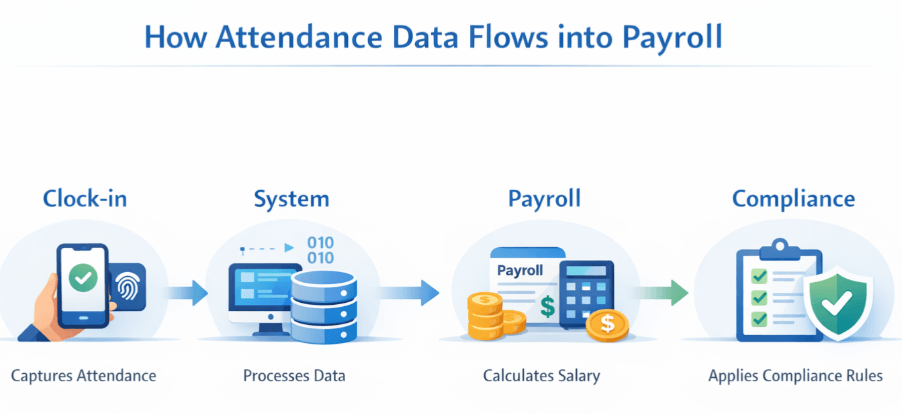
Manual re-entry between attendance and payroll systems leads to data inconsistencies. When attendance flows directly into timesheets and payroll without human intervention, overtime calculations, leave balances, and pay figures stay consistent across HR and finance. The risk is eliminated by removing the step where the error happens.
Analytics and compliance
A centralized dashboard gives managers a live view of late entries, early exits, absence patterns, and attendance trends across the workforce. That visibility matters for workforce planning, but it matters more for compliance. HR teams that can spot irregularities in the data before an audit do not spend the next quarter explaining them to a regulator, and automated attendance systems enable that.
10 Best Employee Attendance Management Systems for Efficient Tracking Solutions
Here are the top 10 workforce management systems that enterprises can adopt:
Darwinbox
Darwinbox is built for enterprises managing large, distributed workforces across geographies. Its attendance module integrates biometric tracking, geo-fencing, real-time data sync, and AI analytics into a single platform, with direct payroll and workforce management integration. It covers the full employee lifecycle without requiring separate systems.
Key features include:
Real-time biometric, card, and mobile attendance tracking
AI analytics across productivity, compliance, and engagement
Customizable policies with direct payroll integration
Pros: Full lifecycle coverage with strong AI automation and mobile-first design.
Cons: Feature depth exceeds what smaller teams with basic tracking needs will actually use.
Best suited for: Large enterprises that need a scalable, compliance-ready HRMS platform with deep workforce management capabilities.
Zimyo
Zimyo showcases a seamless platform that captures real-time attendance accurately and efficiently. It empowers managers with insights, streamlines workforce management, and boosts productivity. You can simply eliminate manual tracking and embrace effortless attendance management with Zimyo.
Key Features:
Real-time attendance tracking for accurate workforce data.
Boost workforce efficiency by up to 80% with automated processes.
Customizable attendance policies to fit organizational needs.
Generates quick, and personalized reports for actionable insights.
Best Suited For:
Businesses aiming to eliminate manual attendance tracking errors.
HR teams looking for detailed leave and attendance insights.
Companies seeking to enhance workforce engagement and productivity.
Organizations needing compliance-ready attendance management.
Kredily
Kredily combines free payroll and attendance tracking for small businesses that need basic automation without complexity. PMS and timesheets are not part of the package.
Its prominent features are:
Clock-in and clock-out with remote access and biometric support
Automated tax deduction with payroll integration
Self-service portal for leave and personal data
Pros: Free HRMS with low adoption barriers and built-in basic tracking.
Cons: Customization is thin, and meaningful features sit behind paid tiers.
Best suited for: Small businesses needing payroll-attendance automation at a low cost.
Zoho People
Zoho People suits businesses already inside the Zoho ecosystem. Attendance tracking is flexible across devices and integrates natively with Zoho's finance and operations tools.
Key characteristics of Zoho People are:
Biometric, web, and mobile tracking with automated notifications
Real-time monitoring with payroll sync
Native integration across Zoho applications
Pros: Strong ecosystem integration with AI-driven tracking and geo-fencing.
Cons: Key features sit behind premium plans, and new users face a learning curve.
Best suited for: Businesses running Zoho products that need reliable cloud-based attendance.
FactoHR
FactoHR is built for Indian SMEs that need precise time tracking with strong payroll integration. Facial recognition and geo-fencing cover field and distributed teams.
Key features are:
Mobile, facial recognition, and geo-fencing attendance modes
Automated shift scheduling, overtime, and leave management
Real-time analytics with multi-time zone support
Pros: Solid payroll integration with self-service attendance correction capability.
Cons: The interface is not intuitive, and customization options are narrow.
Best suited for: SMEs needing automated, compliance-ready attendance with AI facial recognition.
Keka
FactoHR is built for Indian SMEs that need precise time tracking with strong payroll integration. Facial recognition and geo-fencing cover field and distributed teams.
Key features are:
Mobile, facial recognition, and geo-fencing attendance modes
Automated shift scheduling, overtime, and leave management
Real-time analytics with multi-time zone support
Pros: Solid payroll integration with self-service attendance correction capability.
Cons: The interface is not intuitive, and customization options are narrow.
Best suited for: SMEs needing automated, compliance-ready attendance with AI facial recognition.
Keka is designed for businesses that treat employee experience as part of HR infrastructure. Tracking works across biometric, mobile, WiFi, and IoT devices with strong payroll automation.
Principal features are:
Real-time tracking via mobile, biometric, WiFi, and IoT
Automated shift scheduling, overtime, and payroll integration
Flexible hybrid workforce policies with a gamified attendance layer
Pros: Intuitive mobile app with strong automation and IoT-enabled tracking.
Cons: Pricing runs high for small businesses, and initial setup takes time.
Best suited for: SMEs prioritizing employee experience alongside payroll and attendance integration.
GreytHR
GreytHR is built for accuracy and compliance across multiple locations without demanding complex configuration. It handles Indian payroll requirements reliably.
Key attributes are:
Biometric, mobile, and web-based multi-device tracking
Geo-attendance and IP-based access control for remote teams
Payroll integration with tax compliance and shift management
Pros: Strong leave and attendance tracking with solid Indian payroll compliance.
Cons: The interface feels dated, and AI-driven automation is limited.
Best suited for: SMEs across multiple locations needing centralised, compliance-ready attendance.
Pocket HRMS
Pocket HRMS is a cloud-based platform built around mobile-first attendance and AI-powered HR tools. Its chatbot handles routine queries without HR intervention.
Main aspects of this platform are:
AI chatbot for instant HR query resolution
Mobile, kiosk, facial recognition, and biometric attendance options
Real-time analytics with geo-tagging and compliance reporting
Pros: Flexible attendance options with strong AI features across a scalable platform.
Cons: Attendance management sits outside the standard plan, which raises costs for budget-focused teams.
Best suited for: Mid-sized businesses integrating AI for workforce automation and mobile attendance.
SumHR
SumHR keeps attendance simple for startups and small teams. WhatsApp-based check-ins reduce friction for workforces that live on mobile.
Its key features include:
WhatsApp attendance marking for quick, accessible logging
Real-time geo-fencing for remote and hybrid teams
Customizable policies with payroll integration
Pros: WhatsApp-based tracking is practical and genuinely useful for mobile-first teams.
Cons: Advanced HR features are limited, and the platform does not scale to enterprise needs.
Best suited for: Startups and small businesses with remote or hybrid teams needing a low-friction solution.
Timecheck
Timecheck is a focused attendance system for shift-based businesses that need scheduling and geo-tracking without a full HRMS. It integrates with existing payroll tools rather than replacing them.
Top features include:
Real-time tracking with customizable shift rules and attendance policies
Geo-tracking for field and remote workers
Integration with existing payroll and HRMS platforms
Pros: Strong geo-tracking and shift policy support at a competitive price.
Cons: The interface needs work and lacks the breadth of a full HRMS.
Best suited for: SMEs with shift-based workforces needing cost-effective attendance automation.
Benefits of Using Attendance Management & Tracking Systems
Using an Attendance Management & Tracking System offers a range of benefits that streamline HR operations, improve employee satisfaction, and enhance organizational efficiency. Here are the key advantages:
Compliance and risk reduction
Labor law requirements do not apply uniformly across locations, and manual processes cannot enforce them consistently. Attendance systems automatically apply work-hour, break, and overtime rules across every site and every shift. Accurate records mean fewer compliance failures. Role-based access controls prevent sensitive attendance data from falling into the hands of unauthorized users.
Payroll accuracy and efficiency
Automated systems handle data flow within the payroll processes. It eliminates the need to manually input leave deductions and overtime data. The entire payroll calculation process accesses data from a single source. HR and finance stop reconciling against each other. Payroll runs that once took days now take hours, but because the manual step that caused most of the errors no longer exists.
Workforce visibility and planning
A real-time dashboard tells managers who is present, absent, or on leave without making a single phone call. BI analytics surface absenteeism and overtime patterns before they become scheduling problems. The difference between reactive and planned workforce decisions is usually just data arriving at the right time.
Cost control
Manual attendance tracking carries overhead that compounds quietly. Administrative time, payroll corrections from over- or underpayment, and time theft that goes undetected all add up across pay cycles. Catching absenteeism patterns early costs far less than addressing the productivity loss after the fact. Accurate tracking does not eliminate these costs entirely, but it makes them visible before they grow.
Productivity and operational efficiency
HR teams running manual attendance processes spend a disproportionate share of their time on administration that adds no strategic value. Automated systems shift that time toward workforce planning. Employees with self-service access handle leave requests and attendance corrections without waiting for HR to intervene. Less friction per cycle means the gains are not one-time. They repeat across every payroll run and every performance review.
How to Choose the Best Attendance Management System for Your Enterprise?
Selecting an attendance system is a buying decision with downstream consequences. Vendor reputation matters, but the platform's capabilities are where the decision is actually made. Evaluate any shortlisted system against six criteria.
Scalability: The system needs to handle your existing workforce and all future employee increases. A platform that works with 500 employees but strains at 5,000 cannot be the right solution. The automation platform must enable your organization to expand its operations without requiring additional HR resources.
Payroll and HRMS integration: The system must transfer attendance data directly to payroll systems without needing any manual processing steps. Disconnected systems create reconciliation work and reintroduce human errors.
Biometric and device flexibility: A workforce that operates from multiple office locations and field sites and works remotely will use different methods to check in to work. The system needs to support biometric devices, mobile check-ins, RFID, and geo-fencing. The system must track attendance through multiple methods while consolidating all attendance data into a single central database.
Compliance and anomaly detection: Labor law rules should apply automatically across countries and states. The system should detect irregularities and flag exceptions before they become audit findings. Organizations that operate across multiple jurisdictions require multi-jurisdictional compliance support as a mandatory requirement.
Centralized visibility and analytics: HR and managers need attendance data without having to submit report requests. A unified real-time dashboard handles this. A dashboard that requires engineering support to build or update is a liability that will quietly cost you time every month.
Ease of use and implementation speed: A system nobody uses correctly solves nothing. An intuitive interface cuts training time and drives adoption at every level. Rapid implementation limits the disruption that comes with any rollout.
Inconsistent rules, disconnected data, and manual steps introduce errors at every handoff. A scalable HR platform that handles all six criteria removes those handoffs. Payroll runs cleaner, compliance holds across geographies, and the HR spends less time fixing and more time deciding.
Conclusion
Choosing the best attendance management system shapes payroll accuracy, compliance, and how your HR team spends its time. The right attendance management software removes the manual steps that slow every HR process and replaces them with data that is accurate from the point of capture.
The systems here serve workforces of different sizes and structures.
For enterprises managing scale, multi-geography compliance, and payroll integration in one place, Darwinbox is worth evaluating seriously. It handles that operational complexity natively and scales without additional effort. Ready to see it in action? Schedule a demo with Darwinbox today.
FAQs
What is an ERP system for attendance?
An ERP attendance system is an integrated module within an enterprise resource planning platform that tracks work hours, shifts, and absences. It connects attendance data directly with payroll, leave management, and compliance reporting. Every downstream process draws from one source rather than reconciling across separate systems, which is where most attendance errors actually originate.
What are the types of attendance management systems?
The main types of attendance management systems are biometric systems using fingerprint or facial recognition, RFID and NFC card-based systems, mobile and app-based tracking, GPS and geo-fencing tools, and web-based cloud platforms. Most modern enterprise solutions combine several of these, so organizations can apply the right method to each employee type or location rather than forcing a single approach across a diverse workforce.
Can employee attendance be tracked remotely and offline using Darwinbox?
Yes, with Darwinbox, employees mark attendance from any location using mobile devices, with GPS and geo-fencing confirming they are checking in from an authorized site. Offline mode stores data locally and syncs automatically once connectivity returns. Field and remote employees never lose records due to dropped connections.
Does Darwinbox support RFID or NFC-based attendance?
Yes, Darwinbox supports both RFID and NFC-based attendance. Employees can use their ID cards to check in at a shared kiosk, and Darwinbox marks attendance automatically. There is no need for manual entry.
How secure is Darwinbox for attendance tracking?
Darwinbox uses anti-spoofing technology, encrypted data storage, and biometric validation to prevent fraudulent check-ins. Role-based access controls limit who can view or modify attendance data to authorized HR personnel only. Audit trails log all system activity, so there is a complete record of every change made.