2025 has increasingly become an important year for organisations to acquire the ability to gain, develop, and retain the best talent. Talent Management Software (TMS) is no longer a 'good to have'; it's evolving to be one of the must-haves for HRs across various industries, especially in streamlining hiring processes.
With remote working, skill gaps, and staff expectations changing beyond recognition, organisations require systems that go beyond core HR functions.
According to Grand View Research (2024), the global TMS industry was valued at USD 9.96 billion in 2023 and is projected to grow at a CAGR of 12.5% between 2024 and 2030. It empowers human-centric approaches that yield real business results.
Keep reading to know about talent management software, how it transforms HR talent operations, and how you can implement it in your organisation.
What Is Talent Management?
Talent management is much more than employee onboarding, recruiting, or payroll management. Talent management is about Human Capital Strategy: putting the right people in the right place, at the right time, and for the right reasons to foster employee growth . It includes systematic efforts through recruitment, development, retention, engagement, and succession. 64% of organisations in the world are currently investing in human capital management (HCM) platforms as they realise the power of human capital.
What Is a Talent Management System (TMS)?
A Talent Management System (TMS) is a specialised software solution that is built to manage and optimise each phase of the employee life cycle, including interview scheduling, recruitment, performance measurement, talent development, and succession planning- all under one digital roof.
A talent management system integrates multiple talent functions into a single platform that automates HR tasks, generates insights, and enhances decision-making. Thus, it enables HR to transition away from laborious administration and reduce administrative workload to strategic workforce management solutions.
Who Uses a TMS?
A talent management system can be a game-changer for:
| User | Purpose |
|---|---|
| HR Managers | To automate hiring, appraisals, and training. |
| Line Managers | To track team performance, establish goals, and sanction development plans. |
| Executives | For workforce analytics and succession planning. |
| Employees | To view learning materials, leave feedback, and track goals. |
Key Features & Core Modules of Talent Management Software
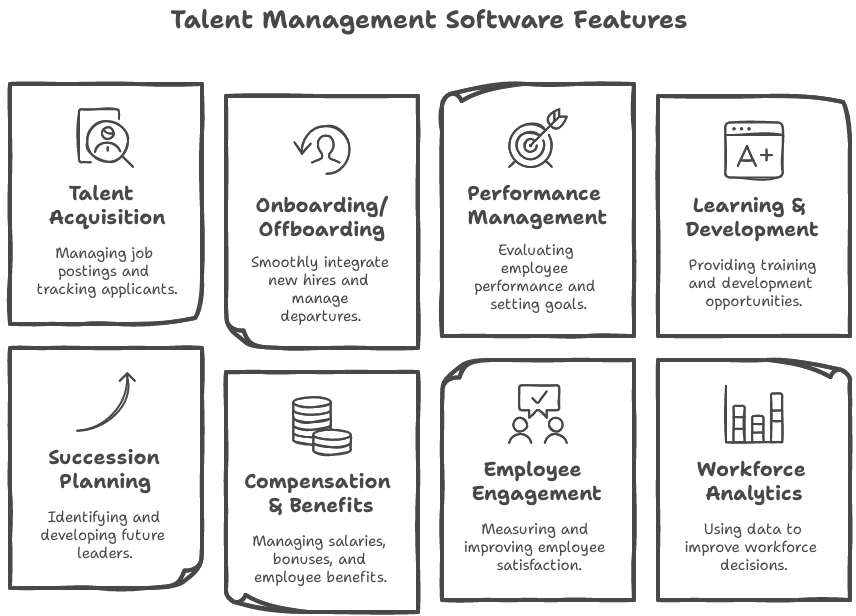
A Talent Management System brings together different HR functions under a single collaborative platform. The core modules in such systems automate and integrate information transfer across the employee life cycle, facilitating ongoing feedback and ensuring that rapid and intelligent decisions are made.
Talent Acquisition & Applicant Tracking
The talent management software simplifies the hiring procedure, relying on centralised resume tracking, AI-algorithmic candidate ranking, and integrated scheduling. From then onwards, recruiters can concentrate on closure and fit, not on manual tasks. Predictive analytics capabilities can further help by identifying top sourcing channels and minimising screening time.
Onboarding & Offboarding
Diligent onboarding workflows mean new employees receive the requisite documents, tools, and welcome processes before day one. Task completion is monitored on dashboards across various teams so nothing will fall between the cracks. Offboarding processes are equally seamless with interview, handover, and compliance checklists.
Performance Management
New platforms allow employees to set goals, track progress and receive real-time feedback, all in one place. Managers can see trends and align team performance with business OKRs. When review cycles are ongoing, it can boost engagement levels are high and reduce the burden on HR managers.
Learning & Development
LMS modules may be integrated or embedded to deliver personalised learning based on roles and performance. Workers consume curated content on demand and work toward certifications and micro-learning that support their career growth. Managers observe advancement and spot skill gaps early.
Succession Planning & Career Pathing
Talent management software platforms spot high-potential workers and discover internal candidates for mobility. Dashboards support staff in career planning while managers view their bench strength. The skill gaps and readiness are monitored in real-time.
Compensation & Benefits Management
Compensation solutions connect salary, performance, and market data in one open system. Managers can budget reasonably, and employees can see how rewards are derived. The whole process of enrollment into benefits and their changes is automated to minimise paperwork.
Employee Engagement & Experience
According to Gallup, employee engagement around the globe fell to 21%, equating to US$438 billion in productivity losses. Pulse surveys, real-time feedback, and peer-to-peer recognition tools foster employee satisfaction, morale, and engagement. Customised dashboards grant employees access to topical discussions on their objectives, progress, and growth from a single perspective. Wellness and DEI tools enable leaders to follow inclusion and well-being.
Workforce Analytics & Predictive Insights
Advanced analytics convert HR data into insights for better decision making. Dashboards track leading indicators: turnover, DEI, training ROI, etc. AI models can detect flight risks, talent gaps, and hiring needs.
The Employee Lifecycle: How Talent Management Software Powers Every Stage
Talent Management Software not only assists HR but also redefines every point of the employee lifecycle. From hiring to retirement, TMS infuses consistency, clarity, and control in each phase.
Strategic Talent Acquisition & Workforce Planning
Recruitment is not merely a matter of speed; it's about locating the appropriate fit for the position and the company. Talent management software platforms introduce order, automation, and transparency to the recruitment process. With AI-based talent acquisition as part of their talent management strategy, businesses reduce the time it takes to hire by 50%.
Candidate information, job requisitions, interview ratings, and tests are centralised, providing recruiters and hiring managers with a single snapshot of progress. Predictive workforce planning capabilities enable future needs modelling, attrition forecasting, and last-minute, expense-huge hiring avoidance.
Looking ahead by linking scenario planning to skills inventories, HR teams can simulate "what if" scenarios, such as retirements or growth, and react ahead of talent gaps impacting the business.
Empowering Employees Through Self-Directed Development
Workers no longer settle for yearly training. They demand ownership of their development. A TMS allows them to discover customised learning paths according to their jobs, skill deficits, and goals.
AI platforms suggest courses based on an employee's development level, performance metrics, and business goals. Internal mentorship platforms pair learners with internal coaches and mobile-first, bite-sized learning fosters habits of continuous learning. Interactive dashboards even visualise career plans within the organisation, clearing the confusion about growth.
By making learning self-directed, organisations increase adoption, enhance internal mobility, and develop a more agile and future-fit workforce.
Compensation, Benefits & Rewards: A Strategic View
Compensation isn't only about figures; it conveys fairness, trust, and long-term value. Talent management software introduces discipline and transparency to reward policies, enabling managers to link remuneration to performance, competence, and market data. Approximately 65% of employees are more inclined to leave if they believe that they are not fairly remunerated.
Dashboards enable the manager to allocate budgets strategically while illustrating to employees how bonuses or salary increases are determined. Benefit enrolment is simplified through self-service capabilities that decrease HR reliance and enhance precision. From medical coverage to long-term rewards such as equity, workers have a better understanding of overall rewards.
Making it automatic ensures consistency, compliance, and fairness throughout the organisation, principal retention drivers within today's workforce.
Boosting Engagement, Recognition & Experience
TMS platforms are critical to trust-building, motivating, and connecting. Real-time feedback, recognition modules, and employee sentiment tools are no longer nice-to-haves—they're must-haves.
Pulse surveys grab employee sentiment on a regular basis so leaders can act before discontent festers. Recognition platforms enable peers to publicly celebrate contributions, bringing visibility and energy to the everyday wins. Personalised dashboards put goals, learning, and feedback front and centre, encouraging ownership and motivation.
Inclusion and well-being modules now do more, monitoring burnout indicators, DEI success, and psychological safety. It paves the way for an integrated perspective on engagement founded on facts, not guesses.
Retention Plans & Internal Mobility
Hiring a replacement for an employee runs 50% to 200% of their salary per year, but the greater effect is on morale, productivity, and knowledge continuity. Talent management software addresses this with the tools that keep talent engaged, informed, and developing, and provide significant benefits to the organisation.
Internal mobility software surfaces available jobs and project-based opportunities that workers may have otherwise gone unseen. By aligning internal talent with business requirements, businesses decrease time-to-fill and increase engagement.
Career pathing modules provide workers with visibility on vertical or lateral transitions. Concurrently, AI-driven dashboards identify flight risks through sentiment, engagement, or performance patterns. These signals enable interventions like appreciation, development conversations, or new responsibilities to be offered before people fly off the talent radar.
Data-Driven Decision Making with Workforce Analytics
Most HR teams want to be strategic, but only 22% say their processes effectively use people analytics. That’s where a TMS with embedded analytics makes the difference.
Real-time dashboards offer visibility into top metrics, attrition, engagement, comp ratios, learning progress, and so on. Leaders are able to slice by team, region, or tenure, enabling them to move quickly and make better resource decisions. Predictive analytics predict who's likely to leave, whose jobs have no successors, and what skills will be needed.
McKinsey discovered that firms that pay attention to people's performance are 4.2 times as likely to outperform others. Data must be used not just for report generation, but for how HR demonstrates value, informs decisions, and drives results.
Step-by-Step Implementation, Integration & User Adoption Process
Talent Management Software won't produce results if it's badly deployed. A solid plan, system compatibility, and user readiness ensure long-term success.
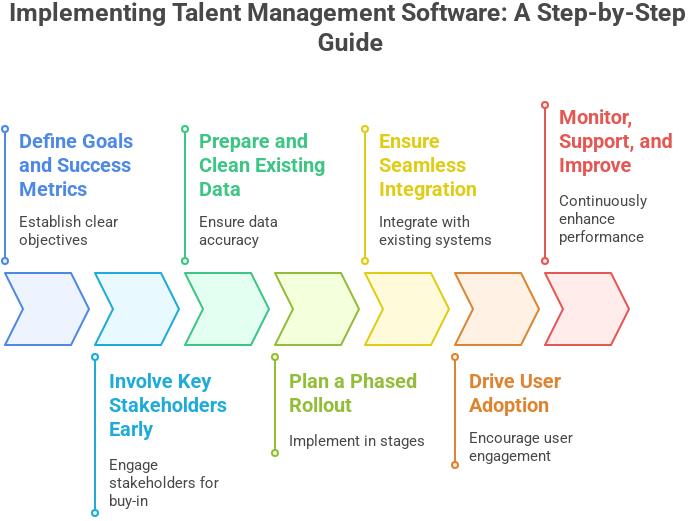
Step 1: Define Goals and Success Metrics
Begin with clarity. Establish definite outcomes prior to the start of the project. Tie-down success indicators such as reduced time-to-hire, improved employee engagement, or quicker learning completion. Tie software objectives to broader business goals to ensure leadership buy-in.
Step 2: Involve Key Stakeholders Early
Get the right stakeholders, including HR, IT, operations, and finance departments, involved from day one. Establish a project committee for decision-making, communication, and accountability. This ensures that everyone stays on the same page.
Step 3: Get and Clean Existing Data
Clean data is crucial for the strong implementation of data analytics for HR. Audit employee records and eliminate duplicates. Standardise job titles, departments, and performance history. Test for accuracy before migrating to prevent system issues.
Step 4: Plan a Phased Rollout
Don't go live all at once, and launch first in small groups or departments. This allows you to tune up the implementation as and when needed. Utilise feedback loops to eliminate bugs. Then, you can scale when the initial implementation goes smoothly.
Step 5: Ensure Seamless Integration
Ensure that every system communicates with every other system. Integrate the TMS with HRIS, payroll, CRM, LMS, and analytics software. Employ secure APIs or integration middleware to prevent data silos. All the automation systems must communicate with each other properly and operate using a single source of truth.
Step 6: Drive User Adoption
The software will only function if users utilise it. Create role-based onboarding sessions and train your employees. Provide hands-on training, cheat sheets, and support mechanisms. Offer early successes and visible outcomes to establish trust and habitual use.
Step 7: Monitor, Support, and Improve
Monitor adoption and adjust on a continuous basis for success with TMS implementation. Monitor login rates, feature adoption, and feedback. Tweak training content, ensure it meets regulatory compliance, and provide refresher sessions. Relieve pain points before they turn into roadblocks.
How to Choose the Right Talent Management System
The greatest Talent Management System (TMS) isn't the most feature-rich one—it's the one that aligns with your business objectives, integrates smoothly and delivers real results. Here's how to make the optimal selection without being overwhelmed by the hype.
Define Clear Objectives First
Begin with the "why." Are you addressing high attrition? Leadership gaps? Damaged hiring workflows? Any feature you're considering should map back to a quantifiable business requirement, whether it's time-to-hire, engagement percentages, or learning completion.
Prioritise Integration Over Complexity
A talent management software that doesn't integrate with your HRIS, payroll, or CRM creates data silos. Find solutions with open APIs, native integrations, or middleware support. Real-time sync across systems cuts back on manual labour and provides greater visibility. Disconnected systems damage more than old ones.
Check for Usability, Not Just Features
Even the strongest platform is a failure if your managers won't utilise it. Ask for a live demo, not a recorded demo. Engage end users and solicit feedback upfront. A clean UI, an intuitive UI, and mobile accessibility are non-negotiables for adoption.
Test Scalability & Localisation
Plan for the long term. Will this TMS still accommodate when your team triples or moves into new geographies? Search for multi-country capabilities, compliance notifications, and modularity. Don't pay too much for things you don't need today, nor platform down the road.
Assess Reporting & Analytics Depth
Metrics without analysis are static. The ideal system must provide real-time dashboards, drill-downs, and predictive recommendations. CEOs today demand that HR deliver strategic insight, not merely reports. Ensure your TMS can communicate those insights in simple language, not spreadsheets.
Verify Vendor Support & Customer Success
What do you get after the contract is signed? Check onboarding, training, SLAs, and access to user communities. Fantastic software requires fantastic support to thrive. Consider customer feedback, renewal rates, and response times, not merely hype on paper.
Call for Real-World Case Studies
Request examples of companies of similar size, industry, or challenge. Check before-and-after metrics. Success stories demonstrate how the system stands up to pressure, and if the vendor provides more than technology.
How Darwinbox TMS Makes Organisations Successful?
Darwinbox Talent Management System is designed to give measurable results. It combines intuitive functionality, robust automation, and thoughtful analytics—all aimed at making HR efficiency and employee experience better.
Streamlined Recruitment & Hiring
Darwinbox assisted Bharti AXA in cutting time-to-hire by 25% and doubling requisition processing speed through intelligent automation of workflows and AI-based shortlisting. Centralising candidate information and interview workflows improved hiring accuracy as well as offer-to-joining rates by 20%, significantly boosting the talent pipeline.
Digital HR Transformation & Performance Excellence
At professional services organisation Nexdigm, Darwinbox automated 99% of the key HR processes of recruitment, performance appraisal, and employee engagement. The performance module in the platform cut 40% of the appraisal cycle time while allowing goal clarity and 360° feedback, fostering a high-accountability, transparent work culture.
Better Engagement & HR Efficiency at Scale
Physics Wallah, a 13,000+ strong EdTech company, witnessed attendance requests rise by 300% post-deployment of Darwinbox's AI-driven reminders and nudges. Ticket resolution in HR was improved four times, and recognition nominations increased two times through more interactive workflows and a mobile-centric user experience.
Conclusion
Talent Management Software is no longer optional; it’s foundational. It brings structure to chaos, clarity to decisions, and alignment across the employee lifecycle, thereby enhancing operational efficiency. Whether you’re hiring at scale, reskilling teams, or building a diverse leadership pipeline, a smart TMS ensures your people strategy keeps pace with business growth.
The top talent management solutions do more than automate; they empower HR and employees. They match data with action, talent with opportunity, and people with purpose. But technology is not enough in itself. Success also requires strategic deployment of that technology, ongoing optimisation, and a human-first mindset.