TL;DR
AI workforce management helps organizations predict staffing needs, balance workloads, and adjust schedules before problems arise.
It moves workforce planning from fixed annual plans to real-time, data-led decisions.
AI reduces overstaffing, overtime costs, and reactive hiring by matching skills with demand more accurately.
Early signals of absenteeism and attrition allow leaders to act before disruption affects performance.
With integrated data and clear governance, AI becomes a long-term capability that strengthens agility and workforce resilience.
Introduction
Enterprise workforce management is more difficult in the face of hybrid work models, global operations, evolving skills needs, and more rigorous compliance requirements. HR operations teams must also manage costs, productivity, and employee experience, while aligning workforce supply with variable demand.
The McKinsey (2025) report states that 92% of organizations plan to increase their AI investment over the next 3 years. To get better ROI from AI in HR, AI workforce management must become a decision intelligence layer. It can improve workforce planning, scheduling, forecasting, and optimization, rather than simply automating these tasks.
This article explores how AI works in workforce management, where value is generated, and how it can be implemented in an organization.
What is AI-Powered Workforce Management?
AI-based workforce management is a comprehensive suite including machine learning models, hypothesis testing, and optimization that drives enterprise-wide workforce planning, scheduling, and execution decisions.
Instead of executing pre-set rules, like traditional systems, AI operates multidimensionally on what data to process, including the previous demands, the skills of the employees, previous attendance rates, performance measures, and the business plan.
Usually, AI-based solutions can:
Dynamically predict workforce demand
Balance staff levels across regions and job types
Detect patterns of absenteeism and turnover
Offer real-time recommendations for altering schedules
AI workforce management converts workforce management from a transactional process to intelligence-driven workforce orchestration.
Types of Workforce Management Systems: How They Work
Conventional workforce management tracks time, assigns shifts, and generates reports. It follows predefined rules and workflows set by HR operations teams. AI-powered workforce management works differently by evaluating patterns across multiple data points and offering recommendations. It doesn’t just automate operations but improves the quality of workforce decisions.
The comparison below outlines how traditional workforce management differs from AI-powered systems across core dimensions:
| Dimension | Traditional Workforce Management | AI-Powered Workforce Management |
|---|---|---|
| Decision logic | Rule-based, static workflows | Machine learning models that adapt over time |
| Forecasting | Historical trend extrapolation | Predictive modeling using multiple variables (demand, attrition, seasonality, growth projections) |
| Scheduling | Manual or semi-automated rostering | Optimization algorithms balancing demand, skills, availability, and compliance |
| Data scope | Limited to Human Resource Information System (HRIS) and time data | Integrates HR, finance, operations, performance, and external demand signals |
| Responsiveness | Reactive adjustments | Real-time, scenario-based recommendations |
| Learning capability | No self-learning | Continuous improvement from new data inputs |
Challenges in Traditional Workforce Management
Before the adoption of AI, enterprise workforce management was based on static planning, manual scheduling, and historical reporting. These constraints meant that enterprises could not react rapidly to changing demands, skill shortages, attrition risks, and the complexity of compliance. Let’s explore the major challenges in working with traditional workforce management processes:
Uncertain demand: Dynamic market changes and seasonal variation continue to challenge static labor force plans. The World Economic Forum (2025) notes that the rate of disruption has levelled, but the core skills of 39% of workers are still predicted to change by 2030, maintaining high levels of planning uncertainty.
Workforce skill gaps: Enterprises are not able to readily assess the skills they have today with the skills they require tomorrow. Static headcount planning disregards skill adjacency or potential for redirecting resources.
Unproductive scheduling: Traditional scheduling is notorious for wasting labor resources in its tendency to overstaff or understaff. This leads to either unnecessarily high labor costs or compromised service quality. The decisions for allocating resources become even more complex when hybrid and shift-based models are introduced.
Risk of absenteeism and quitting: Conventional reports can only highlight the turnover trend history. Absenteeism is an indication of quiet quitting. Early indicators like attention or activity misalignments are not often subjected to systematic analysis.
Compliance complexity: Multi-national companies have to adhere to the labor laws, overtime regulations, and union contracts in each country in which they do business. Manual supervision can increase the risk exposure.
These problems demonstrate that workforce management systems need to be predictive and adaptive, not simply undertake reporting reactively.
Key Enterprise Use Cases of AI in Workforce Management
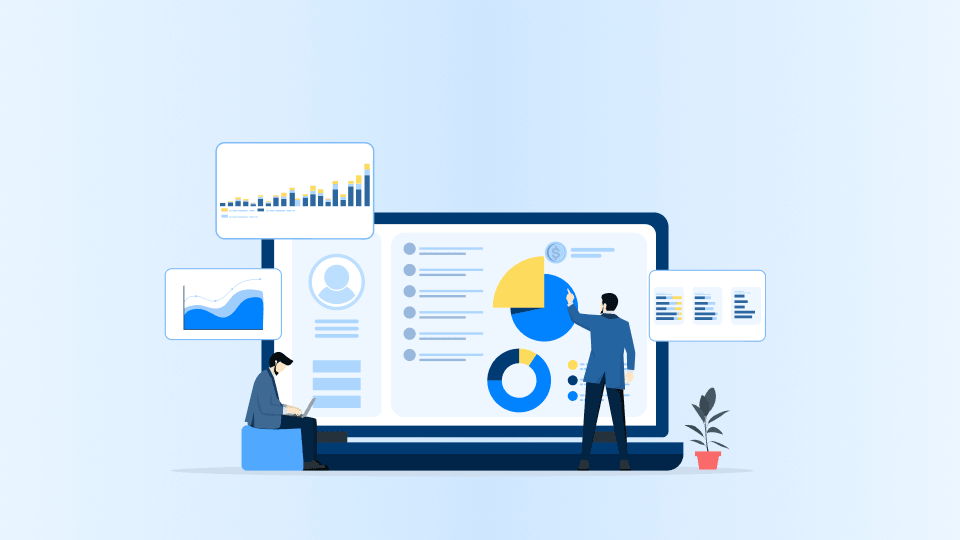
AI-Driven Workforce Planning and Forecasting
AI workforce planning models predict headcount, capacity, and skills needs through various parameters, including business growth predictions, historical demand, attrition risk, and macroeconomic factors.
In contrast to the traditional, static annual workforce plans, AI-enabled models run scenarios like entering a new region or confronting a demand surge in peak seasons.
For example, a multiregional organization can model the effect of growth in one market based on its hiring needs in another. AI also finds redeployment options by matching employee skills through structured skills data, and enables organizations to eliminate redundant positions through external hiring. This proactive response diminishes reactionary hiring and better aligns workforce expenditure.
Intelligent Scheduling & Capacity Optimization
AI scheduling solutions enable real-time balancing of consumer demand, skilled employee availability, and regulatory constraints. Optimization algorithms in the labor market reduce labor cost inefficiencies by decreasing overstaffing and understaffing.
In a hybrid or shift work context, co-scheduling is done in real-time as it automatically adjusts to unexpected absences or variation days in demand. AI scheduling is also more transparent and fairer, and takes employees' preferences into account, unlike manual rostering.
Integration with enterprise time and attendance systems enables schedule decisions to be made on real work rather than assumptions.
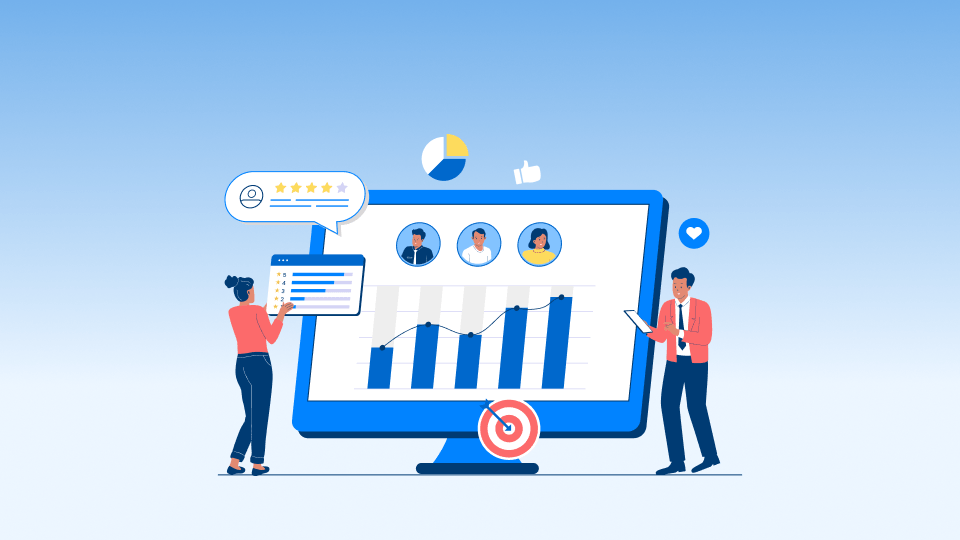
Predictive Attendance, Absenteeism & Attrition Insights
AI models analyze past attendance, workload intensity, engagement signals, and tenure information to track historical patterns of absenteeism and voluntary turnover. Instead of documenting attrition post-event, prediction systems send out early alarms.
HR leaders can then respond through manager coaching, workload redistribution, or targeted engagement interventions. This can result in a strong workforce and less disruption of the workflow.
Performance & Productivity Intelligenc
AI uses work patterns, output metrics, collaboration patterns, and hints of engagement to identify organization-wide productivity trends. AI can identify potential skills bottlenecks, imbalances of work between teams or roles that are overworked. Based on real data, not anecdotes, leaders can redistribute work, change hiring plans, or redesign workflows as they see fit.
How to Get Started with AI in Workforce Management?
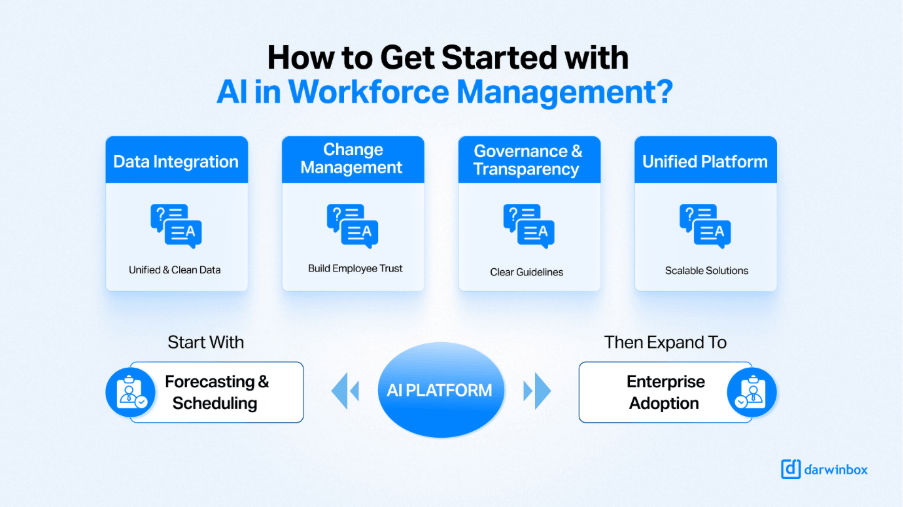
Most organizations that struggle with AI adoption do not have an AI problem. They have a readiness problem. Getting the foundations right before selecting a tool is what separates a deployment that scales from one that stalls. This is all you need to focus on to ensure your foundations are solid enough for AI integration:
Quality and integration of data: HR, finance, operations, and scheduling systems each hold a piece of the workforce picture. If those systems do not connect, then AI is not working with incomplete data. It is working with a distorted version of reality, and every recommendation it produces reflects that.
Change management: Employee trust is not a soft concern. Workforce decisions affect compensation, scheduling, and career progression. When the logic behind a recommendation is invisible to the people it affects, resistance follows. Being clear about how decisions are reached is what makes adoption possible, not a communication exercise.
Governance and transparency: Governance sets the rules before problems arise. Organizations need defined policies on data use, bias mitigation, and how AI outputs are explained and challenged. Without that structure, accountability has no address.
Platform over point solutions: Holistic platforms, rather than point solutions, are required to support scalable AI. A single platform can support enterprise-wide analytics and solution adoption.
Adoption must be staggered, starting with high-value use cases such as forecasting or scheduling optimization, then expanding throughout the organization.
The Future of Workforce Management is Predictive & Adaptive
S&P 500 companies that manage talent effectively generate 300% more revenue per employee than median firms, according to McKinsey. That gap does not close by accident. It closes when workforce decisions are driven by continuous intelligence rather than periodic review.
The shift from administrative management to analytical orchestration is already underway. Headcount, skills, cost, and demand can no longer be planned in isolation, reviewed quarterly, and acted on slowly. The enterprises pulling ahead are the ones where those inputs connect inside a single system and update in real time.
AI in HR makes that possible, but only when it is embedded across the workforce function rather than added as a feature on top of existing tools. Forecasting, capacity planning, risk assessment, and scheduling all need to draw from the same intelligence layer. When they do, leaders stop reacting to workforce problems and start anticipating them.
An organization that can read demand shifts, rebalance skills, and adjust headcount before the pressure peaks is operationally efficient and becomes structurally harder to disrupt.
Platforms like Darwinbox built on an AI-first foundation, enable intelligence to run across the full employee lifecycle rather than sitting inside individual modules. It can turn workforce management into a long-term organizational capability.
External Sources
FAQs
HR Software Features That Matter for Enterprises | Darwinbox
Explore the most important HR software features enterprises need today, from AI and analytics to compliance, scalability, and workforce intelligence.
What is AI workforce management?
AI-based workforce management applies machine learning and predictive analytics to make better decisions about workforce planning, scheduling, and optimization. It processes challenging enterprise data to produce adaptive, data-centric recommendations.
Can AI help predict workforce demand and attrition?
Yes, AI models use historical demand, attrition patterns, and external factors to predict staffing needs in the future and early attrition risks.
How does AI-powered workforce management improve productivity?
AI-powered workforce management balances staffing, evenly distributes work, identifies skill gaps, and provides predictive insights so leaders can make better resource allocation decisions.
Is AI in workforce management suitable for global organizations?
Yes, AI systems have the flexibility to include compliance regulations specific to regions, multi-country workforce information, and varying requirements of operations when building optimization models. It can help organizations balance global oversight with regional flexibility.
What is the ROI of implementing AI in workforce management?
AI offers ROI in workforce management through reduced overtime, improved labor utilization, lower attrition costs, and accurate forecasting. Predictive planning reduces reactive hiring and strengthens workforce stability.
How can businesses get started with AI workforce management?
To start using AI for workforce management, organizations must integrate workforce data with clear governance. Start with high-impact use cases such as forecasting or scheduling, then scale gradually across functions.