TL;DR
Poor candidate communication slows hiring and drives talent away.
AI recruiting chatbots handle screening, scheduling, and updates automatically, so candidates move faster through the hiring process.
Generative AI makes chatbots more natural and context-aware, so responses feel relevant instead of scripted.
Enterprises see measurable impact: shorter time-to-hire, higher recruiter productivity, and more consistent candidate experiences.
Chatbots reduce manual work so recruiters can focus on evaluation, alignment, and closing the right talent.
Introduction
A single job posting can attract up to 250 applications. Recruiters cannot respond to all of them well, and candidates notice. Monster's Work Watch 2025 report found that 50% of candidates have walked away from a role because of poor communication from the hiring team. In a competitive labor market, ensuring candidate experience is a business problem.
Communication has become one of the critical bottlenecks in enterprise hiring. High-volume, multi-role, multi-location recruitment makes consistency harder to maintain. The candidate who applies for a role in one city should not have a materially different experience from the one who applies in another. Most hiring teams cannot guarantee that without help.
AI recruiting chatbots close that gap. They handle candidate conversations at scale, deliver consistent communication across every role and location, and take routine coordination off recruiters' plates entirely. This blog covers how they do it and what changes when they do.
Why Manual Candidate Communication Slows Down Enterprise Hiring
According to a PwC report, 60% of candidates expect the recruitment process to be completed within 4 weeks. Manual candidate communication is slower, especially at scale. When recruiters try to coordinate with hundreds of candidates manually, it causes systemic delays.
For example, recruiters may take more than two days for scheduling, trying to coordinate with the interview panel consisting of two to three members. When the information lives in emails, spreadsheets, and chat threads, updating the candidate about the latest recruitment status becomes challenging. It can result in lost context and missed follow-ups, which in turn impacts candidate experience.
For high-potential talent, a single late reply from a hiring manager or a last-minute rescheduling can hamper the interview process and make them switch to another employer. Candidate drop-offs due to missed or poor communication result in slower movement. Delayed responses from recruiters can also result in a poor perception of the employer brand.
At the enterprise level, when recruiters are engaged in high-volume hiring, these challenges become critical recruitment bottlenecks affecting hiring speed, candidate experience, and recruitment efficiency.
Key Enterprise Use Cases for AI Recruiting Chatbots
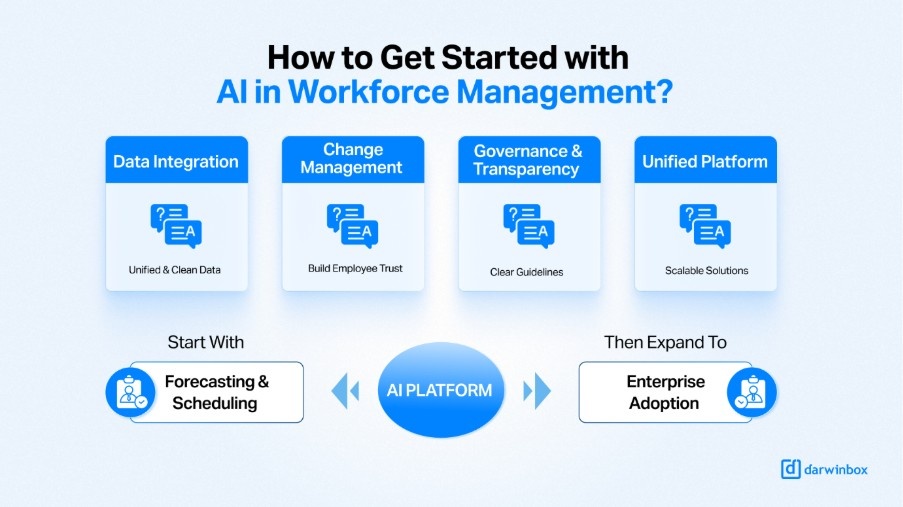
Chatbot in recruitment supports multiple stages of the hiring funnel, from answering candidate questions to interview scheduling and candidate screening. A talent acquisition chatbot can be useful in the following scenarios:
Candidate Engagement at Scale
Chatbots can handle high candidate volumes without delay. AI can answer hundreds of candidates simultaneously, providing personalized answers to their questions. It allows candidates to reach the recruiters 24/7, and interactive chatbots provide consistent responses. By being available to answer candidate queries, schedule interviews, and increase candidate engagement, recruitment chatbots can reduce candidate dropouts, particularly for high-volume hiring.
Pre-Screening & Qualification
Screening hundreds of applications manually is where recruiter time disappears fastest. AI recruiting chatbots handle that first pass automatically, applying role-specific criteria to filter out unqualified candidates before a recruiter reviews a single profile. The shortlist that reaches the hiring team is already qualified. That compression in the early stage reduces time-to-hire and redirects recruiter attention to the conversations that actually require human judgment.
Interview Scheduling & Status Updates
Conventional interview scheduling requires manual efforts from the recruiters for critical follow-ups. When an AI chatbot in recruitment is engaged, these can automatically schedule interviews and coordinate with the interviewers. Depending on the setup, the AI chatbot synchronizes interviews to calendars, making it easy for the candidates and the interviewers to prepare for the interview. Candidates can also get real-time status updates by simply asking questions in natural language using the chatbot. Involving AI recruitment chatbots for interview scheduling reduces the back and forth between recruiters and candidates. When chatbots handle these tasks automatically, it saves time and effort for recruiters.
Employer Branding & Experience
Employer branding can be established from the beginning when chatbots are used for consistent communication with the candidates. Across touchpoints, the chatbots can establish personalization, providing instant answers and status updates for the candidates. When candidates understand that the organization has invested in improving the candidate experience, they may perceive the employer to offer a better employee experience. The chatbots can be an extension of the employer brand, focusing on candidate engagement and experience.
Role of Generative AI in Recruitment Chatbots
Generative AI in recruitment chatbots moves chatbots past scripted responses entirely. Rather than matching a candidate query to a pre-written answer, generative models pull from live data sources to respond accurately to questions that no script anticipated. A candidate asking about culture, benefits, or team structure gets a specific, sourced answer rather than a redirect to a careers page. That capability matters most in high-volume hiring, where the range of candidate questions is wide, and recruiter bandwidth to answer them individually is not.
Generative AI chatbots used for candidate screening evaluate skills and qualifications using natural language, unlike rigid rule-based bots. During interview scheduling, the chatbots can automatically handle back-and-forth scheduling workflow without intensive human supervision. By tailoring communication based on individual candidate profiles, Gen AI chatbots can improve engagement and experience.
The generative AI chatbots are particularly useful for enterprises operating in different geographies as they communicate with candidates in the local language.
Business Impact of AI Recruiting Chatbots
Conversational AI recruiting chatbots offer measurable business impact. In addition to reducing the manual effort for the recruiters, they improve candidate engagement and experience. For example, Chipotle's Ava Cado AI chatbot handles applications, FAQs, and interview scheduling in multiple languages (English/Spanish). It slashed hiring time by 75%, boosted applicant volume dramatically (85% completion), and scaled for 9K-10K annual hires without extra admin burden. Here’s how AI recruiting chatbots impact businesses:
Reduced time to hire: Delays between recruitment stages compound quickly in high-volume hiring. Chatbots compress those gaps by automating the handoffs between screening, scheduling, and communication, so candidates move through the pipeline faster, and hiring cycles shorten without adding recruiter headcount.
Improved recruiter productivity: When routine candidate communication and initial screening run automatically, recruiters recover time for the work that requires judgment. Evaluation, stakeholder alignment, and offer conversations get more attention because coordination tasks are no longer consuming the day.
Enhanced candidate experience: Instant responses and real-time status updates change how candidates perceive an employer during the hiring process. That perception shapes employer brand long before an offer is made or declined.
Automated consistency and fairness: Standardized screening questions and automated communication reduce the variability that introduces unintentional bias. Every candidate moves through the same process, which makes outcomes easier to defend and experiences easier to compare.
Scaling without friction: A recruiter can manage a finite number of conversations at once. A chatbot can handle thousands simultaneously, across roles, locations, and time zones, without any candidate waiting longer than necessary for a response.
How to Select the Best Recruiting Chatbots for Enterprises
When selecting the best recruiting chatbots for talent acquisition, enterprises should evaluate the chatbot solutions based on the requirements and criteria. The solution must be scalable without performance degradation when there are high candidate volumes. Choosing a recruitment chatbot that works well with existing systems like ATS, HRMS, and calendars allows recruiters to integrate it into recruitment workflows seamlessly. Some generative AI-based recruitment chatbots provide analytics and insights about candidates that help with recruitment decisions.
Ask these questions before choosing a recruitment chatbot:
Can it handle high candidate volume during mass recruitment drives without degrading response quality?
Does it integrate cleanly with your existing ATS, HRMS, and calendar systems to avoid creating data silos?
Does it offer strong data protection, encryption, and role-based access controls that meet enterprise security standards?
Can it adhere to applicable compliance regulations, including GDPR and local data protection law, without custom legal engineering on your side?
Does it provide dashboards that surface engagement rates, response rates, drop-off points, and time-to-hire metrics clearly enough to measure ROI?
Can conversation flows, screening logic, and response parameters be configured to match specific roles, functions, and geographies rather than a fixed template?
Does the vendor offer ongoing support, regular updates, and clear documentation that covers deployment and what comes after it?
How AI Recruiting Chatbots Fit into a Modern HR Tech Stack
Talent acquisition chatbots are not meant to be standalone tools. They must integrate well with the existing ATS system to automatically connect with candidates who may be a better fit for the open roles. When the chatbots also integrate with the HRMs, it makes it easier to manage candidate information so that skills can be matched against future role requirements. It allows organizations to derive more value from the talent pool they have access to.
When analytics platforms provide candidate insights, it can result in better recruitment decisions. The chatbots must be integrated as a part of an end-to-end hiring ecosystem. They must be able to manage candidate records, integrate into existing interview workflows, and access workforce information for skill mapping and resource allocation, so as to reduce manual steps and potential errors.
A unified hiring architecture that also includes chatbots boosts visibility for hiring teams and ensures consistent data flow from engagement to onboarding. Modern HR systems built on interconnected tools and chatbots automate and provide insights that drive better decisions.
Final Thoughts: AI Chatbots as a Strategic Hiring Enabler
Recruitment chatbots should not be seen just as a means of automating communication. Rather, they must be looked at as strategic hiring enablers that reduce manual efforts, improve accuracy, enhance candidate experience, and act as an extension of the employer brand. With chatbots, recruiters don’t have to concern themselves with back-and-forth communication; they can engage in strategic decisions and deeper human engagement. By improving speed, consistency, and candidate satisfaction, chatbots in recruitment support outcomes that matter for business performance. For organizations that are looking to modernize hiring, solutions like Darwinbox bring these capabilities together in a unified platform that can be customized for enterprise needs.
External Sources
FAQs
AI Recruiting Chatbots Transforming Modern Hiring
AI recruiting chatbots help enterprises manage high-volume hiring with automated screening and real-time candidate updates. Learn more!
What is an AI chatbot for recruitment?
An AI chatbot for recruitment is a conversational tool that answers candidate questions, collects information, schedules interviews, and delivers status updates without manual intervention. It handles high volumes of candidate communication while freeing recruiters for decisions that require human judgment.
How does an AI recruiting chatbot improve candidate experience?
Candidates drop off when they feel ignored. AI recruiting chatbots reduce that risk by delivering instant responses, personalised guidance, and real-time updates throughout the process. Faster communication reduces uncertainty and keeps candidates engaged through to the offer stage.
What is the difference between a recruiting bot and conversational AI recruiting?
A recruiting bot follows a fixed script. Conversational AI understands context, interprets intent, and adapts to the specific candidate and situation. That distinction matters because hiring conversations rarely follow a predictable path. Rigid scripts break down the moment a candidate asks something outside the expected flow, and that breakdown is visible to the candidate.
Are AI chatbots secure for enterprise recruitment data?
Modern AI recruiting chatbots are built with encryption, role-based access controls, and compliance with applicable privacy standards. Sensitive candidate data is protected within the same governance framework that covers broader HR operations, which means security does not have to be traded off against speed or scale.
Can AI recruiting chatbots integrate with ATS and HRMS platforms?
Yes. Most enterprise-grade chatbots integrate directly with ATS, HRMS, and calendar systems. That integration keeps candidate data synchronized across platforms, removes duplicate data entry, and maintains a single source of truth across the hiring workflow.
How does generative AI enhance recruitment chatbots?
Rule-based models handle predictable queries. Generative AI handles everything else. By interpreting candidate intent and producing adaptive, context-aware responses, generative AI makes chatbot interactions feel less transactional and more conversational. The practical result is higher engagement and fewer moments where a candidate hits a dead end and disengages.