TL;DR
Enterprises are increasing HR tech budgets, yet many systems still store data without enabling decisions.
Modern HR software must move beyond record-keeping to real-time insight, automation, and workforce intelligence.
Foundational features like payroll, compliance, and self-service are baseline expectations.
Advanced capabilities such as embedded AI, skills intelligence, and live analytics drive measurable business impact.
Introduction
The right HR platform connects HR, finance, and managers through one reliable data layer built for global scale. HR software centralizes people-related data and automates the HR process across the entire employee life cycle, from hire to retire. Modern HR software extends this capability further, offering intelligence, visibility, and strategic impact.
Enterprises are now spending more on HR software. In fact, 37% of organizations are planning to increase their HR budget, according to Sapient Insights Group's 28th Annual HR Systems Survey. Yet the most common complaint from HR leaders is unchanged: the system holds data without driving decisions. Workforce complexity has outpaced what most platforms were designed to handle.
This article breaks down the HR software features that matter at enterprise scale and gives HR leaders a framework for what to look for before committing to a platform.
Why Enterprises Are Re-Evaluating HR Software Features
Hybrid and globally distributed workforces have made workforce visibility harder to achieve, but more critical at the same time. Compliance obligations now span dozens of jurisdictions, each with different reporting cycles, statutory requirements, and audit standards. Skills gaps have moved from an HR concern to a board-level risk.
The expectation has also shifted. Business leaders no longer accept workforce reports delivered quarterly. They expect people data to match the frequency and accuracy of financial data.
Feature depth now matters more than feature count. Enterprise HR must include modules that work together, validate data intelligently, and surface what is happening before leaders have to ask.
What Defines Modern HR Software Today
At enterprise scale, the HR platforms must have talent intelligence embedded across workflows. Skills-aware architecture tracks capability and enables real-time decision-making for managers and HR teams. Enterprise-grade configurability is a non-negotiable characteristic of modern HR platforms.
From Traditional HR Systems to Intelligent HR Platforms
The distinction between old and modern HR platforms is a capability gap. Here’s how they differ:
| Traditional HR Systems | Modern HR Platforms |
|---|---|
| Static workflows set at implementation | Adaptive workflows that respond to live data |
| Data storage and record-keeping | Decision enablement with real-time workforce insight |
| Batch or annual reporting cycles | Continuous visibility through live dashboards |
| Reactive compliance management | Automated compliance updates across jurisdictions |
Foundational HR Software Features Enterprises Expect
Every credible HR platform must have these foundational features that form the operational baseline. Gaps here create compliance exposure and data reliability problems that no advanced capability can recover. The most common features found in HR software are:
Centralized Employee Data and Digital Records
A single source of truth for employee data is the prerequisite for accurate reporting, audit readiness, and analytics reliability. When records are fragmented across systems, data quality erodes quietly until a compliance audit or board request makes the problem visible.
Payroll, Time, Attendance, and Leave Management
At enterprise scale, global payroll is a compliance function as much as an operational one. The time and attendance management system must feed payroll automatically, across geographies, without a manual reconciliation step between cycles. The system should handle scale as the enterprise grows.
Benefits Administration and Statutory Compliance
Regulatory complexity multiplies for businesses with different benefit offerings for multiple countries, each with different statutory obligations and audit cycles. The HR platform must track compliance status and flag changes without requiring HR to monitor regulatory updates manually.
Employee and Manager Self-Service
Self-service reduces HR ticket volume by giving employees and managers direct control over routine interactions such as leave requests, payslip access, benefit enrolment, and profile updates. It frees HR from mundane questions and reduces administrative workload.
Advanced HR Software Features
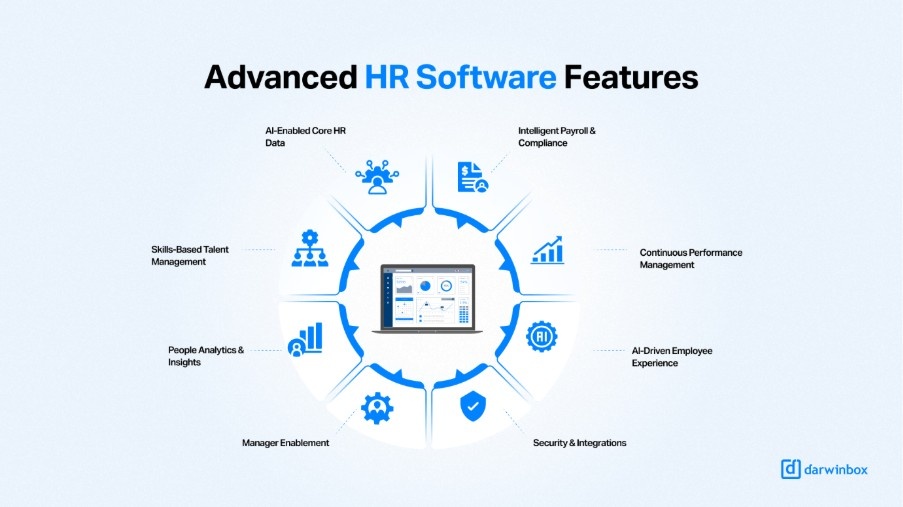
While foundational features are expected in any HR software, differentiation becomes visible when modern HR software contains these advanced capabilities.
AI-Enabled Core HR and Workforce Data Management
Unified global employee data forms the foundation for people intelligence. The system needs to validate data as it enters, flagging anomalies and surfacing missing records before they compound into reporting errors. Real-time workforce visibility allows HR leaders to access headcount, location distribution, cost allocation, and skills availability without generating a custom report each time. That shift from reactive data retrieval to continuous visibility improves workforce management.
Intelligent Payroll, Compliance, and Workforce Cost Control
Multi-country payroll is crucial for global enterprises. When a jurisdiction changes its tax rules or statutory leave requirements, the automated compliance system updates without needing further calibration. Workforce cost forecasting connects payroll data to headcount planning, so finance and HR share one cost model rather than reconciling two separate projections before every business review.
Skills-Centric Talent and Workforce Management
Skills gaps rank among the top workforce risks CHROs report year over year. A skills-capable platform does more than store self-reported competency data. It infers skills from performance history, project assignments, and learning completion, then maps that picture against future workforce requirements. Skills-based internal mobility becomes possible when the system can match open roles to employees whose demonstrated capability fits, without relying on job titles or tenure as proxies.
Continuous Performance and Goal Management
Annual performance reviews generate data once a year and influence decisions made twelve months apart. That cycle does not match how work actually moves, how teams form and dissolve, or how business priorities shift mid-year. Continuous performance management with OKRs tracked in real time and feedback loops that surface coaching moments, changes when those decisions happen. The system enables a manager to act on a performance signal in the current quarter.
People Analytics and Workforce Intelligence
Genuine workforce intelligence connects attrition signals, engagement trends, and succession risk in one leadership-ready view, and it surfaces where to act, not just where a problem has been detected. Trend analysis sheds light on workforce trends so that people analytics can be used for accurate workforce planning. The leadership-ready dashboards present these insights in a visual manner that’s easy for stakeholders to understand and take action.
AI-Driven Employee Experience and HR Service Delivery
The HR team uses conversational technology to help employees understand company policies and their current leave balances and upcoming payroll schedules. Advanced HR software handles regular operations and peak periods, which include benefits enrollment and year-end payroll processing. The system uses proactive nudges to predict areas of potential friction, which helps reduce support ticket creation and enhances the employee experience.
Manager Enablement as a Core HR Capability
Most platforms still treat managers as consumers of HR data rather than as decision-makers who need real-time support. Dashboards that surface team health signals, flag recognition gaps, and prompt specific actions give managers the context to act before a problem escalates. When manager enablement is one of the core HR software features, organizations can ensure proper execution of organizational strategy. Decentralized decision-making works when managers have the information and the confidence to use it.
Enterprise-Grade Security, Privacy, and Governance
As HR and IT accountability converge, data governance becomes a shared function rather than a siloed IT concern. Role-based access controls, full audit trails, and global data protection standards have become an important aspect of compliance infrastructure. A platform that cannot demonstrate where employee data lives, who accessed it, and when it was modified creates audit exposure that no analytics capability can offset.
Scalable, Modular, and Integration-Ready Architecture
API (Application Programming Interface)-first design is a baseline requirement for any enterprise platform sitting within a stack that includes ERP, finance, ATS (Applicant Tracking System), and LMS (Learning Management System). Modular adoption matters because HR maturity varies across organizations. An enterprise should be able to start with the capabilities it needs immediately and expand without reconfiguring what is already working.
How Modern HR Software Features Drive Measurable Business Impact
Features generate value through the decisions they enable, not through their existence on a pricing page. For a global manufacturing enterprise expanding into new markets, that means real-time analytics flagging skills gaps before hiring begins, automated compliance handling new jurisdiction requirements, and finance and HR working from one shared cost model instead of three separate reports. That impact runs across four outcomes that HR leaders are directly accountable for delivering to the business:
Faster workforce decisions: Real-time analytics reduce the gap between a workforce signal and a management response, replacing quarterly reporting cycles with continuous visibility that allows quicker actions.
Reduced operational risk: Automated compliance updates eliminate the manual monitoring burden that creates regulatory exposure in multi-country operations, removing the dependency on HR teams to track jurisdictional changes themselves.
Improved workforce visibility: Unified data across HR, payroll, and talent systems gives finance and HR a shared view of workforce cost and capability, ending the need for reconciliation that delays planning decisions.
Better HR-business alignment: When people analytics shows attrition risk and skills gaps alongside business performance metrics, HR contributes to strategic decisions rather than presenting data after them.
How Enterprises Should Evaluate HR Software Features
A Deloitte research (mentioned in an Unleash interview) found that while 59% of organizations take a tech-first approach, they are 1.6 times more likely to report that their investments aren’t delivering expected value. The key is to choose the right HR software. The evaluation frame is a set of questions about depth and design, not a checklist of features present on a pricing page. Ask the following questions while evaluating HR software:
Feature depth over count: Does the platform handle your most complex workflows, multi-country payroll, skills-based mobility, continuous performance with the same fidelity as its headline capabilities, or does complexity reveal shallow implementation?
Embedded AI versus add-on AI: Is intelligence built into core workflows, or does it require a separate license, login, and team to operate?
Global scalability and compliance: Does the platform update automatically when regulations change, or does compliance accuracy depend on a professional services engagement each time?
Configurability without customization cost: Can non-standard processes be handled through configuration, or does each one become a development project with a timeline and a change order?
Why Choose Darwinbox HRMS as Your HR Software
Darwinbox is a unified platform that enables seamless employee data handling, payroll processing, execution, and talent management activities. It offers workforce analytics through a single data layer that eliminates the need for reconciliation. AI capabilities are embedded across core workflows. For enterprises that need both operational reliability and workforce intelligence in one system, Darwinbox can prove to be a game-changer.
References
Unleash - Deloitte, Heidrick & Struggles and McLean reflect on HR in 2025, plus what must be top of the to-do list in 2026
FAQs
HR Software Features That Matter for Enterprises | Darwinbox
Explore the most important HR software features enterprises need today, from AI and analytics to compliance, scalability, and workforce intelligence.
What is AI in talent acquisition?
AI in talent acquisition uses smart tech to help with hiring tasks like screening CVs and matching people to roles, so recruiters can focus on human decisions rather than manual sorting.
What are the benefits of AI in talent acquisition?
AI makes recruitment faster, helps spot better matches from large applicant pools, and can reduce bias by focusing on skills and relevant experience rather than first impressions.
What are the challenges of AI in talent acquisition?
AI can carry bias from its data, struggle with soft skills and cultural fit, and needs strong oversight to avoid unfair outcomes or legal issues in hiring.
Is AI recruitment technology suitable for all organizations?
AI tools can help many organizations, but smaller teams or highly niche roles may still need strong human judgment to balance fairness, accuracy, and culture fit.