
Summary
“AI-native” has become a common claim among HCM vendors. It is often applied to AI-powered systems, which are existing platforms with AI features added. What separates the two is not how many AI features a product has. It is how the product is built: whether AI was added to an existing platform or designed in as its foundation. That architectural choice determines what the system can deliver. An AI-powered system makes existing HR processes faster. In an AI-native system, AI understands the organization well enough to connect signals across different processes and to recommend, or take, the next best action.
HR leaders evaluating HCM platforms should test vendor claims against architectural criteria rather than product messaging. This article defines both categories, compares them across ten dimensions and sets out how to apply that comparison in a vendor evaluation.
Definitions
AI-powered HCM is an existing HCM platform with AI capabilities added, such as copilots, resume screening or conversational HR service. These capabilities speed up individual tasks within modules and workflows that predate them. The underlying process design (task ownership, sequence and decision authority) does not change.
AI-native HCM is an HCM platform whose data model, workflows and permissions are designed around AI as the organizing principle. It monitors signals across the organization, interprets them against that organization's own history and policies, and acts within boundaries the organization defines.
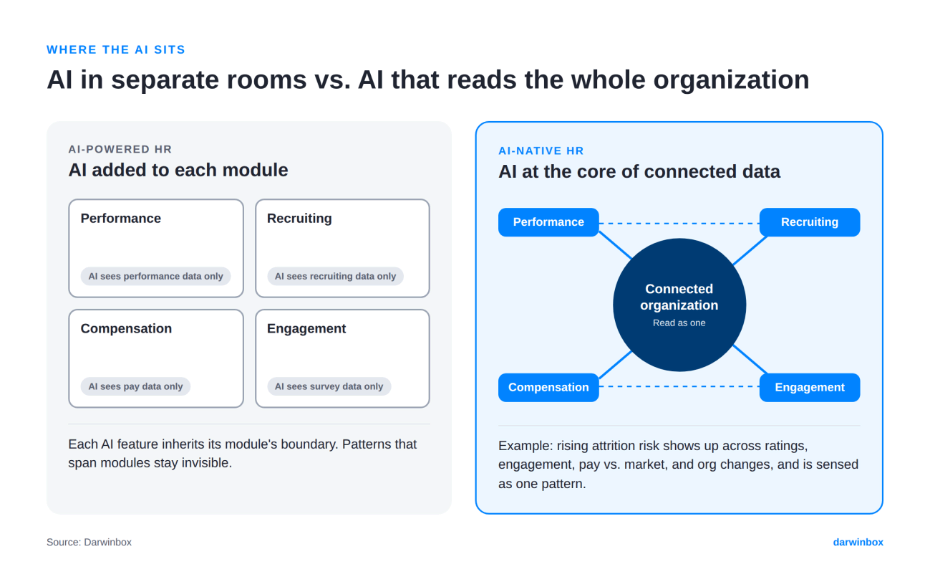
The distinction is categorical, not incremental. Adding features to an AI-powered platform does not make it AI-native, because the limiting constraints sit in the architecture. If recruiting, performance and pay data are kept in separate parts of the system, for example, no feature added later can see the full picture across them.
Most enterprise software buyers have already piloted simpler AI-powered use cases, such as drafting job descriptions or agents answering policy questions, and seen efficiency gains. Few have seen transformational value. Their next wave of investment will go to AI that helps rework the operating model itself, not AI that delivers only incremental gains.
Gartner projects that by 2030, software companies that layer bolt-on AI over legacy applications, rather than redesigning for agentic execution, will face margin compression of up to 80% (Gartner, April 2026).
What building an HCM with “AI as the core principle” means in practice
In an AI-powered system, AI is an afterthought: the platform was built for people to operate manually, and AI was fitted in later. An AI-native system starts from a different design question: what does AI need in order to do its job well and multiply the impact of the people who work with it? Every decision about how the system is built, from what data it collects to how information flows and who can act on what, follows from the answer. That answer has three parts.
Visibility across the whole organization. Workforce signals rarely sit in one place. A team's rising attrition risk shows up across performance ratings, engagement scores, pay relative to market and recent org changes, typically held in four modules never designed to be read together. A system that reads across all of them can put the full pattern in front of an HR business partner early enough to act on it.
Company-specific context. The same signal means different things in different organizations. A spike in sales resignations may be a seasonal pattern tied to commission cycles in one company and an early sign of a manager-driven exit in another. The system learns the difference from the organization's own history and from the people who know it best, so the insight it gives HR fits that company rather than an industry average.
A governed way to act. Insight creates value only when it becomes action. An AI-native system drafts recommendations for HR to decide on and handles routine, well-defined tasks within limits HR leaders set. Every action is scoped, logged and reversible, and the system's remit grows as its record earns trust. HR's time goes to the judgment calls; the system handles the legwork.
How does the operating model change?
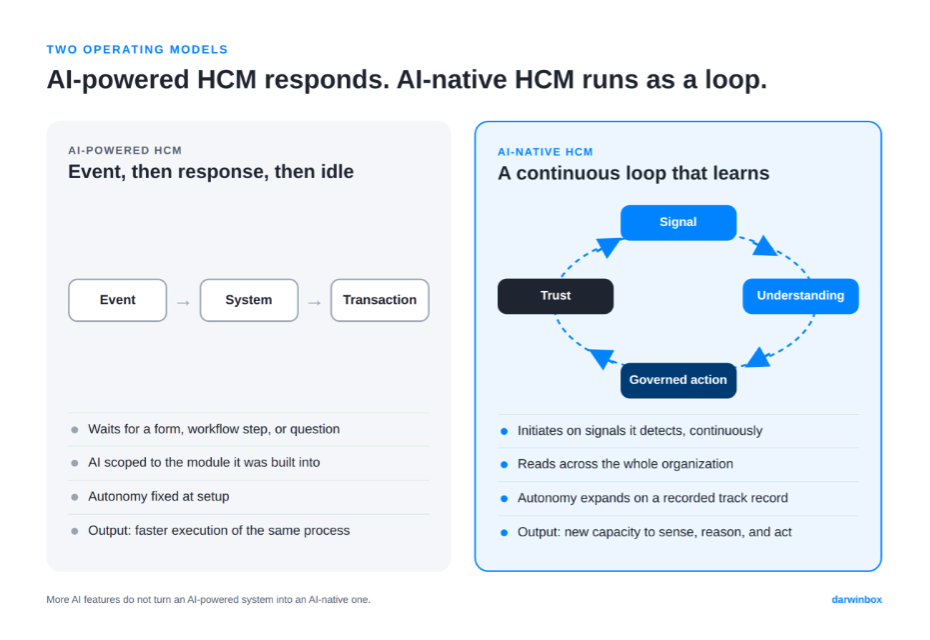
Traditional HCM follows a simple sequence: event, system, transaction. Something happens, the system responds once, and then it sits idle.
AI-native HCM works as a continuous loop with four stages:
Signal. The system keeps watching activity across the organization, much like an attentive manager who senses something is off before anyone says a word.
Understanding. Each signal gets reasoned against the organization's own history and policies.
Governed action. The system acts inside the boundaries the organization has set.
Trust. Every action leaves evidence of whether it worked or needed a person to step in, and that evidence widens or narrows what the system can do next.
In the traditional model, permissions stay fixed until someone reconfigures them, and nothing the system learns from one cycle carries into the next. In the AI-native loop, every outcome is recorded, and that track record gives the organization the evidence to expand or narrow the system's authority over time.
Analogy: AI systems used in cars today.
Many cars carry driver-assistance features added one at a time: a parking sensor that beeps, cruise control that holds a set speed, a camera that warns about lane drift. Each has its own sensor and one narrow job. None shares what it sees with the other, and none learns.
The driver receives a stream of disconnected alerts and has to piece the picture together. That is AI bolted on.
Now consider a car designed from the start around what the driver needs to drive well. Its cameras, radar and navigation feed one shared view of the road, and its systems act on it together. Cruise control reads the map and slows before a bend the driver cannot yet see. Lane assist holds back when a vehicle is closing in the next lane. The system also knows this car and driver: the weekly routes, the driver's cornering habits, how the car handles fully loaded. Every trip sharpens that understanding, and hazards reported by other vehicles reach the driver before the car gets there.
Systems that share what they see, and a learning loop that improves each decision: that is AI-native connected intelligence. The driver still makes the calls, each one better informed.
AI-powered HCM vs. AI-native HCM: A side-by-side comparison
The two categories differ on ten dimensions. The consistent pattern is that AI-powered systems respond to explicit requests, while AI-native systems initiate action based on signals they detect.
| Dimension | AI-powered HCM | AI-native HCM |
|---|---|---|
| Starting point | AI added on top of existing workflows | Architected from the outset around AI-driven sensing, reasoning and action |
| Trigger for action | Waits for a form, a workflow step or a question | Initiates on signals it detects on its own, continuously |
| Relationship with the user | Event-driven: responds once, then goes quiet | Two-way exchange: ongoing and proactive |
| Where it lives | Users must log in and seek it out | Present inside the tools people already use for work |
| Data visibility | Scoped to the module or workflow the AI feature was built for | Connected across the organization by design |
| Understanding of context | Generic rules or benchmarks applied uniformly | Interpreted against that organization's own history and patterns |
| Scope of intelligence | Answers the specific question it was asked | Notices patterns and risks nobody has asked about yet |
| Autonomy | Fixed at whatever level was configured at setup | Expands over time as the system earns trust through a track record |
| Governance | A permissions layer applied on top of existing workflows | Built into the architecture; every action scoped, logged and reversible |
| Outcome for the organization | Faster execution of the same process | A structurally different capacity to sense, reason and act |
Recommendations for HR leaders
Use the table as an evaluation scorecard. For each dimension, classify the vendor's product as AI-powered or AI-native based on demonstrated capability.
1. Require demonstration, not description. Classify each dimension based on live product behavior, preferably on data representative of your organization. Marketing materials and roadmap commitments should not count toward the score.
2. Prioritize the three architectural dimensions. Some dimensions can be added to an existing platform within a normal release cycle, such as in-workflow delivery (where it lives) or proactive notifications (trigger for action). Data visibility, governance and autonomy are determined by the underlying architecture and are costly to change. Weight these most heavily and ask:
Data visibility: Can the system produce a single output that draws on two or more modules, such as recruiting and performance, without manual data consolidation? Request a specific example.
Governance: Is every autonomous action scoped, logged and reversible by default? Request the audit trail for an action the system took without human initiation.
Autonomy: What determines the scope of actions the system may take, and on what evidence does that scope change over time?
3. Classify mixed results as AI-powered. A product that meets AI-native criteria on interface dimensions but AI-powered criteria on architectural dimensions is an AI-powered system with an updated interface. Evaluate its cost, implementation plan and expected outcomes on that basis.
4. Define the required outcome before evaluating vendors. The final dimension, outcome for the organization, should drive selection. If the objective is faster execution of existing processes, an AI-powered system may be sufficient and lower in cost. If the objective is early detection of workforce risks such as attrition or compliance drift, an AI-native architecture is required.
Conclusion
“AI-native” describes how a system is built, not which features it offers. Buyers should validate the claim against the data model, governance design and autonomy model, not the user interface.
Darwinbox Cortex is built as an AI-native HCM on a connected context graph, with governance and earned autonomy designed into its architecture. Explore Darwinbox Cortex