Employee-centric culture puts employees first; it drives engagement, retention, and business growth, fostering a positive work environment. Effective organizations must develop a culture where employees feel valued, heard, and empowered.
Organizations need to focus beyond employee engagement. An employee-centric company cultivates a framework based on “What is most important to the people” for enhancing employee experience (EX), creating a competitive advantage. Employee experience-centric companies are 4.5 times more likely to be ranked on the Most Innovative Companies lists.
Read on to learn about employee-centric culture, its elements, advantages, and effective strategies for enhancing EX.
What is an Employee-Centric Culture?
A people-first culture places individuals at the forefront of how a company functions. It means every procedure, decision, and policy is created with one question in mind: what's best for our people? It doesn't imply sacrificing business objectives. It involves understanding that sustainable growth, innovation, and performance can only be achieved when employees feel respected, listened to, and cared for.
An employee-centric culture creates a work environment in which employees aren't merely viewed as assets; they're viewed as internal customers, bringing many benefits. Their experience is as important as the customer's experience.
From leadership to team structure, recognition, and communication, everything is designed to build trust, drive engagement, and foster a sense of belonging.
Core Principles and Characteristics
An employee-first culture is based on several core principles:
Mutual Trust: Staff trust leaders to act with integrity. Leaders trust staff to get the job done without micromanaging.
Transparency: Important decisions, shifts, and priorities are shared openly without spin.
Inclusion: All feel seen, heard, and respected regardless of role or background.
Ownership: Individuals have the ability to make decisions and own outcomes.
Recognition: Effort, ideas, and impact are recognized on a regular basis, not only in annual reviews.
Employee Centric vs Traditional Culture
Let’s break down how employee-centric cultures differ from traditional ones:
| Traditional Culture | Employee Centric Culture |
|---|---|
| Top-down communication | Two-way, transparent communication |
| Productivity-focused | People-focused, with productivity as the outcome |
| Standardised policies | Flexible, personalised support |
| Annual reviews are the main feedback loop | Continuous feedback and growth conversations |
| Benefits are treated as costs | Benefits are treated as an investment in people |
| Culture as HR’s responsibility | Culture is owned by leadership and employees together |
What Are the Benefits of an Employee-Centric Culture?
An employee-centric environment creates satisfied employees and supports strong morale. It also generates quantifiable business value. Here's what placing employees at the centre really produces:
More engagement and motivation: Individuals who feel trusted and listened to perform better in their jobs. Higher engagement gives rise to greater initiative, ownership, and cooperation.
Less attrition and more retention: A culture of support prevents burnout and boosts employee engagement. This saves on recruitment expenses and retains talent.
Improved customer experience: Happy staff contribute to a better customer service experience. Happy teams create loyal customers.
Increased productivity and performance: Staff do their best in an environment that trusts them. Less resistance leads to faster delivery and improved results.
Increased innovation and responsiveness: An employee-centric culture builds psychological safety and openness. People are more willing to share ideas, challenge norms, and try new things.
Stronger employer brand: Candidates want to work where people thrive. When an employer cares about its people with a people-first culture, the company attracts talent, improves referrals, and enhances reputation.
5 Essential Strategies to Build an Employee-Centric Culture
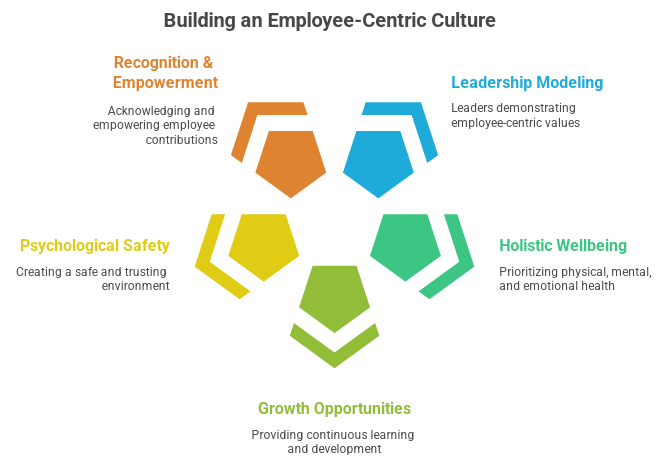
Building an employee-first company culture requires more than good intentions. It requires intentional leadership, systems-level transformation that values people as much as their performance and deliveries. The five approaches outlined below are crucial for building a genuinely people-first organisation.
Leadership That Models Employee-Centricity
Leadership is the cornerstone of any people-first workplace. Leaders' behaviors directly impact employees' engagement, performance, and actions. Ethical and transparent leadership earns credibility. Employees respect leaders who operate with honesty and share information openly, even in difficult times.
Humility and empathy in leadership demonstrate that employees' needs are important, not merely business outcomes. Active listening and participative decision-making show respect for employees' views and encourage a feeling of ownership.
Instead of controlling, employee-first leaders guide and mentor
Instead of issuing commands, they ask questions
Encourage risk-taking and learning in preference to perfection
Get rid of blockers rather than micromanaging results
This kind of leadership builds a more actively engaged, empowered, and energized workforce.
Prioritizing Employee Wellbeing Holistically
A people-first company embeds wellbeing in the culture. Anonymous feedback loops and pulse surveys enable you to see how people are faring and where they're lagging. Begin with the entire wellbeing spectrum, including:
Physical wellbeing: Health insurance, ergonomic offices, wellness programs
Mental health: Therapy access, burnout relief, mental health days
Emotional safety: A culture in which staff feel safe, not judged
Enable work-life balance by making flexibility the norm, not a special perk.
Get leaders to role-model healthy boundaries, no pings after work, no expectations to be "always on."
Design policies through employee life stages, parental leave, eldercare, or sabbaticals.
An organization that invests in wellbeing sends the message that it prioritizes people and not relies only on productivity metrics.
Continuous Growth & Development Opportunities
Growth is paramount in people-focused organisations. Without it, employees lose motivation even when all else seems right.
Begin by establishing a clear foundation:
Clear career paths for every job so that employees know what growth means to them
Internal mobility practices that foster movement from job to job or department to department
Ongoing development dialogue linked to both employee objectives and business requirements
Back this with a strong learning infrastructure:
Personalized learning systems that adjust to skill deficits and career goals
In-workplace mentoring and coaching to implement learning in the moment
Inter-functional projects that enable employees to develop new skills
Prioritize development as part of your culture, not just linked to annual reviews. Employees who experience long-term career value are more loyal, more driven, and more engaged in the firm's purpose.
Establishing Psychological Safety and Trust
Psychological safety is the distinction between workers who remain quiet and those who share ideas, feedback, or questions.
Here's what builds it:
Dissenting leaders who accept criticism without penalizing workers for not going along
Chances for open talk, including town halls, listening opportunities, or anonymity
Feedback loops that actually result in tangible action
But communication is only half of it. Inclusion and representation are important. A diverse workplace only succeeds when every voice is heard, valued, and taken seriously.
Decision-making fairness creates trust, particularly in areas like promotions, workload, and praise. Mistake tolerance allows employees to experiment and engage in constant learning. Where there is trust, engagement is sure to follow. Employees give generously, work better in teams, and become active catalysts of the organisation's success.
Recognising, Rewarding and Empowering Employees
Recognition can drive motivation, but only if it's timely, specific, and personalized.
Break away from normal incentives:
Customized recognition programmes that are based on what really matters to people
Peer-to-peer recognition platforms to build a culture of gratitude
Public recognition for effort, not only results
Reward systems should reflect values as much as performance outcomes. That might include:
Rewarding teamwork as much as sales victories
Recognizing unseen work, such as mentoring or inclusion efforts
Offering development opportunities rather than pure bonuses
Empower employees with autonomy to complete their jobs and take ownership. Provide employees:
Control of projects and results
Authority to make decisions within their purview
Access to the right tools and freedom to fix things their own way
When employees feel both valued and empowered, they become not just task executors but change-makers. And that transformation drives real, long-term business success.
Integrating Technology to Support Employee-Centricity
Technology is instrumental in making the workplace more employee-centric. It enhances, rather than replaces, human connection. The appropriate HR technology can enhance collaboration, individualize learning, and empower staff to have a greater voice.
Technology, when paired with human values, works towards creating a culture that listens, adapts, and empowers. It ensures continuous learning with automated feedback loops like pulse surveys and eNPS tools. They identify issues early and provide the full picture of employee sentiment.
AI-powered personalization helps drive employee satisfaction with development, rewards, and wellbeing initiatives. Employees are given learning suggestions based on their career aspirations, not only their job roles. Platforms now adjust to employee taste, acknowledging individual needs throughout personal lives, work scenarios, and career phases.
Darwinbox For an Employee-Centric Organization
Darwinbox shows the potential of a single platform to enable a genuinely employee-centric organization. It stitches together HR functions throughout the employee lifecycle with people at the centre.
Key features are:
An integrated talent management system that provides goal setting, performance assessment, and career advancement in a single location.
Employee engagement tools such as pulse surveys, rewards programmes, and wellness check-ins are part of the platform.
Real-time analytics dashboards to monitor engagement, manager performance, and employee wellbeing trends, providing HR teams with a clear line of sight into what truly matters.
Support for the hybrid work model, enabling employees to stay connected and productive regardless of location.
Capabilities that enable managers to manage with empathy, recognize employees in real-time, and make data-driven decisions.
By connecting technology with employee-centric leadership qualities, Darwinbox reinforces trust and transparency throughout the entire organisation.
Overcoming Common Implementation Challenges in Creating an Employee-Centric Organisation
Implementing an employee-centric culture frequently falters as a result of resistance, misalignment, or lack of consistent follow-through. Here's how to overcome the most typical obstacles:
Resistance from Leaders
Employee centricity can't thrive without leadership buy-in. Leaders need to align their business strategy and demonstrate behaviors that reinforce empathy, trust, and transparency.
What to do:
Align leadership on the business value of engaged employees.
Embed employee-centric leadership behaviors through coaching and accountability.
Exchange information and illustrations connecting people-first practices with business growth.
One-Size-Fits-All Approach
Off-the-shelf programs don't. Employees demand relevance and customization.
What to do:
Conduct pulse surveys to uncover authentic needs.
Provide customized learning, wellness choices, and rewards.
Customize support by role and life.
Poor Communication and Low Trust
Without transparent communication, employees are excluded from decision-making. Trust is lost quickly.
What to do:
Maintain open communication and regular updates.
Take feedback seriously and act on it.
Train managers to hear and respond with sensitivity.
Wrong or Misused Tech
Technology is to simplify, not to confound problems. Misaligned tools slow progress.
What to do:
Select employee-first platforms such as Darwinbox.
Make tools user-friendly, mobile-enabled, and integrated.
Use technology to give real-time insights, not dashboards.
Lack of Accountability
When nobody owns employee centricity, culture gets diluted.
What to do:
Tie culture metrics to leadership performance.
Ingrain core values into reviews, recognition, and decisions.
Monitor progress and highlight wins on a regular basis.
Sustaining an Employee-Centric Culture Over the Long Term
Once implemented, the employee-centric culture must continue to motivate employees and drive business success. Long-term success requires ongoing effort, alignment, and the right tools, making employee centricity a top priority.
Here's how businesses can maintain a sustainable employee-centric culture over time:
Make employee centricity a strategic priority: Link engagement and wellbeing goals with core business goals. Engage leadership and invest resources.
Take action on employee feedback consistently: Leverage pulse surveys, exit interviews, and frequent check-ins. Close the loop by taking action.
Evolve to changing employee needs: Update work arrangements, career development plans, and wellbeing support as your workforce evolves.
Embed values in leadership: Celebrate leaders who model active listening, inclusivity, and people-first behaviors.
Choose the right HR tech: A platform like Darwinbox provides real-time visibility into engagement and satisfaction trends, making it easier to act quickly.
Conclusion
An employee-centered culture is rooted in trust, steady action, and leadership that values employees’ opinions and ideas. When corporations listen deeply, act wisely, and empower people at all levels, they create happy employees and build more resilient organizations.
With the optimal combination of leadership behaviors, wellbeing initiatives, and opportunities for growth, companies can establish a workplace where employee engagement is more than an initiative. It can become a default standard with HR technology such as Darwinbox.
Culture doesn't only define performance. It determines how employees feel each day. That's where loyalty starts. That's where long-term success originates.
FAQs
How is a people-first and employee-centric culture different?
While both emphasize employee valuing, a people-first culture tends to address more general human needs, such as customers and communities. An employee-centric culture tends to specifically focus on creating systems and environments for meeting employees' needs throughout their life cycle in the company.
Can small businesses build an employee-centric workplace without big budgets?
Yes, most employee-focused practices, such as open communication, flexible work schedules, and personalized feedback, need company-level changes, not huge investments. Listening and following through based on ideas from employees count more than costly programs.
How does employee centricity affect employer branding?
A robust employee-centric culture sends the message to potential recruits that the business truly cares about its people. This tends to mean better feedback, increased referral levels, and reduced difficulty recruiting best-in-class talent for competitive sectors.
Are there dangers in going too employee-centric?
Without balance, over-emphasizing employee desires might cause diluted accountability or detraction from business objectives. It's crucial to couple empathy with performance expectations and firm boundaries.
How do leaders quantify whether their organization is becoming more employee-focused?
Monitor employee satisfaction, retention, internal mobility, and engagement in feedback loops. Combine quantitative data (e.g., eNPS) with qualitative feedback from exit interviews or listening sessions to gain a full picture.