A future-ready talent management base needs skills and AI integration. Build a central skills repository, generate bias-free job descriptions, map skills to roles at scale, and create a complete career architecture to unify talent management processes.
Conventional talent management systems have become ill-equipped for modern workforce needs. Job titles and rigid roles can’t keep up with evolving skills requirements. According to LinkedIn’s 2025 Workplace Learning Report, up to 94% of employees would stay longer at an organization if it invested more in their career development. Yet most talent systems don’t really link learning to actual business needs and skills data.
This lack of skills data weakens core talent processes. Performance management, learning, succession, and workforce planning often live in silos, which makes it harder to deploy talent efficiently.
Employees expect growth, access to skill development, and decisions to be taken based on skills. A skills-based, AI-enabled talent management solution can serve as a foundation to address these expectations.
Meeting these expectations calls for a structural reset in how talent data is defined, connected, and used across the organization. This article shows the problems in conventional talent systems: how HR leaders can use skills-based talent management to enhance visibility and develop a future-ready talent ecosystem.
Conventional Talent Management System is Built for Stability
A conventional talent management system manages the talent lifecycle in isolation. In a challenging labor market with rapid technological disruption and evolving skills, focusing on stabilizing talent management is not the right approach. Traditional approaches to talent management systems can hold back organizational growth in the following ways:
Annual performance reviews miss rapid change: Once-a-year performance evaluations don’t cater to real-time skills needed in dynamic workplaces. Not paying attention to recent skill changes and needs hinders progress.
Siloed learning: In traditional talent management systems, learning operates separately from performance and workforce needs, leading to skill development that isn’t aligned with upcoming roles or business priorities.
Succession based on tenure: Traditional succession planning pays attention to seniority instead of capabilities. Specialized skills necessary for future leadership may not be developed in future leaders, and this impacts readiness planning.
Hiring driven by job titles: Job descriptions and past titles are static, but roles in the modern workplace evolve faster than titles. With skills-based hiring on the rise, recruitment and hiring should not be restricted by conventional processes that focus on job titles.
Workforce planning based on headcount: Workforce planning is not just about the number of available resources for a task. Rather, it should focus on skills needed and skills available so that the necessary skills can be imparted rapidly. Conventional talent management doesn’t support capability-based planning.
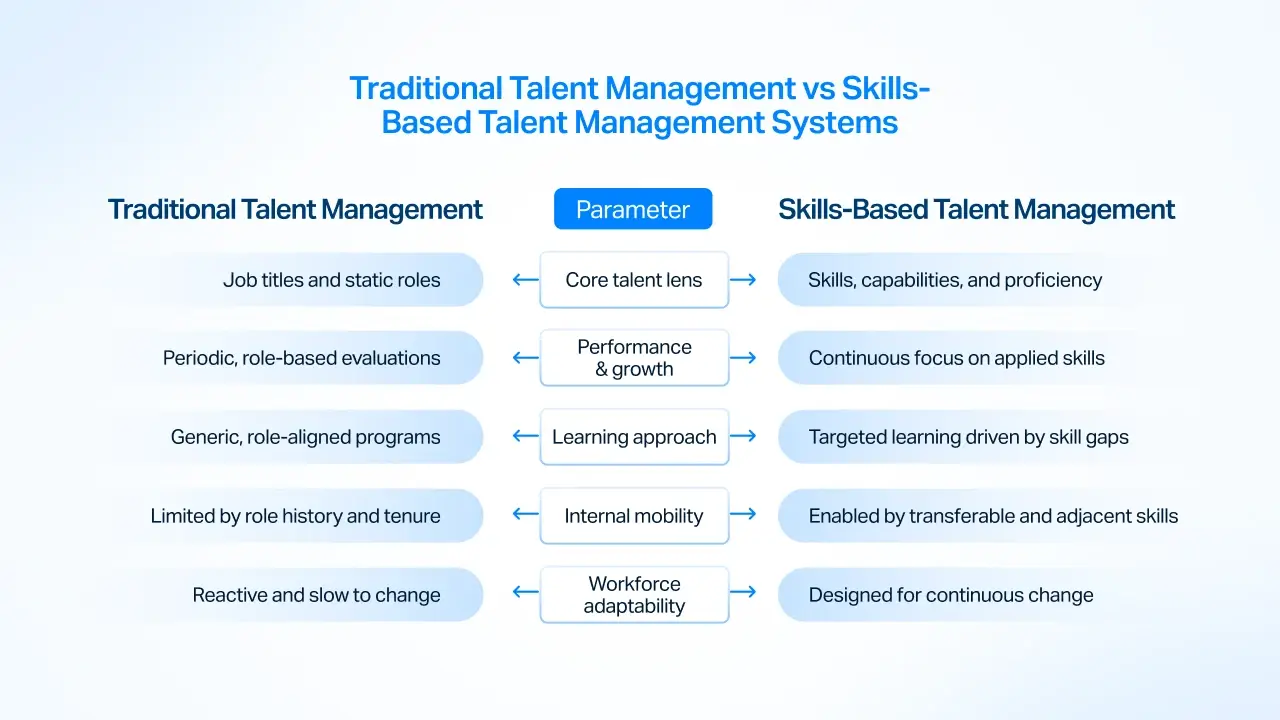
Workforce models are shifting from static job descriptions and linear career paths as skills-based talent management takes the center stage. Legacy systems aren’t built to continuously identify skills, build essential capabilities, and redeploy talent as work needs evolve.
From Roles to Skills as the Talent Currency
Role-based talent management works for organizations where work changes slowly with predictable career paths. However, roles evolve continuously, and employees are expected to develop varied skills to complete a task. For example, a product manager has to know about data analysis and customer experimentation to estimate product fit. These changes in skills don’t reflect directly in the role definition. When performance assessments refer to outdated expectations, real-time capabilities can’t be developed.
Employees with transferrable or adjacent skills remain invisible because their current roles don’t match predefined criteria. This slows down internal mobility, leaving organizations incapable of deploying existing talent. As a result, hiring costs increase, and employees don’t find growth opportunities.
Skill-centric systems work on the principle that two people at the same level may need different development paths, based on the work they perform and the direction the business takes. Skills-based development initiatives support employee growth by offering a direction based on people’s capabilities.
When skills become the talent currency, performance discussions center on actual employee contribution. Learning efforts can be aligned with real-time skill gaps, and mobility discussions focus on talent readiness. Succession planning becomes capability-based training based on the future business needs.
Organizations that move towards skills-based talent management can build an agile workforce where every employee is visible, and their contributions are valued and recognized. That is how an efficient talent management base can be built.
Why Skills & AI Are Now the Core of Talent Management
Fragmented talent systems occur because of the absence of a common skill framework. When the organization does not have a shared ‘skills language’, talent discussions become guesswork, and decisions are often taken based on subjective views.
A skills taxonomy is a structured framework that organizes, defines, and classifies skills within an organization in a clear, standardized way. It provides HR with a single source of truth that can bring alignment to goals, expectations, and development tracks across the organization. Using AI for talent management makes it possible to ensure consistency across roles and skills at scale.
In a Deloitte 2025 Global Human Capital Trends report, 70% of managers and employers agreed that they prefer employers that help them thrive in the AI-driven world. This requires conscious efforts from an organization to build future skills.
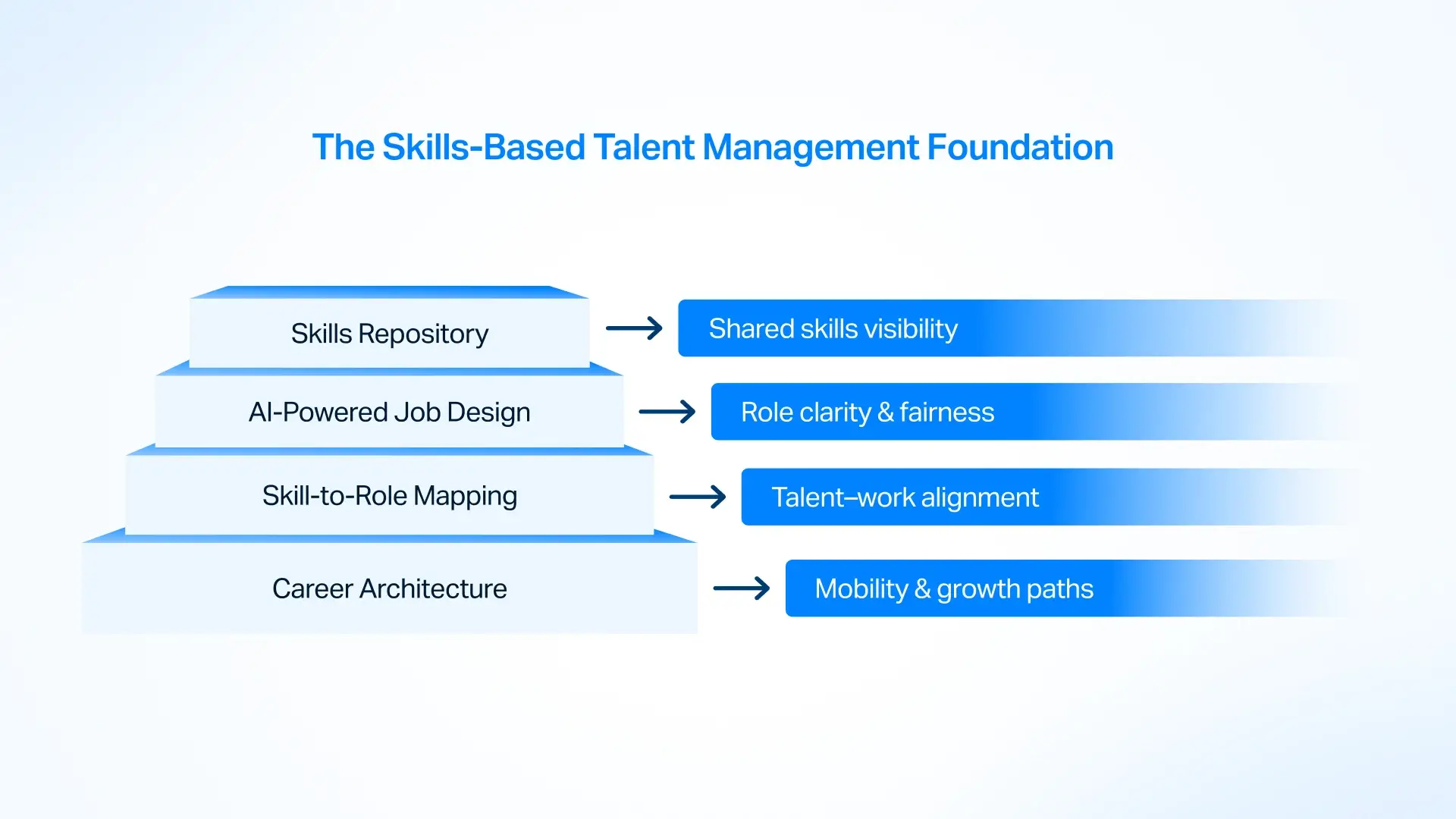
The following four fundamental steps demonstrate how HR leaders can leverage skills and AI to create a connected, scalable talent management foundation.
Step 1: Building a Hyper-Contextual Skills Repository
A skills repository is a comprehensive and organized collection of all the skills an organization currently needs and will need in the future. It serves as the foundation for performance management, learning alignment, career movement, succession planning, and workforce forecasting.
Without a single skills data source, each business function has its interpretation of roles and related skill sets, which could result in hold-ups in hiring, training, and planning for the workforce.
This challenge is being tackled by AI that can parse existing job descriptions, candidate profiles, and assessments to define skills. It can also recommend which skills are missing or are emerging (based on market trends) and align skill definitions across teams and geographies.
This automation reduces the manual effort and the need for external consultants. Instead of spending months on workshops and Excel spreadsheets, teams can now establish an accurate skill backbone in weeks with AI.
Step 2: Generate AI-Powered, Bias-Free Job Descriptions
Job descriptions are much more than just advertisements for outside recruitment. They express expectations, define roles, and provide a benchmark for performance and growth. When they are inconsistent or stale, all downstream talent management processes are impacted.
AI can:
Rewrite thousands of job descriptions in no time.
Use uniform language and structure.
Remove subjective judgments/biased statements, making it more objective.
Emphasize key skills a person needs to be successful today and in the future.
For example, modern AI-powered recruitment platforms can develop or enhance job descriptions and link them to your skills taxonomy. The outcome of this exercise is defining roles that can be ready for the future, aligned internally, and transparent to employees. Both external hires and internal mobility benefit from it.
Step 3: Intelligent Skill Mapping to Roles at Scale
Mapping skills to roles connects workforce supply and demand for the business. It indicates what skills a role requires and how people fit those needs. This transparency is critical for accurate assessment of performance, focused learning for internal mobility, and succession programs.
Manual mapping does not scale and collapses quickly. It is slow, team-specific, and resource-intensive to keep up to date when roles change. Manual updates become unmanageable as the organization grows, and stale insights lead to poor talent decisions.
AI lifts this hurdle. It automatically assesses requirements for roles, aligns them against a master database of skills, and pinpoints skill gaps and developing skills. Since priorities really differ among different businesses, this keeps them current on definitions of new roles.
The automation enables more timely, more accurate insights into talent at scale. AI-powered HR Analytics, according to research in 2025, has reduced the time to hire by over 51.1% and improved the quality of the appraisal by 50.8%. This points out that using automated skill mapping helps improve key talent management decisions.
At scale, skills-based talent management systems embed skill-to-role mapping directly into core talent workflows. As roles evolve, skill requirements stay aligned to a centralized skills taxonomy, enabling consistent, system-driven decisions across hiring, mobility, learning, and succession.
Step 4: Build Scalable Career Architecture for Mobility & Growth
Career architecture is a framework that defines how roles, levels, skills, and career paths are organized across an organization. It provides clarity on how people grow, move, and progress, both vertically and laterally, based on skills, impact, and readiness, not just tenure or titles.It provides clarity to the extent that the employee understands what they have to do today and what they may do tomorrow.
Mobility happens inconsistently when there is no clearly defined career path. Workers can’t see future options, and managers have to make decisions subjectively. Internal movement becomes limited, and it can lead to a higher turnover over a period of time.
AI is capable of assessing skill sets, the relationship between roles, and trends related to skill set progression. This helps create meaningful paths, which stay synchronized whenever roles evolve.
This can provide organizations with the ability to maintain consistent skills-based career paths for all. Employees will know what roles they can be promoted to and what skills they should build up to do so, while HR will have a structured, data-informed view of internal mobility and workforce planning.
For a reliable talent management system, skills, roles, job design, and career paths must live in one system. Setting up this core talent management system calls for a platform that can operationalize skills at scale. That is why Darwinbox is designed to deliver.
How Darwinbox Enables Organizations to Set Up The Talent Management Base
Darwinbox provides the scale and accuracy required for a skills-based talent management approach. It identifies and extracts skills from job descriptions, resumes, learning data, and performance records, and relates them to roles and proficiency levels. That replaces manual skills analysis, job refreshing, and role mapping, cutting down on the work that once required months to weeks.
Darwinbox offers skills foundation with the AI-driven Skills Ontology, a living system with over 40,000 skills across 70+ domains. The Darwinbox Skills Engine keeps skills aligned with organizational needs, evolving roles, and industry changes, creating a shared, up-to-date skills language across the enterprise.
Darwinbox Sense embeds skills intelligence across the talent lifecycle. It assesses current workforce competencies against future role needs to highlight skill gaps, suggests focused learning initiatives, and identifies internal talent matches for mobility and succession.
As skills are ingested, Darwinbox automatically maps them to roles with defined proficiency levels. Role-level mapping ensures that skill expectations are established from the start.
In Darwinbox, career architecture is built as a system layer, connecting roles, skills, and movement rules. Explore how organizations are operationalizing skills-based talent management with Darwinbox.
FAQs
How can HR leaders make use of AI for skills setup?
Start simple: Enter a job description into Darwinbox Sense, and it will automatically create a custom skills library from your data in weeks. Review and refine; before long, you can link performance to training directly. This saves time and aligns teams based on skills.
What ensures fair, forward-looking AI job descriptions?
AI eliminates bias using neutral benchmarks from your skills framework and embeds future needs, such as AI competencies. This way, there are clear expectations for everyone, so hiring and internal mobility can happen more quickly without vague or outdated postings.
Why automate skills-to-role mapping?
Manual role mapping does not scale and gets old fast. AI matches very well; it finds gaps and offers solutions, cutting hiring time by 50%. This enables objective decisions for performance, mobility, and succession using real and current data.
How does career architecture enhance retention and mobility?
Defined growth paths that support employee development foster loyalty. Paths are defined in visual form by AI as upward, sideways, or even diagonal movements based on skills. It provides exposure to all internal roles to employees. This enables employees to develop their skills and grow within the organization, reducing turnover.
How can HR prepare the workforce for artificial intelligence in 2026?
To prepare the workforce for 2026, HR's priority is to focus on skills instead of roles. AI offers ontologies, mobility options, and real-time insights. This brings agility to dynamic changes and allows HR to focus on strategic coaching rather than on mundane tasks.