TL;DR
Manual HR fails at scale and HR process automation brings speed and accuracy.
Automate onboarding, payroll, recruitment, performance, compliance, and more.
HR workflow automation connects systems and removes email approvals.
AI adds insight for hiring, retention, and skills planning.
HR process automation results in better compliance, faster decisions, and stronger employee experience.
Introduction
Businesses that overlook HR process automation face difficulties when their organizations scale, which creates more complex work environments. HR teams must create smooth employee experiences while meeting changing legal requirements and running their operations with fewer staff members. Manual HR systems cannot handle the advanced requirements of contemporary workplaces.
Organizations need to introduce HR workflow automation because it has developed from a basic operational improvement into an essential requirement for strategic operations. An IBM report demonstrates that HR automation delivers a 35% increase in productivity, while training effectiveness improves by 30%, and employee retention rates rise by 20%. This blog identifies ten main areas in which HR process automation enhances operational efficiency.
Why HR Process Automation is a Priority for Modern Enterprises
The manual HR process becomes unworkable when enterprise HR reaches its operational capacity. HR teams experience operational difficulties and risk management challenges that arise from headcount growth across different business units and locations. These include:
High-volume transactions involving repetitive tasks overwhelm HR teams.
Different Human Resource Information Systems (HRISs), payroll systems, recruitment systems, and learning systems create separate data, which prevents organizations from achieving an all-inclusive employee overview.
Organizations face compliance risks because they fail to meet regulatory deadlines while applying their policies in an inconsistent manner across various regulatory frameworks.
Human decision-making processes experience delays because organizations need to wait for report delivery after completing manual approval processes.
HR automation eliminates manual workflows with rule-driven processes to enhance accuracy, efficiency, and insight generation. It maintains consistency at scale, ensuring stronger compliance and fast execution. Nearly 60% of HR leaders report that AI automation improved talent acquisition, reducing bias and accelerating hiring, according to a Gartner report.
10 HR Processes to Automate for Enterprise Impact
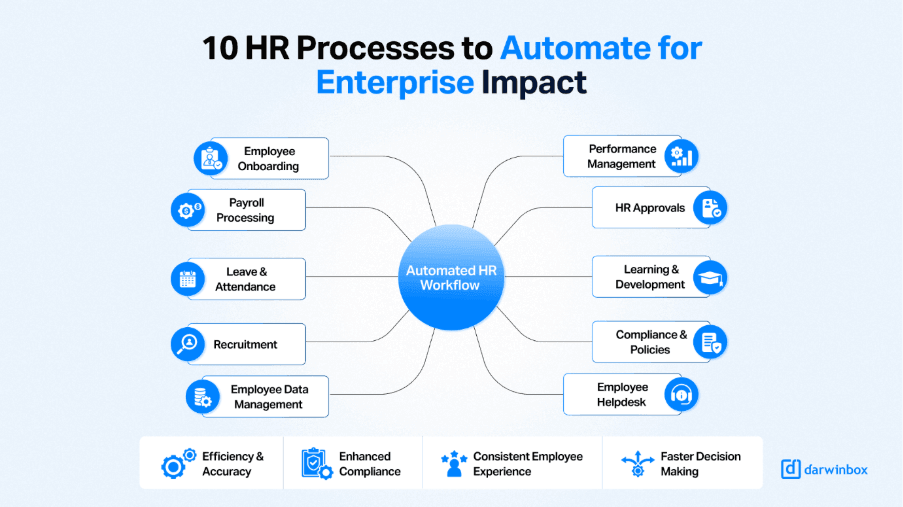
Automating the HR process becomes crucial to manage complexity, especially when the enterprise scales. Automation improves efficiency, ensures compliance, and delivers a consistent employee experience in the entire workforce. Here are the 10 HR automation processes for measurable enterprise impact.
Employee Onboarding
Employee onboarding is a multi-step, cross-functional process in large organizations that involves IT, Finance, HR, and Business Managers. Manual onboarding causes delayed system access, inconsistent policy communication, incomplete documentation, and a fragmented employee experience.
Automation in onboarding unifies all tasks, stakeholders, and documents together into a single workflow. From document verification to offer acceptances, role-based access, and policy acknowledgment, automation ensures that each new hire follows a standardized process. It also helps your HR team to configure onboarding journeys by location, role, and business units, while maintaining compliance and governance. It eliminates the manual coordination and dependency on spreadsheets and emails.
Outcome: Improved new hire productivity, faster onboarding, consistent experiences, and reduced administrative workload for HR teams.
Payroll Processing
Payroll is another HR process that benefits significantly from automation. As the business expands across countries, entities, and compensation structures, it is possible for manual processing to make errors. Even small errors can impact employee trust and expose the organization to regulatory penalties.
Payroll automation integrates leave, attendance, reimbursements, statutory deductions, and tax rules in a unified process. It facilitates rule-based calculations and automated validations, thus maintaining accuracy. It also reduces the dependency on manual checks and saves time.
Outcome: Timely payroll cycles, accuracy, improved statutory compliance, higher employee confidence, and reduced rework.
Leave and Attendance Management
The process of manually tracking leave and attendance for thousands of employees creates problems for HR because it leads to tracking mistakes. The different shift structures, policies, and working models make it impossible to conduct audits on the spreadsheet-based tracking systems.
The automated time and attendance management system allows HR to monitor employee availability and shifts, and leave balances at any moment. The system operates through automatic policy enforcement, which performs accrual calculations and exception identification in real time. The system connects with payroll to enable a smooth processing of activities that follow after payroll processing.
Outcome: Precise payroll data, which improves workforce management while decreasing conflicts and enhancing compliance with organizational policies.
Performance Management
Organizations need established procedures that guide their performance assessments through manual evaluation work. Manual process management reduces speed while increasing dependence on subjective evaluations, which do not show actual skill development or performance. Organizations need to implement automation because manual performance management cycles create obstacles to operational agility and make performance evaluation processes less transparent.
HR automation establishes a performance management system that delivers continuous performance assessment through employee goal setting, feedback collection, check-in meetings, and performance evaluation. The system enables HR to establish standard operational procedures while granting all departments operational flexibility. The system delivers data-based insights that enable managers to make impartial choices.
Outcome: Achieve business objectives through performance assessment, which provides employees with continuous performance feedback and boosts employee engagement, and improves workforce performance.
Recruitment
HR teams must process numerous job applications while managing different recruiting needs, which require multiple levels of approval. The process of manual screening creates delays, which decrease recruiting efficiency through its need for coordination and planning activities. AI systems help organizations that need to hire large numbers of candidates by using AI for applicant screening and structured interview processes, and automated HR functions.
The HR automation system manages the entire process of hiring through its automated functions, which handle resume selection and interview organization, and candidate outreach. Recruitment automation enables HR personnel to focus on vital hiring decisions and create better experiences for job applicants.
Outcome: Higher recruitment efficiency and shorter hiring times through consistent evaluation criteria, which evaluate candidates uniformly.
Employee Data Management
Employee data is typically kept unorganized across disconnected systems for payroll, learning, benefits, and compliance. Manual updates create outdated records, inconsistencies, and lead to audit challenges. Fragmented data undermines compliance and decision-making, and HR can address these issues with automation.
Automated employee data management sets the single source of truth in HRIS. All the changes made are reflected in all connected systems. It helps maintain data accuracy and consistency. It also gives role-based access controls to strengthen data security and support enterprise governance.
Outcome: Reliable reporting, audit-ready records, stronger workforce analytics, and improved data integrity.
HR Approvals and Workflows
HR processes like transfers and reimbursements are stalled because of manual approval requests. Email-based approvals lack accountability and transparency. On the other hand, automated HR approvals and workflows reduce delays and improve process efficiency.
HR automation standardizes approvals through automated routing, predefined rules, real-time status visibility, and escalation paths. It helps enterprises to gain consistency and bring flexibility for exceptions. It reduces delays in decisions due to manual approvals and strengthens governance.
Outcome: Standardized decision making, faster turnaround times, and complete audit trails.
Learning and Development Administration
HR teams deal with inconsistent learning and development programs due to disconnected systems, manual administration, and the lack of real-time tracking. It makes it difficult to coordinate enrollment, progress monitoring, and engagement across the workforce. Manual enrollment, reporting, and tracking make it challenging to personalize training and measure the learning impact.
L&D automation helps to centralize learning systems with role-based learning paths, progress tracking, and automated enrollment. It delivers visibility into skill development and learning ROI to HR, while increasing employee engagement and participation in learning programs. By eliminating manual L&D administration, it enhances scalability and provides predictive insights.
Outcome: Measurable skill growth, higher learning adoption, and better alignment to workforce strategy.
Compliance and Policy Management
Enterprises work under different data protection regulations, labor laws, and internal policies. In such cases, manual compliance management increases the risk of missed deadlines, audit failures, and inconsistent enforcement.
Automated compliance management enables acknowledgment tracking, policy distribution, regulatory change alerts, and audit-ready documentation. It standardizes policy management and adapts to local regulatory requirements. It also reduces compliance errors and protects the enterprise from legal and financial risks.
Outcome: Consistent policy enforcement, reduced regulatory exposure, and strong audit transparency.
Employee Queries and HR Helpdesk
HR teams get a high volume of repetitive employee queries regarding payroll, leave, and policies. Manual handling slows the response time and contributes to employee disengagement.
Repetitive queries drain HR capacity. Automating the HR help desk to handle mundane employee queries allows HR teams to focus their time on employee engagement and improvement. Automated employee helpdesk solutions offer ticket routing, self-service portals, chatbots, and support for faster problem resolution.
Outcome: Reduced HR stress, 24/7 support availability, and improved employee satisfaction.
Role of AI in HR Process and Workflow Automation
AI functions as an essential component that enables HR teams to forecast organizational requirements while making better strategic decisions. The primary functions of HR process automation operate through three main applications, which include:
AI gives advanced recommendations to create personalized learning pathways, assign employee training, and manage worker transitions between positions.
AI provides organizations with predictive capabilities to determine employee turnover rates, identify skill deficiencies, and assess their hiring requirements.
AI in HR continuously improves operational procedures through automatic analysis of user behavior and system performance data.
AI-powered automation solutions enable businesses to speed up their decision-making process while using data to drive their operations, which leads to better employee engagement and effective HR scalability to build a workforce that can adapt to future challenges. Explore the Darwinbox platform to see how it integrates AI technology to automate human resource management through its workforce intelligence system.
References
FAQs
Top 10 HR Processes to Automate | Darwinbox
Explore key HR processes to automate and learn how this process automation drives efficiency, accuracy, and enterprise-wide scale.
What is HR automation?
HR automation is the integrated use of technology and software to streamline and manage repetitive HR tasks, like onboarding, payroll, and talent acquisition, without manual tasks.
Which HR processes should be automated first?
Organizations often begin with automation of high-volume and repetitive HR processes, including employee onboarding/offboarding, payroll processing, and leave management. Automating these processes can make the highest instant impact, allowing organizations to see ROI quickly.
Which HR tools automate routine HR processes so HR can focus on strategy?
The modern HRIS platforms with AI capabilities, analytics features, and HR workflow automation facilities enable HR to focus on shifting from administration to workforce strategy.
What HR systems help unify HR processes after mergers or acquisitions?
Integrated HR systems centralize employee data, workflows, and compliance, and unify the HR process after M&A activity.
What role does AI play in HR automation?
AI in HR automation analyzes the volume of data for predictive insights, streamlines repetitive tasks, and improves the employee experience through 24/7 support.