
The intergenerational workforce of modern businesses has different expectations about their compensation. From boomers to Gen Z, employee priorities are diverse, ranging from wanting a job and health security to valuing individuality and diversity in the workplace.
What is Compensation? Compensation refers to the total rewards (monetary and non-monetary) offered to employees in exchange for their contributions, including base salary, bonuses, benefits, and development opportunities.
77% of employees want voluntary benefits, and compensation isn't about the base pay. Hyper-personalized packages are popular among employees, and organizations can lead with a modular approach to compensation. This empowers employees to customize their rewards so that they align with individual aspirations and preferences.
In 2024, the number of benefits available for employees is 216. Beyond healthcare offerings, family care benefits, and education benefits, companies are now offering modern and lesser-known benefits like menopause support and grandparent leave.
Now, organizations have a big decision to make - Which of these perks do they offer, and how can they manage the whole compensation package with full autonomy for employees to manage their benefits?
Let's explore the components of a compensation package and how effective compensation planning can be a game-changer for employee retention.
What is Compensation and Why Does It Matter?
Compensation includes salary, basic pay, perks, bonuses, and other non-monetary incentives. With careful design, compensation is an effective tool to motivate engagement, loyalty, and performance.
A well-designed compensation system has direct implications for worker retention. Top talent remains longer if they feel fairly rewarded. Engagement increases when compensation reflects alignment with the company vision. Conversely, a lack of clear employee pay practices drives people away and breaks their trust, particularly when workers detect a disconnect between their contributions and rewards.
Competitive compensation packages attract the best talent, particularly in tight markets. Internally, they build culture by emphasising what gets rewarded—long-term outcomes, teamwork, or innovation.
Tips:
Align compensation with the values of your company. Pay for behaviours in line with your culture, perhaps innovation, customer service, or efficiency.
Benchmark employee pay on a regular basis. Utilize market data to guarantee that your compensation structures are fair and competitive, particularly for high-impact positions.
Communicate openly. Explain compensation decisions in a straightforward manner.
What are the Key Components of a Compensation Package?
An aggregate compensation package comprises everything an employee receives from their employer. It is more than salary, including all types of monetary and non-monetary rewards. Leaders have to comprehend all the elements to craft packages that foster retention, motivation, and business development.
Compensation can be divided into five fundamental components: base pay and salary, perks and benefits, bonuses and incentives, work-life balance and time off, and career development. Each component fulfills a different function in satisfying employee needs and influencing performance.
When these elements are aligned, workers often feel supported both personally and professionally. This alignment is particularly critical today, as people place as much value on flexibility, wellbeing, and development as they do on compensation.
Salary and base pay
Salary and fixed compensation form the foundation of any fair and competitive compensation package. It's the amount one earns that they know with certainty as compensation for their regular, or "job" activities, regardless of firm performance or their personal performance. It is, for many professionals, the anchor of job security and financial contentment.
Getting the base pay correct is critical for organizations. Underpaying jeopardizes turnover and disengagement. Overpaying without a reason can escalate payroll costs and internal disparity. Leaders must balance between paying enough to hire and retain talent while maintaining pay structures consistent with role value, experience, and market standards.
Transparency of compensation is increasingly important. Employees want transparency on how base pay is determined. When pay ranges are disclosed and supported by transparent criteria, trust increases and disputes over pay decrease.
Tips:
Utilize market data regarding the pay range. Leverage reliable salary surveys and industry compensation reports to benchmark salaries.
Establish pay ranges. Establish clear salary bands for every job grade. Include a midpoint and discuss any variations for employee pay.
Connect pay to performance. Structure salary growth models based on results, competencies, or time in service to sustainably manage growth.
Benefits and perks
Perks and benefits bring real value on top of base compensation. They encompass meeting the health, security, and wellbeing needs that employees highly value. Crafted well, they enhance retention, morale, and establish your business as an employer of choice.
| Category | What It Includes | Purpose |
|---|---|---|
| Core Benefits | Health insurance, retirement plans, and disability coverage | Provide financial protection and security |
| Perks | Average days from application to offer | Audit each hiring stage. Set clear SLAs for screening, interviews, and approvals. |
| Offer Acceptance Rate | (Accepted Offers ÷ Offers Extended) × 100 | Benchmark compensation, role clarity, and employer branding. Align offers with candidate expectations. |
Though salary is what brings talent in the door, it's the benefits that retain them through job satisfaction.
Leaders need to make sure these offerings are not only competitive but also relevant. No one-size-fits-all benefits package is acceptable. Employees expect tailoring, particularly in multigenerational workplaces where the needs are all over the board.
Tips:
Conduct a benefits utilization analysis. See which benefits actually get used by employees and which ones go unnoticed or are not appreciated.
Provide flexible choices. Implement cafeteria-style benefits, whereby employees get to pick what best fits their lifestyle and requirements.
Emphasize the hidden value. Communicate the complete value of benefits, such as tax benefits and cost savings, regularly to keep employees informed.
Incentives and bonuses
Incentives and bonuses tie compensation to performance. These variable components of pay recognize achievements above regular job responsibilities. When linked with well-defined objectives, they drive motivation, match behavior with business results, and encourage accountability.
Bonuses have different forms - annual performance bonus, spot bonuses, profit sharing, or group-based incentives. Incentive plans with maximum impact are timely, measurable, and transparent. They enhance job satisfaction. Unclear or delayed bonuses may have an opposite effect and create frustration or distrust among employees.
For leadership, incentive design is a strategic lever. It influences what employees value. If you only reward short-term successes, you may be overlooking long-term development. Ineffective goals, either too easy or too hard, can make incentives demotivating.
Tips:
Establish SMART goals. Make bonus criteria specific, measurable, achievable, relevant, and time-bound.
Balance individual and team metrics. This avoids unhealthy competition while driving overall business outcomes to avoid siloed thinking.
Assess the effectiveness of incentives. At the end of the year, measure what incentives propelled real impact and what didn't.
Time Off and Work-Life Balance
Time off isn't an amenity; it's a business tactic. Paid time off, flexible work arrangements, and work-from-home policies have a direct impact on productivity, mental health, and long-term retention. When workers feel trusted to be in charge of their time, they arrive more focused and engaged.
Standard policies cover annual leave, sick leave, and public holidays. But leading employers take it a step further. They provide personal days, wellness breaks, parental leave, and even sabbaticals. Work-life balance isn't about working fewer hours—it's about setting better boundaries and smarter flexibility.
Leaders need to lead by example. If leaders aren't taking time off, others aren't going to either. A healthy culture prioritizes rest as much as productivity.
Tips:
Time-off usage should be audited. If workers aren't taking time off, find out why. It could mean burnout or excessive workload.
Flexible arrangements should be provided. Accommodate compressed workweeks, hybrid arrangements, or customized hours when possible.
Set an example. Ask leaders to emulate balanced habits - taking breaks, clocking off after work hours, and not crossing others' boundaries.
Career development opportunities
Often overlooked, career development is essential to long-term retention. More than job training, it provides employees with ways to develop, acquire new skills, and move up within the organisation. In today's competitive labor market, workers increasingly care about professional development as much as pay and benefits.
By investing in employees, firms cultivate a constant improvement and retention culture. When there are defined opportunities for development, promotions, and skill upgrades, workers will remain. Secondly, providing opportunities for growth matches worker aspirations with organizational goals and thereby infuses meaning and passion into the worker's role.
Career development may come in different forms—tuition reimbursement, leadership training, mentorship programmes, or internal job rotations. Having a variety of choices enables employees to own their career progressions while helping the organisation by developing a qualified and adaptable workforce.
Tips:
Offer learning stipends like coverage for course fees, certification programs, workshops, etc. Create funds for employees to attend courses, webinars, or workshops that align with their jobs.
Establish mentorship programs. Match top performers with more experienced leaders to mentor their professional development.
Establish development objectives. Embed career development in performance reviews and incorporate it into career advancement discussions.
Creating a competitive compensation package
Developing an attractive compensation package is critical in order to attract and retain the best people in the current very competitive job market. A well-tailored package not only addresses employees' financial needs but also their personal and career objectives. For managers, it is about providing a combination of compensation, benefits, and opportunities that employees perceive as valuable and motivating.
The initial step in developing a competitive package is knowing the market. Salary surveys, industry norms, and competitor packages should guide your choices.
But salary is not sufficient; you also need to factor in non-monetary benefits that resonate with employees' changing needs, including flexibility, wellness programs, and career growth.
Your compensation strategy must strike a balance between internal equity (providing fairness within your organisation) and external competitiveness (providing attractiveness within your industry).
Leaders must determine the jobs that contribute to business success. It could be positions that generate revenue, support customer retention, or impact long-term strategic goals. It’s crucial to prioritize them in compensation planning, and not over-invest in jobs that have little impact on business objectives.
Tips:
Perform a compensation audit. Regularly compare your packages with industry standards to provide competitiveness.
Provide tiered benefits. Permit employees to choose benefits that match their lifestyles, e.g., varied health plans or work schedules.
Prioritize high-impact roles. Invest in positions that drive revenue generation, innovation, or strategic objectives
CTA: Discover how Darwinbox simplifies compensation planning for enterprises.
Principles of Effective Compensation Planning
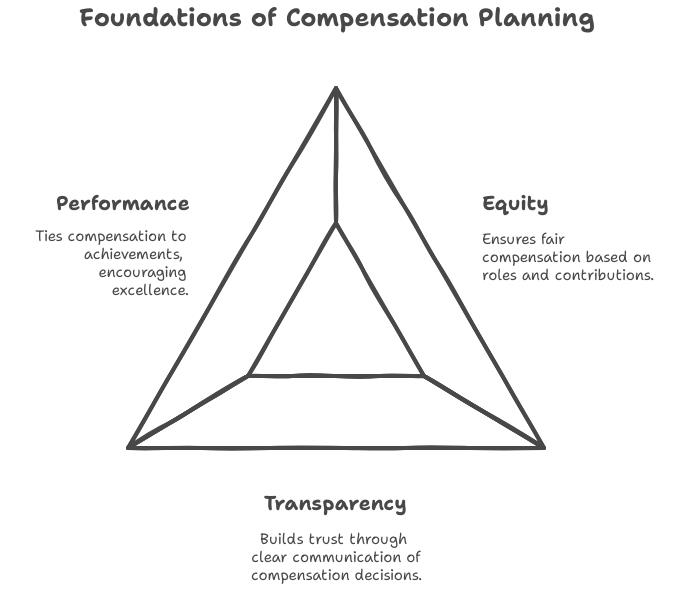
Successful compensation planning is based on fairness, openness, and a strong connection between business strategy and goals. Compensation needs to be treated by leaders as a performance tool as well as a representation of corporate values. Absence of clarity and consistency in compensation can result in inconsistent compensation, inequality, and dissatisfaction within the workforce.
Equity
Make sure that compensation programs are bias-free. Overall compensation equality creates trust, promotes inclusiveness, and increases overall morale. Monitor pay equity on a regular basis and catch any imbalances promptly in order to preserve fairness.
Tip: Audit for pay equity. Regular equity audits must be done to guarantee equitable pay practices throughout your organisation and correct any imbalances.
Transparency
Employees need to know how decisions regarding compensation are made. Salary ranges, bonus schemes, and the factors used for a raise or promotion should be explained to them. Transparency not only builds trust but also makes employees compatible with organisational objectives.
Tip: Make compensation criteria clear. Define obvious, transparent standards for determining compensation, including raises and promotions.
Performance
Alignment of business objectives ensures that compensation schemes instill the appropriate behaviours. Compensation must be linked to both company and individual performance. Providing incentives for quantifiable goals, such as customer satisfaction or sales goals, creates a direct correlation between employee effort and company achievement.
Tip: Connect compensation to performance. Establish direct links between compensation and achieving significant business objectives, making performance metrics clear.
How to Determine Employee Compensation?
Deciding employee pay calls for a thoughtful, fact-based process that splits the difference between marketplace competitiveness and internal equity. For executives, ensuring compensation is aligned with the overall strategy enables long-term success.
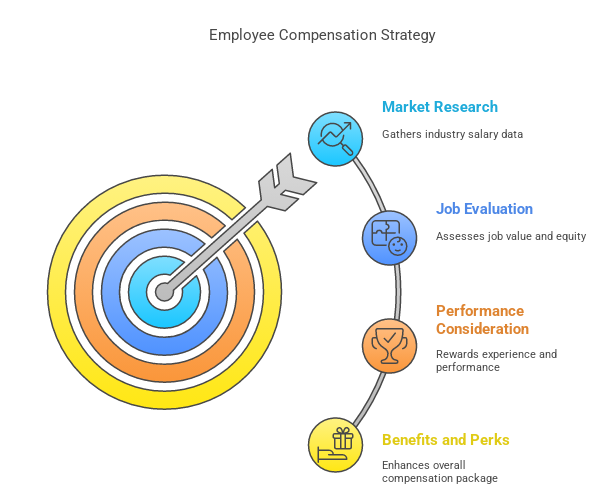
Carry out market research
Start by considering industry standards and salary benchmarks. Consult salary data for a particular job, industry, and location to make sure your pay is competitive. Utilize tools such as salary surveys, compensation reports, and competitor analysis to determine how your pay compares to that of others.
Evaluate job value and internal equity
Value each job according to its contribution to business outcomes. Core jobs that generate revenue or innovation, like sales executives or product engineers, might be eligible for higher compensation or extra bonuses. Nevertheless, it's important to uphold internal equity by ensuring consistency in roles that have similar skill sets and responsibilities.
Consider employee experience and performance
Customize reward packages according to an employee's experience, length of service, and performance. Top performers or employees with specialized skills should be rewarded in such a manner as to reflect their distinctive contributions. For instance, provide performance-related bonuses, stock options, or other incentive programs that reward excellence.
Add benefits and perks
Think about health insurance, retirement benefits, wellness initiatives, and other advantages like telecommuting arrangements or days off. These benefits will go far in terms of making the compensation package overall more appealing.
Using Technology for Smarter Compensation Decisions
Employing technology in compensation management can unlock several benefits. Sophisticated HR software solutions assist in simplifying compensation procedures, promoting fairness, accuracy, and efficiency. For executives, technology provides the tools necessary to make informed, data-driven decisions that drive employee satisfaction and alignment with organizational objectives.
Darwinbox offers an end-to-end platform that incorporates compensation management into larger HR processes. Through its sophisticated analytics, Darwinbox allows HR leaders to make strategic compensation choices by offering insights into market trends, pay equity, and performance metrics. This data-driven strategy helps ensure that compensation strategies are aligned with both market norms and organisational goals.
One of the main benefits of implementing a platform such as Darwinbox is the capability to automate reviews and adjustments of compensation. This lessens administrative work, ensures consistency, and accelerates decision-making. It also provides transparency since employees are able to see compensation-related data (like salary structure, bonus eligibility, benefits breakdown, etc) in a well-organized and clear manner, and this instills trust and engagement.
Darwinbox is also customizable in terms of compensation plans, be it salary, bonuses, or benefits. Top leaders can design personalized packages according to specific jobs, performance criteria, and company budgets so that the appropriate incentives are provided to drive and retain the best performers.
Get real-time insights into market trends and in-house variable pay schemes to make evidence-driven compensation decisions. Use software to streamline the compensation review process for timely, consistent, and equitable updates to employee compensation. Maintain transparency through self-service tools. The employee-facing portal facilitates transparency and enables staff to monitor their compensation information.
Conclusion
Pay is a powerful way to retain talent and drive engagement. When leaders craft careful, fact-driven compensation strategies, they create engagement, trust, and alignment with the organisation’s strategic objectives. A great package goes beyond pay and covers benefits, incentives, time off, and opportunities for career development.
To remain competitive, companies also need to practice internal equity and market alignment. That's where technology comes into play. Platforms such as Darwinbox simplify compensation planning, automate reviews, and provide real-time insights. Managers can make wiser, quicker decisions while ensuring transparency and fairness across teams.
Ready to make compensation a strategic advantage? Learn how Darwinbox can make compensation planning easier and future-proof your compensation strategy. Request a free demo today.
FAQs
What are the principal elements of employee compensation?
Compensation usually consists of base pay, variable compensation (such as bonuses or commissions), benefits (medical insurance, retirement schemes), equity or options, and non-monetary incentives such as rewards or flexible work schedules. All the elements contribute to talent attraction and retention.
How will variable pay affect employee motivation?
Variable pay connects pay to performance. It motivates employees by paying for individual or team results, but it needs to be well-designed, open, and linked to specific KPIs in order to work effectively and justly.
Why is pay benchmarking valuable in compensation planning?
Benchmarking keeps your compensation packages market-competitive. It attracts superior talent, lowers the risk of turnover, and helps maintain internal pay equality for similar jobs.
What is the place of benefits in total remuneration?
Benefits play an important role in the well-being and satisfaction of employees. Health insurance, pension schemes, annual leave, and wellness programmes are central to making your organisation an employer of choice.
How do firms ensure that their pay strategy aligns with business objectives?
Align pay with business objectives by tying rewards to performance, retention, and skill gain. Compulsion for frequent reviews, data-based decisions, and executive sponsorship is necessary for compensation to foster long-term success.