TL;DR
An HR dashboard is a central view of workforce data that turns reports into clear, real-time insights.
Enterprises use operational, leadership, and employee HR dashboard views to track daily tasks and long-term outcomes.
The right HR dashboard metrics cover workforce trends, performance, engagement, compliance, and diversity.
Benefits of HR dashboard adoption include faster decisions, better visibility, lower admin effort, and early risk detection.
Modern dashboards integrate systems and use AI to predict attrition, hiring needs, and workforce gaps.
Introduction
Organizations always measure what the HR team needs, and then are left with numbers without clarity or visualization. An HR dashboard is a centralized view that brings together workforce data, trends, and insights in one location. Rather than looking at multiple reports, the HR team and leaders have access to visualizations of key HR metrics in charts, graphs, and real-time status indicators.
In a modern business, an HR dashboard is more than just reporting. It integrates employee data, talent management results, and organizational performance into a single decision support view. This enables HR to keep track of workforce health, monitor progress toward business objectives, and spot potential problems. This blog explains what is HR dashboard and how the metrics support HR operations.
How HR Dashboards Have Evolved Beyond Traditional HR Reporting
Traditional HR reporting was heavily reliant on monthly data dumps in Excel. These reports were often out of date by the time leadership could take action on them. HR teams were dedicating large amounts of time to gather and format data instead of analyzing it.
Modern dashboards changed that approach. According to the HR.com’s State of People Analytics 2025-26, people analytics leaders are nearly 4x more likely to report that analytics improve business outcomes compared to laggard organizations. Benefits of HR dashboards include:
Offers real-time data visibility
Gives role-based views for managers, HR, and executives
Allows for proactive decisions
Helps spot patterns and anomalies
Combines processes from multiple systems into one workflow
AI in HR provides predictive capabilities so that organizations can predict attrition risk, workforce demand, and even engagement declines before issues arise. Instead of asking “what happened last month?” organizations are now asking “what is going to happen next, and what should we do?”
Types of HR Dashboards Used by Enterprises
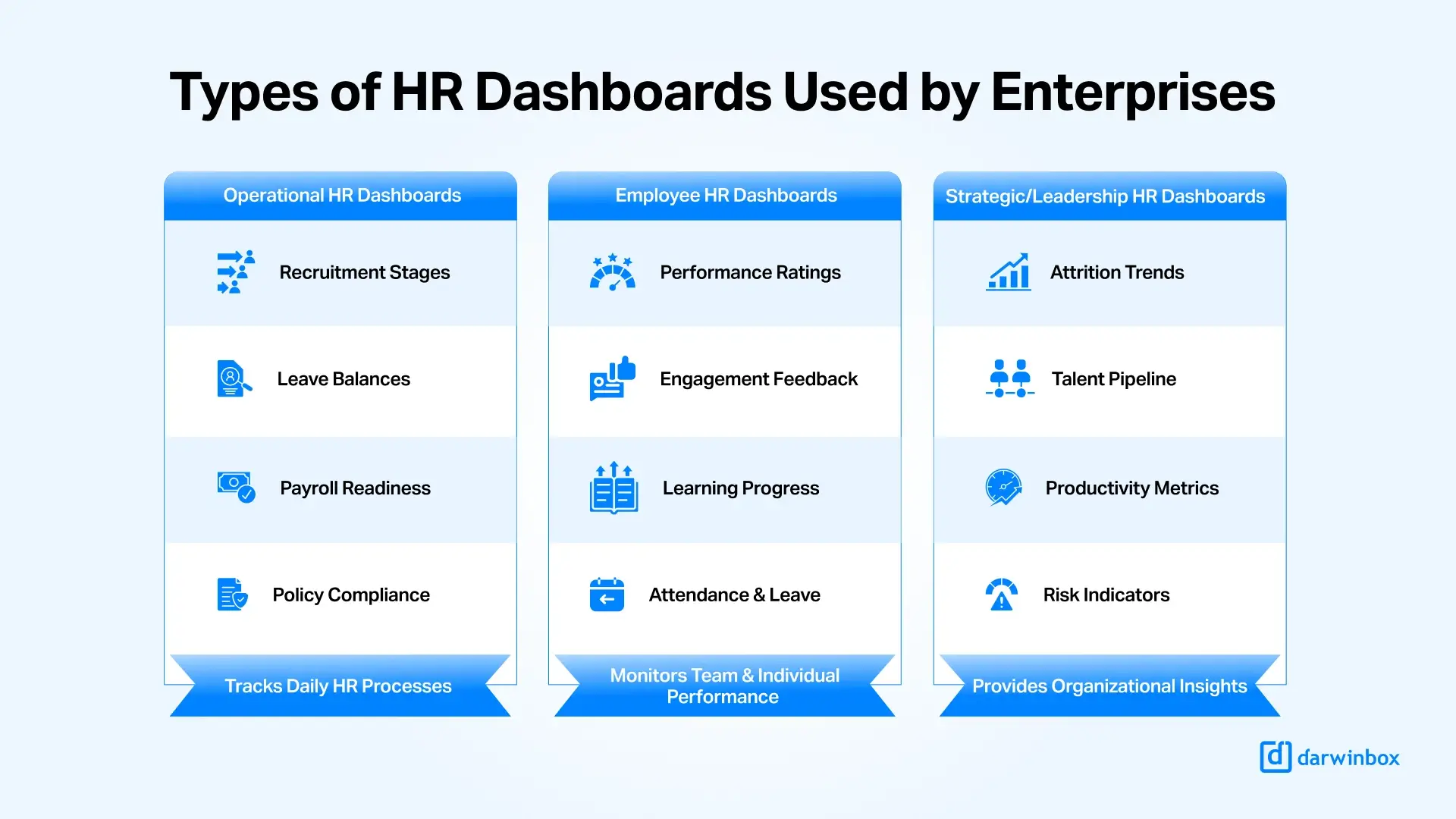
Different stakeholders need different insights. A single dashboard cannot serve the needs of the operational staff, managers, and executives. Businesses generally use several dashboards that are customized to areas of responsibility and decision scope.
Operational HR Dashboards
The operational dashboards support the day-to-day execution of HR. They are typically used by the HR operations team to track workflows and maintain process flow.
The operational dashboard visualizes the following data:
Stages of recruitment: To monitor candidate progress at each hiring stage to spot bottlenecks.
Leave balances: To view leave entitlement and avoid booking conflicting schedules.
Payroll readiness: Checks attendance and pay information before running the payroll.
Policy compliance: Notifies of breaches or non-acknowledgements in real-time.
Documentation status: Keeps track of outstanding employee documents and the proportion that have been filled.
With these dashboards, teams can address bottlenecks immediately instead of reviewing at the end of the month. They make sure HR processes remain both accurate and efficient.
Employee HR Dashboards
The employee HR dashboard is intended for managers and the employees themselves. It offers insight into each individual and team performance metrics.
Typical features include goals and performance ratings, engagement feedback, learning progress, attendance & leave records, and management loops. Managers can monitor the productivity of their teams, and employees know what is expected of them and how they are progressing. Systems integrated with attendance management bring enhanced accountability and scheduling clarity.
Strategic or Leadership HR Dashboards
Strategic or Leadership dashboards are designed for CHROs and business leaders. They are concerned with the results of the organization. Some of the key insights from the leadership HR dashboard include attrition trends, talent pipeline health, workforce productivity, indicators of organizational risk, and cost & output ratios. These dashboards enable leaders to tie talent strategy to revenue goals and growth plans.
Key HR Dashboard Metrics That Matter to Enterprises
The best HR dashboards surface the decisions leadership needs to make. Metrics only earn their place on a dashboard when they answer a real business question: Why is attrition spiking in this region? Are teams actually productive, or just busy? Where are our compliance gaps? That's the lens enterprises use when deciding what to track. Each metric category serves a distinct decision-making function:
Workforce Metrics (headcount distribution, voluntary and involuntary attrition rates, hiring velocity, and time-to-fill) assist in capacity planning and workforce cost control before problems compound.
Performance and Productivity Indicators (OKR and goal completion rates, manager rating distributions, output per team, and high-performer ratios) connect labor investment directly to business outcomes.
Engagement and Experience Signals include satisfaction trends, sentiment analysis, feedback participation, and burnout risk flags. Strong employee engagement data lets HR act on disengagement before it turns into departure.
Compliance and Risk Indicators are measured through policy acknowledgment completion, mandatory training adherence, leave and overtime violations, and audit readiness. These protect organizations from legal exposure and reputational damage before regulators come knocking.
DEI and Workforce Composition Metrics include gender and diversity representation, pay equity comparisons, and leadership diversity ratios. These metrics change inclusion from aspiration to something measurable and accountable.
Individually, each category tells part of the story. Together, they give HR and leadership a complete picture of workforce health.
Benefits of Using an HR Dashboard in Enterprise Organizations
Organizations frequently depend on fragmented reports and lagging summaries to track the performance of their workforces, making it challenging to take timely action. Deploying an HR dashboard delivers KPI value at operational and strategic levels. Key benefits for leadership include:
Faster, data-backed decisions: Leadership has real-time access to workforce intelligence, eliminating wait time for manual reporting. Live dashboards automatically refresh, so leaders can take action in real time rather than waiting for reports to be compiled.
Increased visibility of the workforce: Companies need to track how talent is allocated across the business based on geography and skills. HR dashboards aggregate workforce data into easily interpretable visual displays.
Alignment of HR and business priorities: The workforce planning can be directly tied to the revenue goals and growth plans through dashboards that link metrics to outcomes.
Less work for administrators: Automation reduces the report-writing burden on HR teams so they can focus on strategic initiatives. Recurring information is automatically sourced from system data.
Risks are managed proactively: Real-time alerts show turnover spikes, compliance threats, and productivity drops. It allows HR to fix the issues before they grow to become a bigger problem.
HR Dashboard Examples and Enterprise Use Cases
HR dashboards show value when they drive decisions. Here is how enterprises use it in real-world situations:
Dashboards provide data to spot resignation signals by department early to intervene before the talent quicksand.
Tracking open roles and candidate stages provides hiring pipeline visibility that helps prevent business disruption due to unfilled positions.
Knowing employee ratings, inflation, or gaps across teams helps sharpen coaching and succession decisions with performance distribution analysis.
Dashboard data helps monitor pay, overtime, and contractor spend for workforce cost optimization.
Policy acknowledgement and compliance measures can be monitored to ensure audit readiness.
How to Build or Choose the Right HR Dashboard
Choosing or developing an HR dashboard needs to be driven by the organizational strategy.
The right HR dashboard must integrate with existing HR systems and enable role-based customization. Sophisticated dashboards support proactive decision-making and multi-regional workforce needs.
Instead of comparing tools based on a feature list, use this checklist to choose a platform:
☐ Does it connect with your payroll, performance, recruitment, and attendance modules?
☐ Can executives, managers, and HR each see what's relevant to them?
☐ Does it forecast attrition, hiring needs, and engagement shifts proactively?
☐ Can it handle multi-region data and local compliance rules?
HR dashboards combine operational workflows with employee insights and leadership metrics into one decision-making interface. Organizations can forecast risks and determine workforce needs while developing talent strategies to meet business goals through their continuous assessment of current operations. The integration of platforms like Darwinbox enables HR to function as an enterprise growth driver instead of serving as a mere reporting department.
References
FAQs
What is HR Dashboard? Definition, Examples & Use | Darwinbox
Understand what an HR dashboard is, explore real examples, key metrics, and use cases. Learn how modern HR dashboards drive data-led enterprise decisions.
What are the three types of Dashboards?
Three types of dashboards are:
Operational dashboards for monitoring daily HR activities
Employee dashboards to know about team performance
Strategic dashboards for executives
What metrics should you include in an HR Dashboard?
The key metrics vary based on the organization. Typically, the following metrics are measured: headcount, attrition, hiring velocity, performance ratings, engagement scores, compliance indicators, and diversity data.
How does AI improve HR dashboards?
AI brings dashboards to life by recognizing patterns, forecasting turnover risks, surfacing anomalies, and suggesting corrective measures.
Who benefits most from an HR dashboard?
HR teams, managers, and executives can all benefit from having a structured view into workforce trends and employee experience.