TL;DR
HR systems manage the full employee lifecycle, from hiring to offboarding.
Integration improves efficiency, consistency, and compliance across HR operations.
AI automates tasks, provides insights, and personalizes employee experiences.
Organizations gain better workforce visibility, informed decisions, and scalable growth.
Lifecycle-focused HR systems strengthen employee engagement and long-term retention.
Introduction
Modern enterprises don’t struggle with HR tasks. They have many tools to handle those. However, they struggle with disconnected systems. When HR tasks, such as hiring, payroll, and compliance, operate in silos, both employee experience and employer resources suffer.
That gap is where the true HR system benefits outshine. This article explains how an HR system enables human resource professionals to view the employee lifecycle end to end. It outlines the benefits this vision delivers across recruitment, engagement, payroll, and more.
What Does the Employee Lifecycle Mean for Enterprises Today?
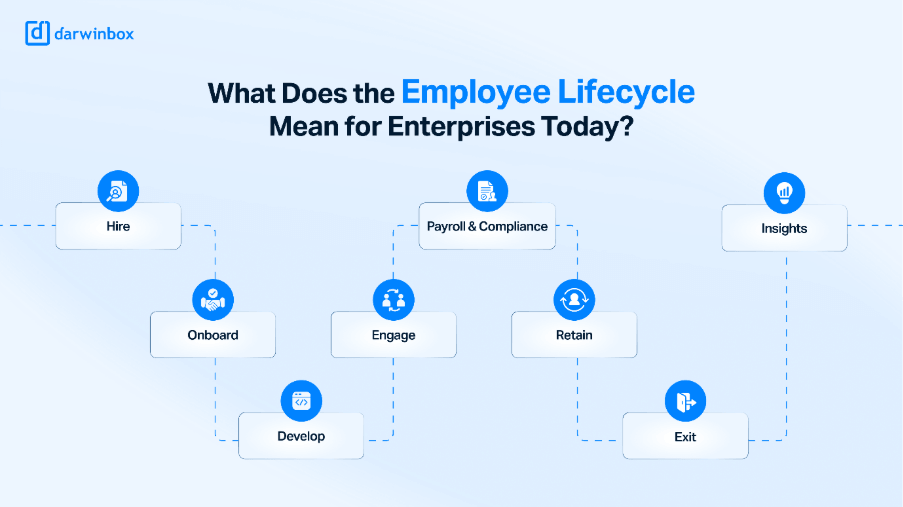
While HR tasks were traditionally treated in isolation, today they are a single employee cycle. This lifecycle is a structured, continuous journey. It stretches from the initial point of contact to an employee's departure from the organization. You can think of it as an HR strategy that focuses beyond hiring and onboarding candidates. It also includes growth support, sustained engagement, transitions, and exclusion.
Here’s what an employee lifecycle looks like:
Hire: Source appropriate candidates, interview the selected ones, and hire the best choice.
Onboard: This includes getting acquainted with the workspace and work culture, and training them to become productive employees.
Develop: Structuring personalized growth paths for every employee based on their skills and capabilities. The HR team can train them in new skills or place them in the leadership pipeline.
Engage: The HR Team’s job doesn’t end with hiring employees; they also need to constantly engage with them. This can include answering any queries they have, giving feedback on their performance, and motivating them to perform better. You should also consider ensuring they are aligned with organizational goals.
Exit: This can refer to transitioning employees to other regions or to leaving the job.
Lifecycle thinking matters more for enterprises because they face unique challenges. Small businesses do not face complexities like rapid growth, larger teams, hybrid work models, regulatory pressures, etc. Thus, they need a continuous cycle in place to maintain the workforce and meet their demands.
Key Benefits of HR Systems
The Human Resource Management System (HRMS) market size was already a whopping $2483.73 million in 2025. It is further expected to grow at a CAGR of 10% from 2026 to 2032 to reach $4840.09 million.
One of the key reasons behind this consistent growth over the years and decades is the HR system's benefits.
In the following sections, we highlight the benefits HR systems offer across various HR processes and functions.
Recruitment & Onboarding
Early lifecycle stages are very important for enterprises. They can significantly affect long-term workforce outcomes like lower churn rates. An integrated HR system brings clear visibility to hiring coordination. For instance, it can engage applicants right from the start to initiate a positive experience.
This experience can further translate into a consistent candidate-to-employee transition and onboarding. A centralized recruitment platform helps candidate data flow seamlessly across different hiring stages. Besides that, recruiters, hiring managers, and leadership can all be kept in the loop to maintain consistency in hiring goals.
Once a candidate is hired, an employee onboarding software within the system can make the transition smooth. This means that the new employees experience continuity rather than administrative friction.
Employee Engagement & Performance
A Gallup survey found that only 3 in every 10 US employees were engaged at work in 2025. This indicates a declining trend in engagement. And this lower engagement can influence productivity, turnover, absenteeism, well-being, and more.
Many employees feel disengaged, but a modern HR system can help change that. As a core benefit of an HR system, it enables structured employee engagement through a continuous feedback loop, transparency, clear communication, etc. This aligns employee performance with business goals to create a win-win for both.
Payroll & Benefits Administration
While salary is still a vital part of a job offer, many employees now focus on additional long-term benefits. This includes better work-life balance, appropriate health insurance, retirement package, and more.
Therefore, enterprises offering consistent payroll and benefits administration experience lower employee churn rates. Accurate and timely compensation with easy access to promised benefits reinforces employee trust, so they don’t want to leave you.
However, this can sometimes be difficult for enterprises due to the large number of employees across different regions. A modern-day HR system deployed in the cloud can offer a centralized data hub for a unified global payroll approach. This mitigates any discrepancies caused by isolated tools.
Compliance & Reporting
Smaller businesses with fewer than 10 employees don’t face stringent compliance rules. But things are different for enterprises. They staff hundreds of employees across different regions. Thus, they have to follow varied local regulations, along with the complexities of federal compliance.
HR systems help maintain compliance by centralizing employment records, policy acknowledgments, compensation data, and statutory documentation. This means the HR team no longer has to rely on fragmented spreadsheets and manual tracking.
Some advanced HR systems can even constantly monitor compliance. They can notify administrators and relevant parties when a regulation is breached. This enables a quick response with either no or minimal consequences.
Training & Development
Another HR system benefit is continuous training and development. Deloitte’s 2025 Gen Z and Millennial Survey found that more young employees are focused on learning. Ongoing learning and development were among the top three reasons why they were working with their current employer.
Traditional isolated HR tools cannot facilitate this because of a lack of centralized data and reporting. HR systems can turn the tables by creating structured pathways for skills building and leadership readiness. With artificial intelligence (AI) about to revamp the in-demand skills set, this becomes a win for both employees and employers/
Instead of treating training and development as a standalone task, HR systems integrate them into the organization's needs and goals. This can even help HR professionals determine capabilities or skills gaps early and bridge them before they grow too wide.
Employee Retention & Offboarding
Hiring new employees can cost enterprises thousands of dollars annually. However, retaining or even onboarding on a positive note is easier said than done, but HR systems can simplify it. They bring together engagement patterns, performance signals, workforce trends, and other metrics. This allows them and managers to understand where any support or workload adjustments are necessary.
A centralized dashboard that brings all the data together also helps the HR team have more informed retention conversations. Even when retention is not an option on the table, HR systems can offer consistent offboarding. They can capture exit feedback so that the HR team can have better insights into culture, leadership, and management.
Analytics & Decision Making
HR systems connect data from different employee lifecycle stages, such as hiring, onboarding, engagement, and more. This unified view enables leaders to leverage analytics to gain a consolidated perspective on how different lifecycle stages interact.
With the help of analytics and accurate insights, these systems support informed decision-making. From workforce trends to turnover patterns, everything can become clear with analytics.
When data flows through the entire employee lifecycle without roadblocks, it empowers better strategy-building. Recruiters and leaders can make structured decisions based on insights, not bias.
How AI Strengthens HR System Benefits Across the Lifecycle
| AI Capability | How AI Helps | Business Impact |
|---|---|---|
| Process Automation | AI can automate repetitive tasks, freeing the HR team to focus on core areas, such as delivering better experiences. | This can reduce administrative workload and improve HR management efficiency. |
| Workforce Insights | With AI-enabled HR systems, your team can identify patterns in hiring, engagement, payroll issues, and more. | AI enables quick, informed strategic decisions across different lifecycle stages. |
| Workforce Insights | AI can personalize many aspects, from onboarding communications to training and development. It can also take feedback from both employees and HR to offer better personalization. | Personalization improves employee experience and relevance |
| Risk & Trend Detection | AI HR systems can continuously monitor compliance gaps, retention risks, shifts in engagement, and more. | This will allow proactive planning rather than taking actions after challenges become severe. |
A Boston Consulting Group article notes that the HR department is the biggest adopter of AI. Of all companies using AI or generative AI, 70% are doing so in the HR department because the technology offers some of the biggest benefits there.
AI can take HR system benefits to the next level. The technology increases speed, accuracy, and relevance across the employee lifecycle.
The table below demonstrates how AI strengthens HR system benefits:
Business Outcomes Enterprises Achieve with an Integrated HR System
An integrated HR system shapes how enterprises operate, scale, and lead their workforce. When all employee lifecycle stages are seen together as one, enterprises can achieve various things, including:
Greater operational efficiency: Since the process is streamlined, duplication, manual intervention, and administrative delays are reduced.
Stronger workforce management: Enterprises operate across regions and manage hundreds of employees together. Therefore, centralized data enabled by HR systems becomes important. They improve headcount planning, skill alignment, and succession visibility across business units.
Organizational consistency: From hiring and onboarding to engagement and offboarding, everything can be structured consistently. This provides consistency throughout the entire process, offering a uniform employee experience.
Improved governance and risk control: With integrated records, businesses can ensure compliance, audit readiness, and leadership oversight.
Conclusion: HR System Benefits as a Long-Term Enterprise Advantage
HR systems can be leveraged to their full potential when used across the employee lifecycle as a single solution. Connecting recruitment and onboarding to payroll, engagement, training, and other HR processes improves visibility and strengthens organizational decision-making.
HR system benefits can vary widely based on your requirements. Let Darwinbox illustrate how a unified, enterprise-grade HR system can help your organization. Book a demo with us today and learn more about the benefits of an AI-enabled advanced HR system for your enterprise.
References
FAQs
What Is an HR System?
An HR system centralizes and automates human resource processes across the entire employee lifecycle. Businesses can use it across recruitment, onboarding, payroll, performance tracking, learning, offboarding, and more. Centralizing these processes offers a unified view, which is essential for making better decisions based on real-time data.
Can HR Systems Help Reduce Employee Attrition?
Yes. HR systems can continuously monitor different metrics, such as engagement, career growth, work-life balance, performance, and more. If they are powered by AI, they can even find patterns in these metrics. Such insights can help identify warning signs early and encourage appropriate actions. This proactive approach improves retention and strengthens employee satisfaction.
How Do HR Systems Use Employee Data Responsibly for Insights?
HR systems gather workforce data to support informed decisions. However, they also need to ensure the data is anonymous and safe from cyberattacks. For this, many HR systems have built-in cybersecurity strategies, such as encryption, role-based access controls, and more. However, enterprises can make it more secure by implementing other cybersecurity strategies so that data can be gathered and shared without any issues.
What Is HRIS Software, and Why Is it Important?
HRIS (Human Resource Information System) software manages core HR functions digitally. This includes employee records, payroll, benefits, and reporting. It is important because it centralizes data, streamlines HR processes, ensures compliance, and enables informed decision-making.