Hiring the right people can tremendously influence the organisation and ensure a strong talent pipeline. The Global Talent Trends 2025 Report mentions that 79% of executives need agile talent processes that change with new business priorities.
This makes human-centric productivity the key driver of every successful organisation, reinforcing a positive company culture. Still, organisations are mistakenly confusing recruitment with talent acquisition. Though both have the same purpose: to attract qualified people, their goals, scope, and results have vast differences.
Typical recruitment processes would be reactive and focus on quickly filling positions. Talent acquisition is more of a strategic process and long-term aimed at developing a future-proof workforce.
With an understanding of these two hiring paradigms, HR leaders, business owners, and decision-makers would know how to align recruitment with overall business goals. Let's explore their differences between talent acquisition vs recruitment, why they matter, and strategies to develop them.
What is the Recruitment Process?
Recruitment is the short-term process to fill immediate needs and job vacancies. A recruitment process would ordinarily start when a vacancy has been recognised and ends when a candidate is selected.
Functions involved in the recruitment cycle are creating job descriptions, identifying candidates, sifting through applications, interviewing, and making offers. Recruitment focuses on acquiring qualified talent for specific job openings and current job openings.
There is a sense of urgency in recruitment. So, it is transactional and responsive to staffing needs, meaning it is most useful in entry-level, operational, or perhaps high-turnover positions.
Successful recruitment marketing makes this possible through advertisements to find the most appropriate job seekers and candidates quickly. Job boards, social media, and employee referrals generate interest and expand the reach to a wide applicant pool.
What is Talent Acquisition?
Talent acquisition takes a different, proactive, long-term angle; it focuses on creating an uninterrupted pool of qualified candidates attuned to the firm's culture, values, and future. This is particularly important when recruiting for leadership positions, specialised skills, or new functions.
Talent acquisition is beyond hiring to fill positions; it is about obtaining talent with the growth of an organisation in mind. It involves strategic planning, succession planning, candidate management, and employer branding programs.
By keeping business goals in mind, hiring teams must develop a talent acquisition strategy as an ongoing plan well ahead of future demands. Here too, the talent acquisition process involves creating enticing job notices, building the company's reputation, and constantly engaging with passive applicants.
Thus, Talent acquisition vs recruitment corresponds to two different hiring approaches. While recruitment finds the person for the role, talent acquisition shapes the team that will shape the future.
Key Differences Between Recruiting and Talent Acquisition
Recruitment and talent acquisition processes are not interchangeable for business leaders. Whereas recruitment concerns filling up-to-date job vacancies, talent acquisition synchronises hiring efforts with long-term business goals. The two processes have similarities, but are different.
Recruitment vs Talent Acquisition: A Side-by-Side Comparison
| Aspect | Recruitment | Talent Acquisition |
|---|---|---|
| Focus | Tactical and short-term | Strategic and long-term |
| Objective | Fill current vacancies quickly | Build a future-ready workforce aligned with business goals |
| Approach | Reactive | Proactive |
| Time Horizon | Immediate and role-specific | Ongoing and pipeline-based |
| Tools Used | ATS, job boards, shortlisting tools | CRM systems, talent analytics, recruitment marketing platforms |
| Candidate Relationship | Transactional—focused on immediate hires | Relationship-driven—engages potential employees over time |
| Role Type | High-volume, operational support roles | Niche, leadership, and critical-skill roles |
| Involvement of Branding | Minimal—primarily job ads | Strong focus on employer branding and value proposition |
| Measurement Metrics | Time-to-fill, cost-per-hire, offer acceptance rate | Quality-of-hire, retention, pipeline velocity, brand perception |
| Use of Job Descriptions | Written for specific vacancies | Designed to reflect long-term cultural fit and role evolution |
| Impact on Strategy | Supports immediate hiring needs | Supports long-term acquiring talent and organisational development |
Why Talent acquisition vs recruitment Differences Matter?
Deciding between recruitment and talent acquisition does not have to do with one being better than the other. It has to do with timing, type of role, and organisational requirements. Short-term staffing requirements call for a formal recruitment process to fill immediate vacancies, whereas long-term talent acquisition focuses on an adaptable, brand-focused talent acquisition approach.
By knowing the differences, HR teams can adapt their hiring model to strategic outcomes and attract top talent at the right time.
When to Use Recruitment or Talent Acquisition—and Why?
Organisations are often uncertain whether to implement a recruitment process or put money into a full-blown talent acquisition strategy. The appropriate option is based on your timeline for hiring, the complexity of the role, and long-term business objectives.
When is Recruitment the Optimum Method?
Use the recruitment process when you need speed or face high-volume hiring. This method best suits:
Entry-level or frontline positions
Urgent backfills for employees who’ve exited
Roles with a predictable turnover pattern
Temporary, seasonal, or contract staffing
In these situations, the priority is speed and efficiency. The focus stays on finding qualified candidates for current vacancies using streamlined processes and clear job descriptions.
When Talent Acquisition Is the Better Choice?
Use talent acquisition when you’re building a workforce for the future. It’s the right approach when:
Hiring for leadership, technical, or niche roles
Expansion into new markets or expansion of operations
Succession planning for core business processes
Increasing workforce diversity or flexibility
In such instances, the organisation requires more than just someone to do the job. You require people who fit your purpose, values, and long-term business objectives. Talent acquisition emphasises relationship-building, employer branding, and establishing interest among passive candidates, candidates who aren't actively job-seeking but might be the top talent around.
Blend Both Strategies for Greater Effect
Leading organisations do not select between hiring and talent procurement—they blend both. For instance:
An organization may hire operational personnel via job postings while leveraging recruitment marketing to cultivate next-generation leadership talent.
Startups can hire urgently in the seed stage and then create strategies to acquire talent for scaling.
By knowing where each model belongs, HR departments can use a hybrid strategy that serves short-term requirements but remains synchronised with a longer-term strategy.
Building a Talent Acquisition Strategy
A successful talent acquisition plan does not occur by accident. It takes a long-term approach, alignment with business objectives, and a keen emphasis on both employer branding and candidate experience. Although the recruitment process fills short-term needs, securing talent from an overall strategic perspective allows organisations to achieve resilience, spur innovation, and remain competitive.
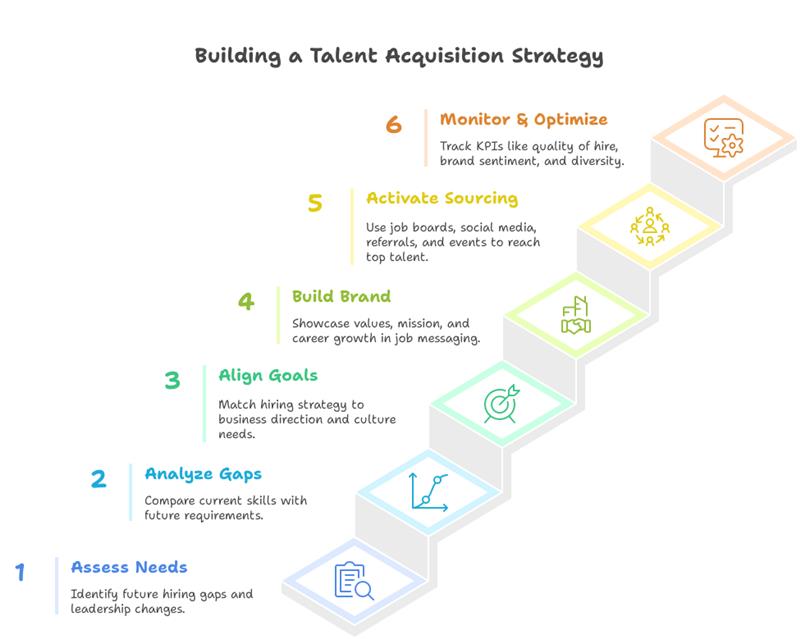
Step 1: Assess Organisational Requirements and Staffing Structure
Talent acquisition managers must begin with the present and future recruitment needs. Review business strategies, growth aspirations, and succession requirements. Ask these questions for long-term talent planning:
Which positions will be difficult to fill over the next 6–18 months?
Are there future retirements or leadership departures?
Is your current workforce in line with expected growth?
This is the basis for your workforce planning process.
Step 2: Conduct a Talent Gap Analysis
Determine the gap between the talent you possess and the talent you will require in the future. A properly conducted gap analysis prioritises positions, skill sets, and schedules. It also discovers if the organisation needs to build (train in-house) or buy (hire outside).
This is important during long-term recruiting and hiring talent decisions, particularly when evaluating emerging skill sets or succession gaps.
Step 3: Align with Business and Talent Goals
Your talent acquisition goals should reflect broader business goals. For example:
Scaling a new vertical? You’ll need specialists and leaders who can set direction.
Focusing on innovation? You’ll need a culture fit, not just a skill fit.
Align hiring with strategic direction using the AI-powered Darwinbox suite to improve employee retention and long-term performance.
Step 4: Build Your Employer Brand and Candidate Value Proposition
Employer branding is the foundation of talent attraction. It determines how prospective employees view your organisation. Utilise genuine storytelling, trusted messaging, and value-based campaigns to make your brand the go-to place for the best and brightest.
Make your job postings speak about your mission, career path, and values, not simply lists of responsibilities.
Step 5: Launch a Multi-Channel Sourcing Strategy
Apply recruitment marketing tools to attract top talent through multiple channels such as:
Job boards and specialised platforms
Employee referrals and alumni networks
Social media and content marketing
Talent communities and events
Developing passive candidates expands your pipeline and enhances the quality of hire, contributing to a strong employer brand.
Step 6: Continuously Monitor, Adapt, and Optimise
Use long-term KPIs such as quality of hire, cost per pipeline lead, brand sentiment, and diversity metrics to measure the performance of your strategy. Update your plan with real-time data to maintain sustainable hiring success.
Designing an Effective Recruitment Process
A well-planned recruitment strategy optimises the process of hiring, minimises drop-offs, and provides a consistent candidate experience for every level of job.
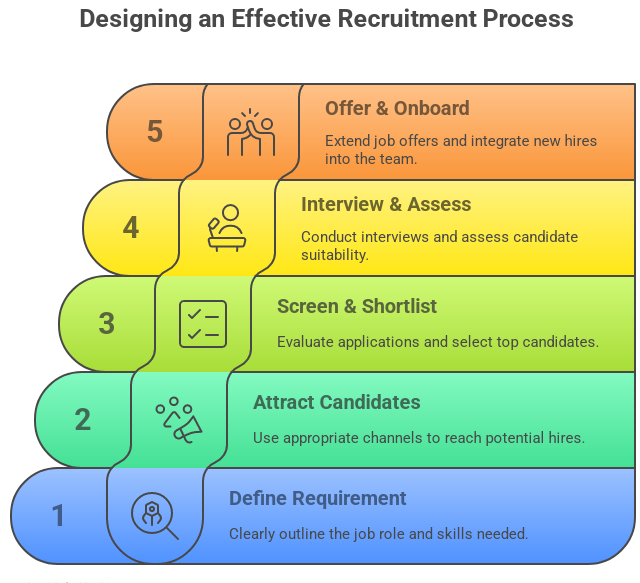
Step 1: Clearly Define the Hiring Requirement
The cycle starts with clarity. There should be alignment between the hiring managers and the HR on:
Role duties and performance measures
Experience level and skill needs
Speed of the hire and any replacement situation
This is where great job descriptions enter the picture. A well-crafted JD encourages qualified employees who are not only suited to the role but also to the organisational culture to apply.
Stage 2: Attract Candidates Through the Right Channels
Apply a combination of internal and external sourcing techniques, such as:
Job boards and company career sites
Referrals and internal mobility programs
External recruiters for specialised positions
Campus recruitment or walk-ins for bulk hiring
Embracing recruitment marketing ensures your job hits the correct talent pool. Position your employer brand well through every ad, career site, and outreach message.
Stage 3: Screen, Evaluate, and Shortlist
This stage should be reliable and unbiased. Employ:
Structured CV screening
Automated skill testing
Pre-interview screening and initial phone calls
Behavioural and situational interviews
Where possible, combine automation to minimise time-to-screen while ensuring quality.
Stage 4: Interview and Assess
This step involves panel or management interviews, technical interviews, or culture fit tests. Interviewers must utilise a scorecard tied to the JD and core competencies. Documented, concise feedback accelerates the decision-making process.
Stage 5: Offer and Onboarding
Once a candidate is chosen, quickly and clearly extend the offer once chosen. Good candidates may be lost if an offer is delayed. Set expectations, time frames, and next steps.
The onboarding starts here, and not after joining. Engage brand communication, culture signals, and resource access within the offer journey itself.
Some of the top recruitment metrics to track are:
Time-to-fill
Offer acceptance rate
Cost-per-hire
Interview-to-offer ratio
Candidate drop-off points
Darwinbox makes it easy to track these metrics and offers insights into where to optimise the hiring process and align them with overall business objectives.
Leveraging Employer Branding and Recruitment Marketing
To appeal to the best talent, organisations have to do more than post jobs. They need to influence how potential candidates view the workplace. That's where recruitment marketing and employer branding fit in. These tactics build long-term interest, establish trust, and turn passive candidates into applicants.
Employer Branding: The Cornerstone of Talent Attraction
Employer branding is your reputation as an employer. It provides answers to questions such as:
What does it feel like to work here?
Are employees developing and feeling appreciated?
Is the work purposeful?
Powerful branding impacts talent decisions, sometimes even more than pay. It makes your organisation a destination for top talent, not merely where there's an opening.
Essential elements of employer branding are:
Consistent messaging across career sites, interviews, and in-house culture
Employee testimonials, reviews, and workplace awards
A clear Employee Value Proposition (EVP) communicated through every touchpoint
This is not merely a talent-sourcing device. Branding touches every stage of the hiring process, from job seeking to onboarding.
Recruitment Marketing: Inspiring Candidate Engagement
Recruitment marketing applies digital marketing strategies to market roles, cultures, and careers. It generates inbound interest among qualified candidates by creating awareness prior to the job opening.
Successful methods for recruitment marketing include:
SEO-optimised job ads with inclusive wording
Targeted LinkedIn, Indeed, and niche-based ads
Role, interest, or geographic-based personalised candidate journeys and talent-nurturing blogs and videos
Email nurturing and culture videos
This strategy works for both recruitment and talent acquisition. For quick hiring, it fills the pipeline quickly. For strategic growth, it keeps your company top-of-mind among talented professionals.
Why These Talent Acquisition Efforts Matter?
Marketing and branding aren't nice-to-haves—they drive conversion, retention, and even employee satisfaction. When aligned with your hiring process, they drive cost-per-hire down and bring in candidates who are a fit long-term.
In these areas, investing isn't optional. It's essential to remain competitive in a world where candidates screen companies as much as companies screen them.
Trends Shaping the Future of Talent Acquisition and Recruitment
Both recruitment and talent acquisition are changing fast. Spurred by technology, workforce changes, and shifting candidate expectations, today's strategies bear little resemblance to those of a decade earlier. Keeping pace with these changes is the key to securing the best talent and aligning hiring with long-term business objectives.
AI-Powered Hiring
Artificial Intelligence is revolutionising the recruitment function. From resume-screening automation to chatbot-facilitated candidate interaction, AI streamlines time-to-fill and enhances candidate fit.
73% of talent acquisition professionals expect AI to change how organisations hire people.
In recruitment, AI assists in predicting workforce requirements, individualising outreach, and discovering passive talent at an early stage. It also assists in DEI by highlighting bias within job postings and job descriptions.
Data-Driven Decision Making
Today's HR leaders are dependent on recruitment analytics to make better decisions. Indicators such as quality-of-hire, cost-per-application, and candidate conversion rates now guide both short-term recruitment and long-term talent acquisition strategies.
Talent teams are applying predictive analytics to determine skills gaps and succession threats before they affect performance.
Remote and Hybrid Work Models
Geography is no longer a limitation. The remote work revolution has expanded the pool of potential employees. However, it also requires different models for engagement, onboarding, and evaluation.
Organizations need to adjust their employer brand and outreach to attract remote-first talent and have flexibility included in their job postings.
Candidate Experience as a Competitive Advantage
With more options for candidates, experience is paramount. Long wait times, bad communication, or generic messaging can dissuade qualified candidates. For recruitment or talent acquisition, a smooth, individualised experience - from first touch through to offer - puts your organisation ahead.
Emergence of Internal Mobility and Talent Marketplace Models
Innovative businesses are turning inward. Rather than bringing in new talent, they're upskilling, reskilling, and promoting internal employees. Talent acquisition leaders are creating internal marketplaces to pair employees with new careers, projects, and growth opportunities, linking workforce flexibility to changing business objectives.
Human + Tech: A Balanced Approach
While technology brings efficiency, the human touch remains at its core. Recruiters and TA professionals have to combine tech-facilitated processes with empathy, intuition, and genuine engagement. A balanced model enhances the results and bolsters your brand within a candidate-first world.
Conclusion
Recruiting and talent acquisition are often perceived as similar, yet they are used for very different ends. While recruitment is concerned with just filling existing gaps, talent acquisition is more about taking a long-term focus on aiding businesses to align hiring with future objectives. One fills short-term gaps, and the other builds lasting workforce strength.
Knowing when to use each makes all the difference. Recruitment works well when positions need to be filled right now. Talent acquisition matters when the goal is to bring in people who’ll drive impact. By understanding these key differences and adapting your hiring process accordingly, you’ll be better equipped to attract and retain the best talent.
From smart recruitment marketing to nimble talent acquisition workflows, Darwinbox is designed to handle every step of your recruitment process. Schedule a demo today!
FAQs
In implementation, how does talent acquisition differ from recruitment?
Talent acquisition is strategic, which involves a workforce planning, talent mapping, employer branding to form long-term pipelines. Recruitment is transactional addressing immediate vacancies with fast hiring.
Why is talent acquisition especially appropriate for specialized or senior roles?
Roles that are senior and niche-specific require careful planning, networking and building relationships. Talent acquisition is primarily passive candidate sourcing and builds trust to attract highly skilled professionals even if they aren't actively looking for new jobs.
How does technology enhance talent acquisition differently from recruitment?
Recruitment tools streamline applications, assessments, and onboarding. Talent acquisition adds predictive analytics, workforce planning, and talent relationship management features, helping organizations anticipate needs and attract candidates before roles even open.