TL;DR
AI screens 250+ applications per role within minutes and reduces inconsistency from manual seven-second reviews.
The system parses multiple formats, identifies transferable skills, and applies contextual scoring based on role relevance.
Recruiter feedback improves model accuracy over time and aligns predictions with real hiring outcomes.
Organisations gain faster hiring at scale, stronger shortlists, and better governance across teams.
Human judgment remains essential for nuanced decisions even when AI delivers high accuracy on objective data.
Introduction
Recruiting teams in enterprises experience immense stress due to the enormous influx of applications. The Employ 2025 Hiring Benchmarks report found that companies across all sectors can expect to receive 257.6 average applications for each position in 2025. Recruiters have to work more quickly without compromising quality, but manual resume screening causes bottlenecks, inconsistent shortlisting, and lost talent.
Manual screening takes longer to hire people and hurts the candidate's experience. AI resume screening can speed up and improve the process of filtering out applicants.
AI moves the recruitment process from making manual decisions, which are arbitrary, to smart, system-based analysis that is built into the hiring process. With this technological assist, companies can now quickly and correctly look over a lot of resumes. Let’s find out how AI resume screening tools revamp the hiring process.
Why Traditional Resume Screening Fails in Enterprise Hiring
Manual screening fails when the volume is high. One job opportunity may receive more than 250 applications on average, and recruiters spend around 7.4 seconds during the first scan.
In conventional Applicant Tracking System (ATS) configurations, keyword-only screening often misses transferable skills (e.g., “budget management”). They prefer ideal fits and ignore good applicants who have the relevant experience but are not an ideal fit. Time pressure and recruiter workload introduce inconsistency in teams and regions, which results in biased or uneven shortlisting.
The business consequences are evident: the drop-off rate of the candidates is increased, and the best talents are lost. These loopholes slow down development and hamper employer branding.
What is AI Resume Screening?
AI resume screening is a Machine Learning (ML) and Natural Language Processing (NLP) technology that analyzes the resumes in terms of their actual relevance to the role, instead of superficial similarity.
AI CV screening is much more than a keyword match. Modern tools examine the abilities, accomplishments, trends, and career trends in the entire resume.
This means that it can process a wide range of formats and can suggest capabilities despite changes in phrasing across candidate resumes or geographies. This can lead to quicker, more balanced shortlisting that is much more consistent with the real job needs.
How AI Resume Screening Actually Works in a Modern HR Tech Stack
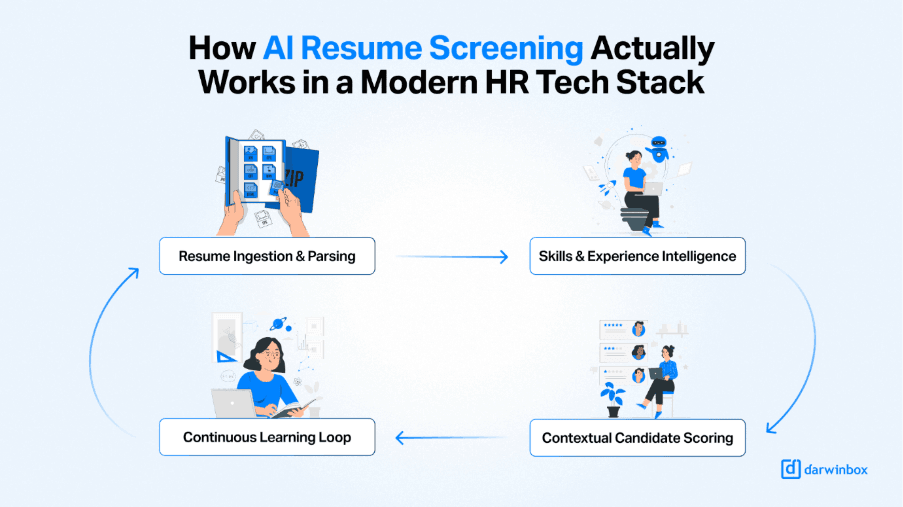
Resume Ingestion & Parsing
Applicants send applications in varied formats, such as PDFs, Word documents, scanned pictures, or even photos. These files are inputted into the AI systems and undergo optical character recognition (OCR) and sophisticated parsing to standardize data. Unformatted text is converted to structured profiles with education, working experience, skills, credentials, and accomplishments. It allows recruiters to evaluate resumes in different styles in a similar manner.
Skills and Experience Intelligence
AI models deduce abilities with NLP to interpret context and semantics. They identify transferable skills. For example, an experience-holder in agile methodology in software development may apply to a position in project management. AI can detect trends in career growth. This may reveal qualified candidates with transferable skills from a non-traditional field based on the recognition and identification of qualified project manager skills. By providing better identifiers than standard keyword searches, AI enables recruiters to identify effective, qualified applicants from a large talent pool.
Contextual Candidate Scoring
Rating algorithms sort the applicants into groups based on how closely their skills match the standards of the job posting. AI takes into account things like how recent the experience is, how senior the person is, how relevant the skills are, and the cultural or business situation. The hiring teams tailor priorities such as speed in volume jobs, specialization in technical jobs, or long-range promise in leadership jobs, producing role-specific rankings as opposed to generic pass/fail results.
Continuous Learning Loop
Through a recruiter-driven feedback loop, the AI resume screening software improves over time. Training of recruiter actions (shortlisting, rejection, or successful hire) occurs through supervised learning. With time, predictions become more reflective of real hiring performance and are shaped by real hiring data. The continuous enhancement maintains hiring relevancy over time as the positions and the talent markets evolve.
Key Business Benefits of AI Resume Screening
Speed & Scale
AI screens thousands of resumes in minutes to accelerate time-to-hire. Speed matters most during large-volume hiring such as campus drives, seasonal hiring, or rapid expansion phases. Also, the organizations can manage higher application volumes without increasing recruiter headcount at the same rate. When the hiring demand goes down, the screening capacity adjusts automatically. When positions are filled faster, it lowers time-to-hire, hiring cost, and improves candidate experience.
Improved Quality of Hire
AI reveals better matches by finding pertinent yet hidden experiences. Decisions are made based on role fit and not surface cues, which increases the general talent potential. Screening decisions can align with role relevance, agency, experience, and skill depth rather than surface-level figures like job titles. As a result, hiring teams can review stronger and better-matched shortlisted applicants.
Recruiter Productivity
Recruiters do not have to spend time filtering, and they spend more time interacting with candidates and working closely with the hiring managers. When administrative load reduces, teams can focus on assessment quality and stakeholder alignment with clearer rankings and structured insights. The result is speedy and more assured hiring decisions.
Consistency & Governance
In corporate HR, AI-assisted resume filtering applies the same logic universally to all teams/regions so that hiring teams have consistent/objective evaluations based on the candidate's qualifications/skills to perform the job requested. Complete traceability logs each hiring decision for compliance, bias auditing, and a more equitable participant selection process, strengthening overall company governance/talent pools.
Enterprise Use Cases Where AI Resume Screening Delivers Maximum Impact
AI resume screening tools play an important role in strategic talent orchestration. They offer value across all roles, but in the following high-stakes scenarios, AI CV screening offers measurable business impact:
High-volume recruiting: Rapid, scalable shortlisting is enabled via AI screening. It is done at a fast rate and eliminates application volume overloads to keep teams from getting overwhelmed, while also preserving speed.
Niche jobs: The technology enables relevant skills that are not tied to the exact keyword matches to be identified, thus filling technical jobs or niche jobs better. A skills software matches candidates with the skills required for the job role to direct skill-based hiring instead of focusing on educational background. In practice, Amazon uses NLP to analyze resumes and identify the skills and interests of candidates in their pipeline. The system automatically matches candidates with open positions to recruiters, ensuring a strong skills-based match beyond job titles alone.
Global recruitment: AI tools understand diverse languages, resume templates, and area specifics, helping to ensure equal assessment practices regardless of boundaries.
Internal mobility: Fair, skills-based screening assists in matching current employees to new positions, improving employee retention and growth.
How AI Resume Screening Fits into a Modern, AI-Powered HCM Platform
AI resume screening is a component of a linked hiring system. It is connected to sourcing, evaluations, interviews, and wider workforce insights.
Single talent information travels throughout the employee lifecycle- starting with application and onboarding, among others. Darwinbox skills platform combines AI resume screening with Applicant Tracking System (ATS), skills intelligence, and analytics.
With AI CV screening, companies can better match candidates’ skills and abilities to job requirements by using advanced search techniques to identify the best possible candidates quickly. It creates end-to-end visibility of the hiring process, enabling organizations to make faster, more informed decisions about hiring and managing talent. Overall, organizations can transition from a reactive approach to screening candidates to using data-driven approaches to develop and strengthen their workforce strategies and organizational growth.
Here’s how organizations can get started to embed AI resume screening:
Audit & Align: Assess the current screening process, volume per role, and ATS setup and define what "quality hire" means for the top role types.
Pilot & Integrate: Connect the AI screening tool to existing ATS or HRMS and run a controlled pilot on one high-volume role. Collect recruiter feedback early to activate the learning loop.
Scale & Govern: Expand across roles and regions while running regular bias audits and accuracy reviews. Track time-to-shortlist, shortlist-to-offer ratio, and quality-of-hire to measure ROI.
As hiring volumes grow and talent markets shift, the organizations that screen smarter today can build stronger workforces tomorrow.
References
FAQs
AI Resume Screening: How It’s Transforming Hiring | Darwinbox
Discover how AI resume screening is reshaping enterprise hiring. Faster shortlisting, better quality hires, and scalable, bias-aware screening. Read now!
What is the accuracy of AI resume screening in comparison to human resume screening?
Compared to human screening, AI resume screening is more accurate for objective data extraction and high-volume consistency. AI excels at verifying technical skills, matching certifications, and analyzing more than 150 data points simultaneously without fatigue. According to a 2025 research study, the accuracy rate of AI screening is approximately 95% for job category classification. Humans excel in assessing subjective nuances like cultural fit and leadership potential.
Can AI resume screening integrate with existing ATS or HRMS?
Yes, AI-based resume screening systems integrate smoothly with virtually all current ATS and HRMS by using APIs or connectors. They read through resumes, assign candidate ranks based on suitability, then pass results back to the system via an automated process. It requires minimal workflow modifications as the screening process is entirely automatic.
Are AI resume screening appropriate for high-volume and global recruiting?
Yes, AI resume screening can scale easily to thousands of applications per day and support multilingual, multi-format resumes that help achieve uniform processes in a distributed, international setting.
What is the time required to deploy an AI resume screening tool?
Depending on the integration of data, customization, and testing, implementation takes a few weeks to 2-3 months to roll out entirely to an enterprise. The cloud-based solutions can be deployed using quick pilots and go live within days or weeks.
Is AI resume screening less influential or biased in hiring?
Well-designed AI screening tools lead to uniformity and skills orientation, which could minimize human biases. Continuous supervision and variable training statistics continue to be important to mitigate the threats of inherent algorithmic bias.