As workspaces become more digital and competitive, organisations require smarter, faster, and more scalable methods of handling talent. That's where artificial intelligence talent management comes in.
Talent management is the end-to-end process of attracting, developing, retaining, and engaging employees by optimising the talent management processes and employee lifecycle. Conventional talent management methods can't match increasing workforce complexity and changing talent expectations. HR leaders are now looking towards AI-fueled talent management tools to drive strategic advantage.
Talent strategies have to be nimble and AI-led, insights-based, to continue to be competitive. An Insight Global report shows that 99% of hiring managers use AI in the hiring process. Let's explore how AI transforms talent management practices and what it means for HR teams, talent leaders, and business leaders looking to hire smarter, develop existing talent, engage talent and retain employees in a dynamic environment.
Evolution & Rise of AI in Talent Management
From humble beginnings with early Applicant Tracking Systems (ATS), there has been a quick evolution to the new generation of smart, AI-driven solutions that can crunch data, provide recommendations, and foresee future hiring requirements.
Early use centred largely on automating mundane tasks, sorting CVs, scheduling interviews, and tracking job boards. AI today powers predictive analytics, which allows HR leaders to foresee turnover, measure critical skills gaps, and align talent plans with long-term business objectives.
HR leaders consider AI and automation among their top three strategic talent management priorities. Not only do they view AI as an upgrade in technology, but they also view it as an essential driver of smarter, faster, and fairer talent choices.
In a McKinsey Analysis, generative AI in HR was impactful, contributing to a 20% improvement in major functions like hiring, recruiting, and onboarding new employees. Despite this enthusiasm, the implementation reality is different. Only 1% of organisations globally have achieved complete AI maturity functions. Most firms remain at early or mid-states of adoption, experimenting with tools but not integrating them fully into their talent management practices.
Most organisations have not yet leveraged the AI talent management value. HR teams can shift from reactive decision-making to proactive, data-backed insights that reshape the entire talent lifecycle with the proper AI tools and responsible implementation.
As talent strategists look forward, the advent of AI is an opportunity to rethink how organisations recruit, develop, and engage the talent of the future.
How AI Powers Talent Management Across the Employee Lifecycle
From talent acquisition to career growth, AI-driven tools enable HR teams to hire better, retain employees for longer periods, and leverage the maximum potential of current talent.
Smarter Talent Acquisition
AI platforms complement hiring by faster and more accurately identifying qualified candidates. These systems employ natural language processing (NLP) and machine learning algorithms to scan resumes, social media profiles, and past records, aggregating the most suitable talent for available positions. A SHRM report shows that 86.1% of organisations employing AI to hire indicate that it enables them to identify quality candidates quickly.
AI chatbots similarly make candidate communication a faster, more automated process, keeping engagement higher and drop-offs lower throughout the hiring process. Predictive hiring software helps HR leaders avoid premature turnover by identifying possible risks.
Seamless Onboarding & Integration
AI streamlines onboarding by automating tasks such as document verification, compliance training, and setting personalised learning goals early. New employees are given tailored training recommendations by role and skillset, speeding up the integration process.
About two-thirds of employees are satisfied with their onboarding experience. However, 47% of the workers took several months to learn and understand what they needed to do to perform their roles. A personalised onboarding experience can help new hires quickly prepare for their job role.
AI-assisted onboarding, including automated training modules, helps establish clear role-specific goals and impart skills required for the job based on the new hire's skillset. Effective onboarding helps retain talent and ensures that new employees feel engaged and valued right from the outset.
Performance Management and Evaluation
AI-powered performance assessment is based on data points such as trends in feedback, project performance, and engagement scores. These metrics assist HR teams in discovering top performers and issuing on-time coaching and upskilling suggestions. 45% of HR leaders prioritise organisational transformation to improve talent management.
HR teams can reduce their administrative burden when AI tools automate the performance review process. Using this data, personalised training and development opportunities can be created. Responsive AI practices foster a culture of continuous improvement and employee engagement.
Real-Time Engagement and Retention Insights
AI-driven sentiment analysis reads employee feedback, communication trends, and survey results to track engagement and improve performance evaluation. HR can then address disengagement before it turns into attrition based on these insights.
Around 69% of the workforce remain attracted and engaged with an organisation that values their skills and potential. This demands getting closer to every employee and engaging them in unique ways, tailoring their experience.
Early warning indicators of burnout or dissatisfaction are also picked up by AI, facilitating early interventions and personalised development plans to retain high performers. This is important because around 46% of global workers were keen on quitting their jobs.
Career Growth and Succession Planning
AI provides real-time career pathing recommendations via performance, aspirations, and workforce planning requirements. AI facilitates HR to assist career development opportunities, drive internal mobility, and effectively plan leadership pipelines.
By identifying suitable internal candidates for high-level positions, organisations can use AI to retain top talent and fulfil critical roles more efficiently. Internal mobility also improves employee satisfaction and reduces hiring costs.
42% of all job changes or career growth opportunities and role transitions in People + Performance-focused companies happen within the company instead of internal hiring, and such companies have better business outcomes.
Leadership pipeline planning requires a proactive approach and predictive insights to ensure that a succession plan is in place to meet future leadership needs.
Key Technologies Powering Talent AI
Behind the scenes of AI talent management are some powerful technologies that cumulatively make HR processes smarter, faster, and more personalised:
Machine Learning (ML) & Natural Language Processing (NLP)
ML algorithms sift through vast amounts of workforce data from resumes, performance records, and training logs to reveal insights on critical patterns and top performers. NLP capabilities drive CV parsing, chatbots, and sentiment analysis, enabling HR leaders to better understand employee engagement and candidate fit.
Generative AI
Using generative AI, recruiters create customised content such as job descriptions, learning modules, and candidate outreach messages. AI HR modules can identify and suggest language and keywords that resonate with high-quality candidates. It can help craft value propositions that reflect the values and mission of the organisation and establish the branding.
Automated follow-ups with personalised messaging make the candidates feel valued and understood, keeping them engaged throughout the hiring process.
Agentic AI & Autonomous Agents
This is the next frontier in HR tech. These agentic AI agents perform multi-step tasks independently, such as screening resumes, arranging interviews, suggesting short-term projects, and even onboarding. A Salesforce study worldwide discovered that agentic AI adoption will rise 327% by 2027.
Many HR leaders believe humans and AI agents will collaborate in most HR functions. After integration, agentic AI is anticipated to boost employee productivity by 30% and minimise labour expenses by 19%.
Two-Way Human–Machine Learning (RHML)
In contrast to conventional AI, RHML allows for bidirectional learning—machines learn from human input, and human users learn from AI conclusions. This facilitates ongoing loops of improvement, monitoring, and skill development in HR staff.
Growing Trends: Autonomous Project Matching
AI now suggests short-term project assignments matching employees' career progressions, existing skills, and organisational critical requirements. These abilities broaden the scope of HR, facilitating dynamic internal mobility, reskilling, and career development—all powered by smart matching algorithms.
Challenges & Practical Considerations
Most organisations encounter pragmatic challenges in implementing these systems successfully. From integration issues to moral dilemmas, HR leaders need to navigate this new terrain with caution, even though 94% of organisations are already using AI in HR operations.
Skill Gaps and Readiness Gaps
AI has the potential to amplify current skills gaps if HR teams are not equipped to work with these technologies. Lacking AI literacy, teams might underperform or abuse tools, losing out on data-driven insights.
Upskilling HR departments is essential for future-proofing the talent management strategy. LinkedIn's 2025 Workplace Learning Report reveals that 49% of employees lack the skills needed to execute the business strategy. Organisations that don't invest in learning are at risk of lagging in career development, internal mobility, and employee performance initiatives driven by AI.
Integration and Compatibility
Not all older systems are compatible with the latest AI-driven tools. Substandard integration leads to data silos, hinders automation, and diminishes the utility of workforce data. This also impedes real-time decision-making throughout the talent life cycle, from talent attraction to performance measurement.
Privacy and Ethical Concerns
Privacy is an ongoing concern for HR leaders. AI applications to use for engagement score analysis, communication behaviour, or sentiment analysis must respect employee privacy.
63% of HR leaders expressed data security and privacy concerns when it comes to collecting AI data. Data mismanagement fosters distrust and can hurt both company culture and employee retention initiatives.
Ethical usage of AI is crucial to ensure that there is no unintended bias. While AI tools can remove manual bias from talent management, there is also a risk of introducing new biases.
Finding a Balance between Automation and Human Touch
AI may guide decisions, but not replace them. Talent decisions like deciding to promote a high-potential employee or selecting a career track need context that humans alone can supply.
Human oversight at every point is required for responsible AI governance, making sure talent management practices are equitable, inclusive, and transparent. The correct balance between automation and empathy is the key. AI must advise HR, not control it.
Implementation Framework: Bringing AI Talent Management to Life
Embracing AI in talent management isn't plug-and-play. It takes a clear strategy, piloting with care, and intentional upskilling. Here's the way HR teams and business leaders can operationalise AI talent management.
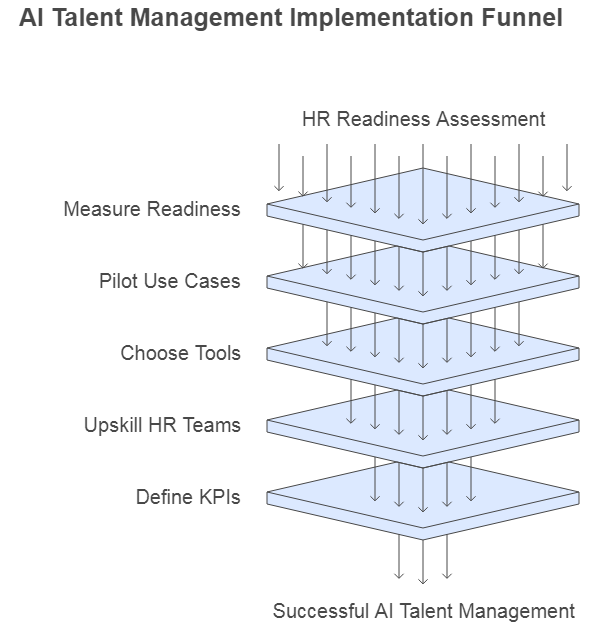
Step 1: Measure Readiness with HR Maturity Models
Before embracing AI, measure your existing talent management practices with HR maturity models. This points out gaps in workforce data, systems, and AI literacy across the team. Consider frameworks such as the Bersin Talent Maturity Model or SHRM's Digital Readiness Index. Organisations that race ahead without readiness tend to have difficulty with long-term impact.
Step 2: Pilot with High-Impact Use Cases
Don't go big. Go smart. Pilot AI-enabled tools in high-impact areas such as:
Talent acquisition (resume screening, candidate matching)
Onboarding (AI-driven journeys and training suggestions)
Talent development (skills gap analysis, tailored learning)
These areas deliver early wins and provide early ROI without flooding your HR team.
Step 3: Analyse and Choose the Right Tools
The needs of every organisation are different. Analyse AI tools on features, data transparency, ethical governance, and vendor support. Select tools that suit your ecosystem and honour data collection standards.
Step 4: Upskill HR Teams in AI Literacy
A team is only as good as the tools it uses.
Train HR teams to know how to interpret, analyse, and oversee AI recommendations.
Offer workshops on AI fundamentals, bias avoidance, and deciphering AI-driven insights.
Boost cross-functional projects among HR, IT, and data teams—dismantling silos.
This allows for more empowered, informed talent decisions.
Step 5: Define KPIs and Measure Success
Adoption should be measurable. Apply straightforward metrics to measure performance and outcomes.
Primary KPIs to monitor are:
Speed of hiring process (time-to-hire)
Employee engagement scores
Retention percentages
Career development opportunities delivered
Skills gaps reduction
Monitor success throughout the employee life cycle—from sourcing to succession planning—to guarantee that your AI strategy is producing value.
Real-World Use Cases: How Leading Brands Use AI with Darwinbox
Darwinbox, a pioneer in AI-driven HR solutions, is empowering organisations to redefine their talent operations with tangible results. Let's see how industry leaders are leveraging the platform throughout the employee journey.
TVS Motor Company: Digitising HR at Scale
TVS had a high manual HR burden across functions such as onboarding, attendance, and welfare. This was not something they could manage for 10,000+ employees.
Thanks to Darwinbox, the organisation automated 300+ man-hours every month by digitising core processes. A mobile-first strategy resulted in 79.5% adoption, cutting down time spent on activities such as address-proof generation and optimising background checks.
Impact:
Faster onboarding and smooth engagement
Improved mobile adoption, enhancing employee experience
Enhanced compliance and operational efficiency
TVS demonstrates how AI-driven technologies can propel scale, velocity, and happiness in distributed large workforces.
Quick Heal: Facilitating Internal Mobility with AI
Quick Heal aimed to minimise outside hiring reliance and cultivate deeper internal talent pools. But scattered skills and information made it hard.
Darwinbox's AI-based skills inventory catalogued more than 95% of jobs and monitored 127+ competencies. This enabled the HR department to create equitable, bias-free job descriptions and identify the right internal talent for the right positions.
Impact:
84% usage of the AI-based skills module
20% reduction in external recruitment
More defined career growth paths for existing staff
By connecting skills, roles, and individuals with AI, Quick Heal opened both performance and potential, improving talent agility from within.
ROI & Business Value: What Gets Measured Matters in AI Talent Management
AI talent management is not solely about innovation; it's about impact. Business leaders and HR professionals equally need to be able to see results. The best news? AI produces outcomes in all areas. From saving on hiring expenses to optimising performance, AI is creating value at every phase of the talent cycle.
Cutting Hiring Costs and Time
AI tools streamline sourcing, screening, and candidate engagement. By automating time-consuming tasks and improving the accuracy of shortlisting, businesses can fill roles faster and with fewer resources. This is not simply saving dollars. It is allowing HR teams to spend more time developing relationships and enhancing candidate experience rather than being hindered by manual tasks.
Enhancing Quality of Hire
AI identifies the right candidates with the appropriate skills and fit for the position. AI looks at historical data, job demands, and performance metrics to suggest the best talent, including external candidates, mitigating poor hires. This contributes to improved employee performance, shorter ramp-up time, and increased retention rates.
Enhancing Productivity Through AI Performance Measurement
AI doesn't end at hiring. It keeps delivering ROI through wiser performance measurement. By analysing data points such as project completion, peer reviews, and employee engagement, AI gives real-time insights into workforce productivity. These types of insights assist managers in determining gaps in skills, rewarding star performers, and taking action promptly if issues occur.
Fueling Long-Term Strategic Benefits
The true power of AI comes from its capability to fuel long-term workforce planning. It supports data-driven decision-making throughout the employee life cycle, aligning talent strategy with business objectives.
AI facilitates succession planning through the identification of future talent. It assists HR teams in retaining talent by predicting attrition risk early. It guarantees that skills for future growth are being cultivated today.
When used with a proper framework and governance, AI-driven tools not only optimise HR but also enhance business resilience, agility, and bottom-line performance.
Conclusion
AI talent management has become a business necessity. As the workforce changes, organisations must upgrade how they manage talent processes, make decisions, and develop individuals. From talent acquisition and career growth to performance management and succession planning, AI-enabled tools assist HR leaders in making quicker, more equitable, and better-informed decisions.
What makes AI-fueled talent strategies so powerful isn't the technology alone. It has the potential to transform workforce data into action. It enables you to identify skills gaps, direct career paths, and retain your best people with certainty.
But AI is not a magic solution. It needs robust governance, human control, and a well-defined talent strategy. It becomes an incredibly powerful assistant not just for HR teams but for all parts of the company, with the right combination.
To remain competitive, nimble, and ready for tomorrow, it's time to adopt AI talent management today. Book a demo with Darwinbox.