TL;DR
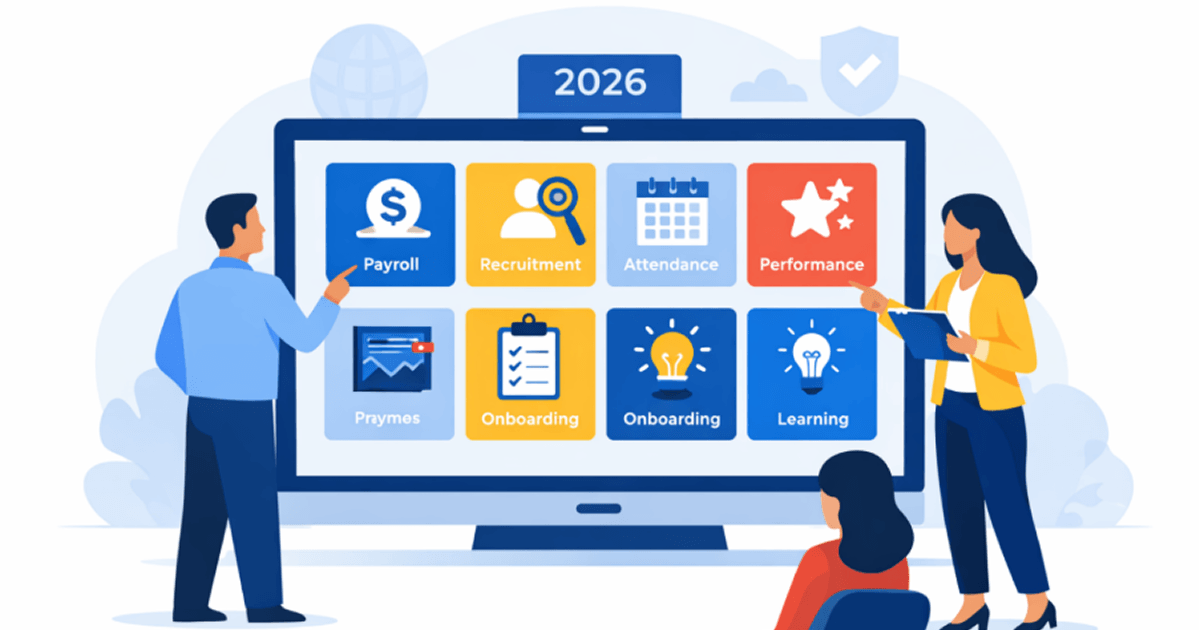
HRMS modules break HR platforms into specialized capabilities such as payroll, recruitment, and analytics.
Enterprises use modular HR architecture to scale HR technology across global operations.
Integrated modules unify workforce data across the employee lifecycle.
Intelligence modules like people analytics are becoming strategic decision engines.
The right module stack aligns HR technology with long-term workforce strategy.
HRMS modules are specialized functional components within a Human Resource Management System that automate and manage HR processes throughout the employee lifecycle, from recruitment and onboarding to engagement and retirement.
Enterprise HR teams rely on these modules to streamline operations while maintaining HR compliance across teams and locations. Traditionally, there were no modules. The entire HR management tool was built as a single, monolithic system. However, technological advancements, especially cloud technology, have accelerated the shift towards modular architectures.
Therefore, ISG’s 2025 State of HR Technology and Service Delivery report reveals that 69% of global HR cores now run on SaaS or in a hybrid cloud. Similarly, all the other HR processes can have dedicated modules built for them. Although built in a modular architecture, these modules work together as one integrated solution.
Thus, they can share data across modules and leverage artificial intelligence (AI)-enabled analytics for strategic insights and decision-making. This integrated ecosystem connects workforce data, talent strategy, and employee experience across the entire HR lifecycle.
What are HRMS Modules?
You can think of HRMS modules as specific functions for different HR processes. For instance, the payroll process can include a payroll module that automates and manages all aspects of employee compensation. This can include salary calculations, tax withholdings, statutory deductions, etc. Similarly, each HR process can have a different module.
Listed below are some common HR system module categories:
Core modules: Core modules manage foundational HR operations. Take, for example, employee data management. Modules for this process simplify the collection, storage, and analysis of data to prevent siloed information. The same goes for other core module processes, such as payroll processing, attendance tracking, and organizational data management.
Strategic modules: They support long-term workforce initiatives. Some of the key processes strategic modules cover are talent development, workforce planning, and leadership pipeline management.
Intelligence modules: As the name suggests, these modules are for transforming data into insights with reporting, analytics, dashboards, etc.
Experience modules: Experience modules improve both the employee and your experiences. Consider the employee self-service module as an example. It enables employees to get some basic tasks done without waiting for HR responses. This improves their overall experience.
Compliance and governance modules: Enterprises have to adhere to compliance requirements across different regions and sometimes even different industries. These modules help with that through regulatory compliance, localization, and policy management.
Of these modules, the intelligence and experience modules are among the fastest-growing segments within HRMS. An S&P Global survey shows that the talent intelligence segment is growing at a 17.9% CAGR. People analytics use is growing at 12.4% CAGR, and employee experience use at 10.2% CAGR.
Core HRMS Modules Every Enterprise Platform Includes
Enterprise HR operations involve large workforces, complex organizational structures, and different regulatory requirements across locations. Thus, the use of HRMS modules becomes even more important for them than for small or medium-sized businesses. They provide the operational backbone for HR teams to manage the end-to-end employee lifecycle with ease.
Listed below are some core HR modules that form the foundation of a modern HR enterprise platform:
Data Management
Data management centralizes and organizes employee information to bring almost every other HR system module together. Large enterprises employ hundreds or thousands of employees. This transfigures into millions of employee records.
The data management HR system module maintains these records and puts them into structured employee profiles. Other information, such as department changes, organizational hierarchies, performance, bank details, etc., all come together here for a centralized view. Some of the core features of this module include:
It centralizes data
Facilitates digital document storage
Prevents siloed information
Data validation and audit trails
You can offer role-based access
A unified data foundation created with the data management module strengthens strategic decision-making. With such a reliable data source, you can improve reporting accuracy, support compliance audits, and enable advanced analytics capabilities.
Localization
Localization enables enterprises to comply with country-specific labor laws, tax regulations, and language requirements.
Multinational companies operate within different regulations. The localization module enables HR teams to comply with these laws. And it’s not just about countries, though. Even states can have different rules to comply with.
For instance, the federal minimum wage in the US is $7.25 per hour. However, the basic minimum rate still differs across US states. Alaska, for instance, has this limit at $13.00, Arizona has it at $15.15, while California has it at $16.90. The localization module helps manage such payroll rules, statutory benefits, leave policies, and more.
With effective localization, enterprises can scale to new markets while minimizing regulatory risks. Thus, HR leaders can maintain centralized governance.
Payroll
The payroll module automates and manages all aspects of payroll and benefits.
Since enterprises work with diverse pay structures and complex statutory requirements, this module becomes extremely useful for them. Whether it's salary calculations, deductions, or salary disbursements, the payroll module can streamline it all. And it does so while complying with all state and country-specific regulations.
Key features:
Automated wage calculations
Tax deductions management
Multi-country payroll support
Payslip generation and payroll reports
An efficient payroll module improves financial accuracy, but goes well beyond that. For instance, it reduces administrative workload and offers consistent employee compensation across departments and locations within an enterprise.
Time & Attendance
The task of the time and attendance module is to track employee working hours, shifts, leave balances, and attendance patterns. It supports accurate workforce scheduling and payroll processing.
Large enterprises have teams operating in different time zones. And a significant portion of them operate 24/7. With multiple time shifts and employees working across different zones, it can be challenging for businesses to manage logins, logouts, and attendance. Having a separate tool in different locations also leads to siloed data. Therefore, a central time-and-attendance module becomes the need of the hour to maintain interoperability.
Key features:
Track attendance and work hours
It lets you manage shifts and rosters
Monitors and calculates overtime
You can use it for biometric and mobile attendance capture
Recruitment
The recruitment module covers the end-to-end hiring process, from candidate sourcing to offer management.
Your business likely posts multiple roles annually and receives thousands of applications for them. The recruitment module facilitates HR recruitment software to automate the processing of these applications.
It centralizes hiring workflows, including candidate sourcing, pipeline streamlining, collaboration with hiring managers, applicant journey tracking, and more. This centralization enhances the employment journey and reduces time-to-hire.
Some of the key features of the recruitment module include:
You can manage job postings
Includes an applicant tracking system (ATS)
Allows candidate database management
It lets you schedule interviews with candidates
Offer management and approval workflows
With the right recruitment module, you can attract qualified candidates, improve the employee hiring journey, facilitate hiring decisions, and more. Apart from that, you can also build stronger talent pipelines for future workforce needs.
Onboarding
Another core HRMS module is onboarding, which simplifies the transition of new hires into the organization. Structured workflows, documentation process, and guided tasks acquaintance can all be managed through the onboarding module.
As enterprises need to hire large numbers of employees across multiple roles, they need a systematic employee onboarding process in place. With the onboarding module, you can automate the entire journey. For instance, you can streamline employee data gathering, documentation, task & test allocation, and more.
Key features:
It facilitates pre-boarding and digital documentation
You can automate onboarding task checklists
Policy acknowledgment and compliance tracking
It can provide easy access to orientation resources
A structured onboarding with an effective module can help enterprises improve early employee engagement. This can further accelerate productivity and create a consistent first experience.
Performance Management
Performance management HRMS modules are used to create and track employee goals. Besides just helping create goals, they also evaluate performance.
Without the right tool, performance management can become complex for enterprises, given the large, diverse teams they manage. Therefore, it is important for them to create individual goals that align with the broader business objectives.
This module also offers means of continuous feedback input. You can use the feedback to improve employee goal creation. With that, you can support appraisal cycles, calibration discussions, and goal alignment across departments and locations.
Key features:
You can set goals that align with business objectives
Get continuous feedback
Create structured performance reviews
You can rate performance based on data
Performance analytics and reporting dashboards
The performance management module enables enterprises to build accountability and link individual performance to long-term business priorities. Put simply, it creates a win-win situation for both employees and employers.
Workforce Management
As the name suggests, the workforce management module lets you plan, schedule, and optimize employee deployment and management. For instance, you can allocate staff resources efficiently across roles and locations with this HRMS module.
Consider Walmart, which operates in 19 countries. Besides that, it also has online stores, just like Amazon. To top that, most of their stores operate from 6:00 AM to 11:00 PM. This means that its employees work across different shifts.
Now, suppose there’s a holiday season coming, and managers expect the foot traffic to increase in the evening. During that time, efficient workforce management software allows them to adjust the timing of some employees' shifts after approval to address potential increases in demand.
Enterprises can use the tool for managing their complex scheduling, shift rotations, and labor allocation across departments.
Key features:
You can quickly manage workforce scheduling and shift planning
Some modules allow labor demand forecasting
Manage overtime approvals
It lets you plan workforce capacity
This tool lets HR managers optimize labor costs and improve operational forecasting.
Talent Management
The talent management module allows you to develop and retain the best employees. You can do so by offering career development and learning objectives.
As someone in the HR department at an enterprise, you will aim to build strong internal talent pipelines. According to Forbes, the average cost per hire in the US in 2025 for non-executive roles was $5,475. However, for executive roles, the cost rises to $35,879 per hire. And if you make a single hiring mistake, the cost simply doubles.
Therefore, building an internal talent pipeline and preparing employees for future roles makes much more sense in enterprises. The talent management HRMS module helps you with this. It allows you to identify high-potential employees, map career paths, and align learning initiatives with organizational goals.
Key features of the talent management module:
You can plan an employee's career path with ease
Find high-potential employees internally
It facilitates talent reviews
You can track capability assessments
Talent pipeline visibility and reporting
A talent management module lets you retain the best talent. You can also strengthen leadership pipelines and create retention strategies based on an employee’s lifetime value.
Succession Planning
If you want to identify and prepare future leaders, the succession planning module is what you need. Its structured leadership planning helps with talent readiness.
There’s a large hierarchy in place in most enterprises. For instance, there are base-level employees, managers, department heads, and C-level executives. While replacing a base-level employee can be easy for an enterprise, imagine when a C-level executive decides to leave the company.
Despite months of notice in advance, finding someone to replace an executive can be challenging. That’s where succession planning comes into the picture. Succession planning software lets you identify potential successors, evaluate readiness levels, and design targeted development plans for future leadership roles.
Key features:
Leadership pipeline mapping
You can identify a successor and track readiness
Carry out risk assessment for critical roles
Get succession analytics and reporting dashboards
Succession planning software reduces leadership gaps in enterprises. With it, you can strengthen organizational stability by reducing the time to find replacements. It also lets you ensure that critical roles remain supported by well-prepared internal talent.
People Analytics
People analytics HRMS modules transform workforce data into actionable insights. It analyzes data from various sources and generates insights to support strategic decisions.
Enterprises generate vast amounts of data across various HR processes. Having centralized data storage eliminates silos. However, the data is still not useful unless analyzed effectively. Most people analytics modules are equipped with advanced artificial intelligence technology to find patterns and insights in this data.
Therefore, a Gartner survey found that nearly 60% of HR leaders believe that AI-powered tools improve talent acquisition. While AI has potential in several other areas, such as automation, training and development, etc., analytics remains one of its core advantages.
Key features:
Create and track workforce analytics dashboards and reporting
You can find predictive workforce trend analysis
Find attrition and retention analytics
People analytics brings custom HR reporting tools
Let's you visualize data and benchmark capabilities
While intuitions can be right many times, enterprise HR leaders cannot take any risks. People analytics software enables evidence and data-backed workforce strategies. This improves organizational planning and talent management outcomes.
Employee Experience
Employee experience modules focus on improving workers’ journeys. From customized training pathways to self-service portals, this HRMS module is dedicated to enhancing employee experiences.
HR teams in an enterprise have to work with hundreds and thousands of employees across different locations. This creates discrepancies in employee experience and engagement. For instance, a worker may have to wait hours for a response to a simple leave request.
Employee experience modules include features like self-service portals. They allow employees to take control of basic tasks like leave requests and data entry on their own. Besides that, these modules can also create customized training and development paths to keep employees engaged with the work.
Gallup data shows that only 31% of US employees are engaged at work. The global numbers are far worse at 21%. Thus, a smooth and consistent employee experience from the beginning becomes important for enterprises to build highly engaged teams.
Key features:
Employee self-service portals
Pulse surveys and feedback tools
Recognition and rewards programs
Internal communication and announcements
Employee engagement analytics
A strong employee experience platform helps organizations improve engagement, which influences productivity, wellness, and absenteeism rates. This strengthens the overall workplace culture through consistent experiences.
Compensation Planning
Compensation planning modules, as the name suggests, handle the employee compensation process. It optimizes salary adjustments, bonuses, incentive structures, and more.
Since enterprises have different salary structures across employee levels, departments, and locations, they need a compensation planning module. Put simply, it lets you and your team efficiently manage workers' salary expectations. From planning salary revisions to managing bonus cycles, you can do it all with this module.
Besides the basic salary planning and bonuses, you can also manage incentive programs. There are also approval workflows and integration with payroll and performance tracking HR system modules.
When they all work together, tracking work hours and compensation becomes easier. For instance, when an employee works extra hours or meets an incentive target, these systems can automatically calculate the benefits and add them to the employee's base salary for the month.
Skills Management
Skills management HRMS modules identify, track, and develop workforce capabilities. They do so by enabling organizations to map employee skills across roles, teams, and business functions.
Most employees have many more skills than they were hired for. For enterprises that are always looking to scale and grow their revenues, finding the true potential of their workforce is essential. A skills management module lets you do this for your organization.
It centralizes the skills framework to let you track employee capabilities, identify skill gaps, and align development initiatives with future business needs. This skills management framework is also important for adapting to changing job roles and emerging needs.
For instance, the World Economic Forum states that today’s employees need proficiency in carbon intelligence, virtual intelligence, and artificial intelligence. Identifying candidates with these skills and who can adapt quickly is more important for enterprises than for any small business. This is because enterprises are usually the first to adopt new technologies or tools.
HR Compliance & Policy Management
HR compliance and policy management modules track regulatory requirements and ensure adherence. You can use them to maintain a compliance checklist and stick to it through automation and continuous monitoring.
Enterprises operate across many states and countries. Each region can have different regulations around employment, such as minimum wage, termination policies, statutory obligations, and more. This module lets you comply with these regulations without major hurdles.
Key features:
Centralized policy documentation and version control
It offers digital policy acknowledgment tracking
You can monitor regulatory compliance
Automated compliance reporting
You get automated alerts for policy updates
Effective compliance management reduces regulatory risk and improves transparency in governance. Thus, enterprises can maintain consistent HR practices across global operations.
Choosing the Right HRMS Module Stack
Most HRMS module tasks are carried out through the features they include. Yet, the path to choosing the right HRMS module for your enterprise should actually depend on your organizational strategy. The aim should be to assess your requirements and then find a module that provides the necessary functions.
You should assess how each module supports long-term workforce goals, operational efficiency, and future growth. It should connect people processes across the employee lifecycle.
You must also prioritize scalability, seamless system integration, regulatory compliance, and real-time data visibility when evaluating HRMS modules. The module stack you select should offer a unified data environment that allows you to scale as required. This flexibility is handy when your organization plans to enter new markets, grow by acquiring new projects, or introduce new workforce strategies.
Modern HR platforms like Darwinbox are built on such a modular architecture that evolves with enterprises. Our enterprise HR software solutions let organizations implement HR modules step-by-step based on their requirements while maintaining a unified, interconnected HR ecosystem.
References
FAQs
What Are the Core HRMS Modules?
Core HRMS modules are the foundational HR tools used to facilitate core HR processes, such as recruitment, employee data management, payroll, compliance, etc. While different for each process, these modules are integrated and work in accordance with each other. Thus, they provide the operational foundation for any broader HR strategy
What Is the Difference Between HRIS and HRMS Modules?
HRIS (Human Resource Information System) focuses only on core data management. This includes employee data, payroll data, compliance data, statutory benefits data, and more. HRMS, on the other hand, offers a comprehensive solution spanning the entire employee lifecycle. It goes beyond HRIS features to cater to talent management, recruitment, performance, and advanced analytics.
What Role Does AI Play Across Different HRMS Modules?
AI takes HRMS modules to the next level by introducing automation, predictive analytics, personalization, etc. For instance, it can automate resume screening and salary calculations in the recruitment and payroll modules. In the talent management and skills management HR system modules, it can personalize learning and development for individual employees. And then in performance management, it also offers its predictive capabilities for data-backed goal creation.
Do All Modules Share the Same Data Model or Require Separate Integrations?
This strictly depends on the architecture of the HR system. Most modern-day, advanced solutions work on a unified record and data architecture. And this is beneficial for enterprises because it enables data interoperability. With access to a single, trustworthy source of data, processes can be consistent.