TL;DR
Enterprises are making AI a strategic hiring priority.
AI is helping cope with the scale and speed demands of recruitment models.
AI-enabled, data-driven decisions are replacing reactive hiring.
HR professionals cannot be replaced by AI, but technology can aid them.
Introduction
Did you know that around 88% of businesses already use some form of Artificial Intelligence when hiring? That’s because AI in recruitment can offer benefits that help recruiters hire the best talent.
Enterprises face challenges like high volume and process efficiency when recruiting.
The sheer volume of the applications alone makes it difficult for human recruiters to consistently meet the demand for quality talent within a short timeframe. But AI can help cope with most of these challenges before they become severe with automation and data-based decision-making.
This has made technology a strategic priority in recruitment. But it’s not here to replace humans. With AI, HR professionals will have more time to focus on core strategic functions like onboarding candidates, managing talent development, and fostering organizational structure.
It’s not that simple, though, to implement the technology. It is important to first understand what it is, its use cases, benefits, and limitations. So, let’s delve deep to learn more about the use of Artificial Intelligence in recruitment.
Why AI Is Becoming Core to Enterprise HR Recruitment
Enterprises have financial resources to plan their growth strategically. However, enabling these strategies requires human resources, and that’s where the challenges arise. Growth plans demand faster workforce expansion. But that does not mean compromising with quality. AI addresses the problem by bringing in efficiency in demand hiring.
According to Mordor Intelligence, the global AI in recruitment market can grow at a CAGR of 7.52% over 2026-2031, reaching 920.91 million. The report states that the biggest driver of this is the demand for efficiency in hiring.
Here are the top drivers enhancing AI adoption in HR recruitment:
Efficiency demands in hiring: Enterprises cannot consistently source quality candidates due to high-volume hiring.
Candidate-experience focus: Replying to and engaging with all the candidates is not possible for a human recruiter.
Job-description optimization: Enterprises require talent across multiple roles and geographies. However, recruiters usually use a single template description for all job posts.
Talent shortage: While enterprises receive thousands of applications, only a select few are actually qualified enough for the role.
All these challenges are driving the adoption of AI in HR recruitment.
Many firms also rely on basic manual task automation tools. These tools could be adequate at automating sourcing, interview scheduling, or sending an email after a candidate applies. However, they fall short because they cannot effectively engage the right talent.
To make that happen, there’s a need for customizable analytics and automation tools. And AI-enabled HR recruitment automation can help with that.
How AI Is Transforming the Recruitment Process
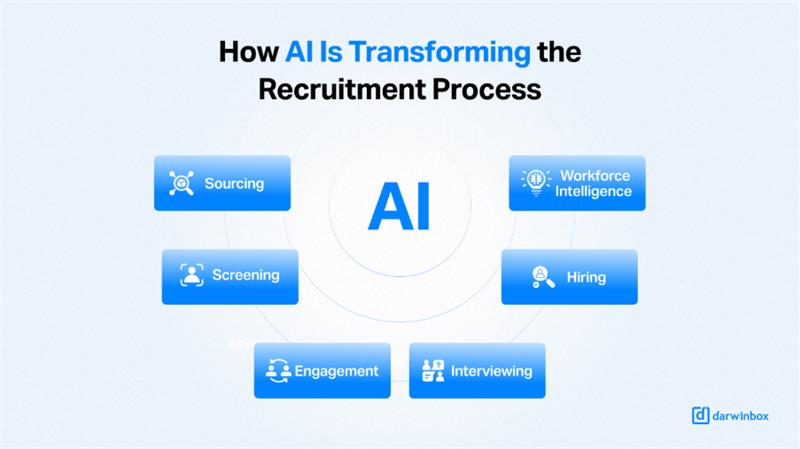
AI now influences every stage of the recruitment lifecycle. It makes every stage more structured and insight-led. Enterprises can then align HR strategies with business priorities by introducing data-driven intelligence.
AI-Powered Talent Sourcing & Matching
Enterprises usually focus on job boards and networking-based recruitment. While quick and efficient, it limits access to the right candidates. The use of AI in recruitment expands discovery beyond these limited options.
For instance, you can use it to source candidates from:
Talent communities
Alumni databases
Internal employee profiles
Past applicants
Niche or skill-based pools
This means recruiters can overcome the limitation of visibility into just active candidates. With AI, they can identify and reach out to passive candidates, since most employees are always on the hunt for better opportunities.
Besides that, AI also facilitates the shift from keyword-based to skills-based search. For example, almost every enterprise uses an Applicant Tracking System (ATS) for initial resume reviews. These tools look for specific keywords associated with a job profile.
So, if a resume does not include this particular keyword or a set of keywords, the recruiter will never even get to see the candidate’s profile.
Intelligent Screening & Shortlisting
Resume screening becomes complex at the enterprise level because hundreds of applications come in for a single role.
To give you an example, Goldman Sachs received 315,126 applications for its summer internship program in 2024. If you consider the number of annual applications these firms receive, the total can easily reach millions. Processing all these applications manually is resource draining and ineffective. That’s where AI comes into play.
Using Artificial Intelligence in recruitment and selection helps maintain consistency even as application volume increases. Many AI models are also context- and bias-aware. Thus, they ensure that screening is conducted while complying with all regulations.
Here’s a basic idea of how AI works:
Parsing: The process starts by extracting relevant candidate information to create their profiles. These are made based on details, such as:
Skills
Qualifications
Experience
Certifications, etc.
Scoring: The AI will then score each profile based on metrics such as skill alignment, experience depth, and role relevance. Since the evaluation is conducted using a pre-formatted framework, it reduces the risk of bias.
Shortlist: Finally, AI will shortlist the top-most qualified candidates.
Thus, recruiters will avoid spending manual efforts in finding matching profiles. But there’s more because this also allows the hiring individual or team to prioritize candidates. For example, they can decide which applicants to target first or what salary range to offer them.
AI in Candidate Engagement & Experience
Experts from the Forbes Human Resources Council note that today’s applicants expect quick feedback. Enterprises that meet this expectation attract better talent.
Artificial intelligence has the potential to enable real-time responsiveness. As a result, communication becomes timely and structured throughout.
For instance, AI-enabled chatbots can answer common questions a candidate may have. If there’s anything they cannot answer, they can simply transfer the query to a human HR representative and notify them. This ensures that candidates always have access to the information needed to decide whether and how to proceed with the application. It saves their time and your time.
Similarly, automated yet intelligent workflows can trigger updates, reminders, and next-step guidance based on the candidate's current stage in the hiring process. This can allow personalization at scale.
For example, messaging can reflect the role type, location, hiring stage, the candidate’s profile data, and the extent of the applicant's understanding of the job role.
Data-Driven Interviewing & Hiring Decisions
Interviewing relies on recruiters' subjective judgment. And if unconscious bias is involved, which a vast majority of HR professionals believe is a severe problem, the result can be a wrong hire that wastes resources and adds costs.
According to the Society for Human Resource Management (SHRM), the average cost per hire is around $4,700. However, the actual cost can be far worse if the wrong candidate is selected.
First, the entire time on hiring and onboarding will be wasted. Second, the manager will also have to spend time on training the wrong hiree. Third, the enterprise will have to go through the entire process again to hire the right candidate.
AI introduces structured guidance while keeping final decisions in human hands. It supports hiring managers. It does not replace them; it cannot, at least not until now. The role of AI in recruitment is to help humans make the right decisions based on data and intelligence.
For example, an SHRM research found that 94% of business leaders believe that people analytics aid the HR profession. Recruiters also believe the same, as 71% cited it is an important part of their HR strategy.
Benefits of AI in Recruitment for Enterprises
Enterprises adopt AI in hiring because of the outcomes it offers. From speed to consistency, AI can address almost all the challenges enterprise hiring faces. And these benefits aren’t limited to HR metrics; they extend to revenue, growth, and workforce stability.
Here are some of the core benefits of AI in recruitment:
Faster time-to-hire: AI accelerates hiring cycles. This reduces vacancy costs and prevents project delays. Thus, it helps protect revenue and maintain operational continuity even amid fluctuating workforce demands.
Better quality of hire: Technology-based solutions enable data-driven decisions informed by analysis and analytics. The result is improved performance outcomes and lower early attrition.
Higher recruiter productivity: Automation reduces administrative load, which allows recruiters to focus on stakeholder alignment and strategic workforce planning.
Enterprise scalability: AI-driven systems can support high-volume hiring across roles and regions. Enterprises don’t have to proportionally increase HR headcount for scaling.
Improved candidate experience: Timely, consistent communication from a business builds trust with applicants. This strengthens the employer brand and improves acceptance rates for offers.
Stronger compliance and consistency: Enterprises need to comply with hiring regulations across different regions. AI can standardize evaluation frameworks to support fair hiring practices across geographies for better compliance.
While an AI recruitment software can offer some or all of these benefits, it is also essential to find the right solution for your needs. The right modern-day tool will embed all these capabilities within a unified HR ecosystem. Thus, enterprises will be able to align talent acquisition with long-term business goals.
Traditional Hiring Systems vs AI Recruitment
Many enterprises still rely on legacy hiring systems. However, the adoption of AI in recruitment is accelerating. As manual workflows and rule-based automation struggle to meet talent demand and growing workforce complexity, the use of AI has accelerated. As hiring volumes and skill demands increase, traditional tools reveal structural limits that AI can surpass.
AI-driven recruitment reframes how talent operations function within enterprise HR platforms.
The table below shows how AI overpowers traditional recruitment software across different hiring aspects:
| Aspect | Traditional Recruitment | AI-Driven Recruitment |
|---|---|---|
| Talent Sourcing | Recruiters need to do database searches manually and depend on job boards | Recruiters need to do database searches manually and depend on job boards |
| Resume Screening | Screening is done based on simple rule-based filters | Enterprises can create skill-based shortlisting models that pay attention to nuanced details |
| Hiring Speed | The process is very slow | Automated workflows accelerate the pace |
| Hiring Speed | The process is very slow | Automated workflows accelerate the pace |
| Automated workflows accelerate the pace | Cannot cope with high-volume applications | It can easily ingest, analyze, and provide accurate insights regardless of the volume |
| Scalability | Cannot cope with high-volume applications | It can easily ingest, analyze, and provide accurate insights regardless of the volume |
| Bias & Consistency | Recruiters can show intentional and unconscious bias | Bias-aware models aid recruiters in mitigating any conscious or unconscious bias involved with hiring |
| Integration | Disconnected point solutions | Embedded within modern HR platforms for an interoperable approach |
| Hiring Manager Collaboration | Email-driven coordination is required to keep hiring managers in the loop | AI can automatically include managers in every communication. All communications are also sent to a central dashboard, where managers can proactively assess candidates |
| Platform Connectivity | Traditional tools offer descriptive reports after the hiring is completed | Using AI for hiring can embed analytics during the activation of recruitment stages |
AI delivers greater value when integrated with connected frameworks. For instance, a skills platform aligning with hiring decisions with broader talent intelligence and organizational capability data can yield better results.
Future of AI-Driven Recruitment
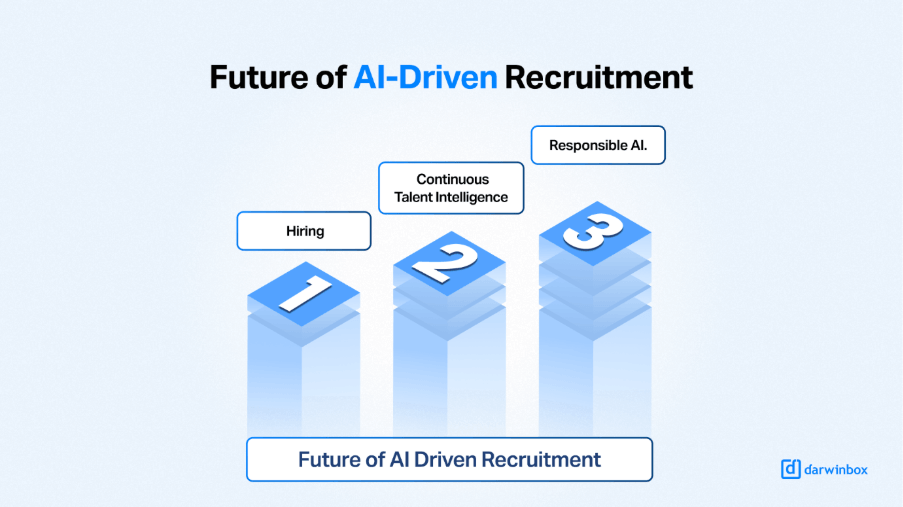
AI-driven hiring has already taken recruitment beyond standard automation. It is now heading towards deeper workforce intelligence. The focus is now shifting from role-based hiring to a capability-based strategy. Therefore, even enterprises are preparing for a more dynamic talent landscape.
The future of AI in recruitment also includes focusing on skills-first hiring, which will define the next phase. According to the World Economic Forum, this hiring method also works for roles that don’t yet exist. The organization even states that 39% of current skills will be transformed or replaced. Thus, businesses are preparing for this phase, and artificial intelligence in recruitment is helping with that.
Another AI adoption change is seen within continuous talent intelligence. Organizations no longer rely on one-time hiring cycles. They are and will continue to use AI in HR to train the future workforce, track past applicants, and maintain real-time visibility into internal and external talent pools.
Conclusion: Key Takeaways for HR Leaders
It is time to stop viewing recruitment as merely a management process. AI has become a strategic workforce enabler, affecting everything from culture and engagement to productivity and revenue. AI in recruitment brings structure to scale, clarity to decisions, and consistency across enterprise hiring environments.
However, choosing the right AI platform for HR is essential. While there are many options, solutions like Darwinbox stand out. Darwinbox is a modern AI-enabled solution that connects recruitment with broader workforce intelligence.
You can schedule a demo with us today to see how AI can help your HR team achieve goals.
References
FAQs
How Is the AI Workforce Transforming Recruiter Roles?
AI is automating repetitive administrative tasks, such as resume sorting and status tracking. Thus, HR professionals are now free to focus on other aspects of their job, including shaping workforce plans, developing new hiring strategies, engaging with top candidates, and more.
Can AI Improve the Quality of Hire at Scale?
Absolutely. Since AI doesn’t rely on keyword-based search as traditional systems do, the volume of applications doesn’t affect quality. It can still source the finest of candidates with role-to-skill alignment. Consistent scoring models, structured interview insights, and contextual knowledge can further improve the quality of hire.
Is AI in Recruitment Suitable for Global Enterprises?
One of the biggest challenges global enterprises face is recruiting for different roles across countries while ensuring local compliance. Artificial intelligence is known for continuously monitoring various parameters and alerting the appropriate people to discrepancies. Thus, AI becomes ideal for global enterprises, as it can not only source ideal candidates but also ensure compliance throughout the process.
Does AI Replace Human Decision-Making in Hiring?
Artificial Intelligence works based on probability. It will not decide for you or tell you which path is right. It will only tell you which path has better chances of success. So, the ultimate decision still lies in your hands. Therefore, AI cannot yet replace human decision-making.