
A resignation letter, a compliance finding, a team that burns out under the weight of too much work: these are the moments that finally reach HR leaders, and by then, the window for early intervention has already closed. A missed signal rarely feels expensive on the day it appears. The cost comes due months later.
In most cases, the warning signs were already in your HR data. Most human capital management systems just weren't built to connect the dots and see the pattern. A system of record can tell you what happened. It can't tell you what's happening right now, and it won't help you see what might happen next.
Below are three warning signs that are likely hiding in your HR data today, why your HCM probably misses each one, and what it would take to catch them while there's still time to act.
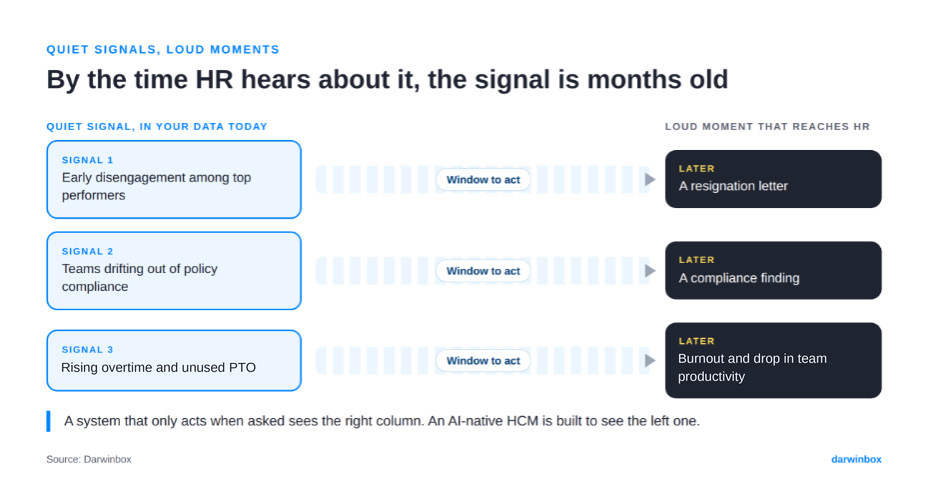
Figure 1: The warning sign appears first. The loud moment that reaches HR comes months later.
Why do these warning signs stay hidden?
Three design assumptions keep them out of sight.
The system waits to be asked. Traditional HCM, including platforms that have added AI agents, acts only when something triggers it: a form submission, a workflow step, or a typed question. If nobody thinks to ask about a signal, it never gets a response.
Data lives in separate modules. Most platforms keep payroll, performance, recruiting, and engagement data in modules that were never meant to be read together. AI added to one module only sees that module's slice.
Patterns are judged against generic rules. Without context about a particular company's history, a system has no way of knowing whether a pattern is normal for that organization or a warning. E.g. A spike in sales team’s resignations might be a five-year seasonal pattern tied to commission payouts at one company, and the first sign of a manager problem at another. A system working from generic benchmarks treats both the same way.
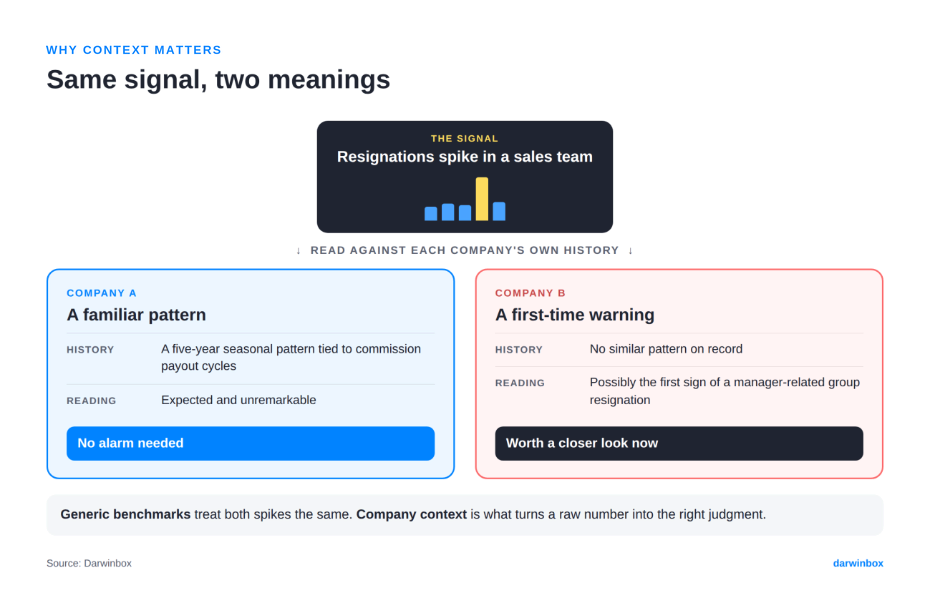
Figure 2: Identical numbers, different meanings. Only company context tells them apart.
Managers and HR business partners can't make up the difference through effort alone. A manager racing to hit a delivery date rarely has the headspace to notice these early warning signs. An HRBP responsible for hundreds of employees can't keep track of every team member.
Warning sign 1: Your strongest people are starting to disengage
What it looks like. Two of a team's best engineers begin showing early signs of disengagement while their manager is heads-down on a delivery deadline. Their pulse survey scores have dropped two quarters in a row. They've stopped signing up for learning programs they used to take on eagerly. One was passed over in the last promotion cycle, and the other is now paid below a peer who joined the team last year.
Why your HCM misses it. Each of these data points lives in a different place. Survey results sit in the engagement tool, promotion history in the performance module, pay in compensation, and learning activity in the LMS. None of them looks alarming on its own, and no rule fires when all of them move at once. The manager, focused on the deadline, isn't looking. The first time the system registers a problem is when one of the engineers submits a resignation.
What it takes to see it. A system that reads these signals together and understands what they mean in combination. Instead of waiting for someone to run a report, it flags the pattern to the manager inside the tools they already use, with the context behind it: which signals moved, when, and why it matters. It also suggests a next step, such as scheduling a career conversation this week, reviewing the pay gap with the HRBP before the next compensation cycle, or offering a stretch project. The goal is to give the manager enough time to act while the engineer is still deciding whether they want to quit, not after they've decided.
Warning sign 2: Teams are drifting out of policy compliance
What it looks like. In three regional operations teams, overtime has been creeping up for months. A few employees are now regularly logging hours above the weekly limit set by local labor rules, and their rest periods between shifts are getting shorter. Managers are approving the overtime one request at a time, each with a reasonable justification. Meanwhile, mandatory safety training certifications are lapsing for a handful of employees, and several timesheets have been edited after the pay period closed.
Why your HCM misses it. Workflow systems check what they've been told to check at the moment a step runs. Each overtime request passes approval on its own merits, and each training lapse is a single overdue item in a long list. Nothing looks at the cumulative pattern across weeks, teams, and data sources, so no alert fires. An HRBP covering 400 employees can't piece it together manually. The problem finally surfaces during an audit or a labor inspection, when it has already become a finding with penalties attached.
What it takes to see it. A system that observes these patterns continuously and reads them against the organization's own policies and the local rules that apply to each location. When a team starts trending toward a limit, it flags the issue to the manager and HRBP with the specifics: which employees, which policy, and how far the trend has moved.
Warning sign 3: A short-staffed team is burning out
What it looks like. A support team has lost four people in six months, and only one has been replaced. The open roles have been sitting unfilled for weeks. The people who remain are logging more overtime, and their leave requests are being postponed or denied.
Why your HCM misses it. Attrition, open roles, overtime, and leave are tracked in different modules, and each one looks manageable on its own. Nothing reads them together, so no one sees a team that is steadily wearing thin. The problem becomes obvious only when more people quit or burn out. By then, the answer is usually a rushed reorganization.
What it takes to see it. A system that reads these signals together and warns the team's leader and HR partner early. It shows what has changed, such as roles left open too long and hours rising across the team, and suggests next steps, like prioritizing those hires or moving people over from another team, while there's still time to plan.
How does Darwinbox Cortex surface what your HCM misses?
Darwinbox Cortex is an AI-native HCM built from the ground up on a context graph, which connects information across the organization instead of keeping it walled off in separate modules. That foundation is what makes cross-module warning signs, like a disengaging top performer or a team heading toward burnout, visible in the first place.
Cortex works through four capabilities that match the requirements above. It senses signal continuously across the organization, so early indicators come up on their own. It reasons against each organization's own policies, history, and people, so a seasonal pattern doesn't get mistaken for a warning. It acts within boundaries the organization sets, with every action scoped, logged, and reversible by design. And it meets people inside the tools they already use for their daily work.
These capabilities work as a loop. When a manager or HRBP accepts or corrects something Cortex surfaces, that response feeds back in as new signal. Cortex starts with narrow authority and earns more through a track record the organization can inspect, so it keeps getting better at reading a particular organization with each cycle.
The warning signs are already in your data
None of these three warning signs need new data. The disengagement, the compliance drift, and the burnout are all already in systems your organization runs today. What's missing is a system built to notice them before someone has to ask. Organizations that close that gap will spend less time reacting to loud moments and more time acting on the quiet ones.
Learn more. Explore Darwinbox Cortex
FAQs
What is an early warning sign in HR data?
An early warning sign is a pattern in workforce data that points to a risk before it becomes a problem, such as rising disengagement, compliance drift, or a team heading toward burnout. Warning signs often show up across several data sources at once, and they appear well before the outcome they point to, like a resignation or a compliance finding.
Why can't a traditional HCM detect early attrition risk?
Attrition risk usually shows up across performance ratings, engagement scores, pay relative to market, and recent org changes. Traditional HCM keeps these in separate modules and acts only when triggered, so nothing connects them, and nobody asks until a resignation lands.
Will adding AI agents to my current HCM surface these warning signs?
Not by themselves. Agents added to an existing platform run predefined processes, wait for a trigger, and see the data of the module they were built for. Catching cross-module, context-dependent signals takes a system built to read the organization as one whole and interpret patterns in its own context.
How does an AI-native HCM act on a signal safely?
It acts only within boundaries the organization sets and asks for approval when the stakes call for it. Every action is scoped, logged, and reversible. Each outcome is recorded, and that track record decides whether the system's authority grows or shrinks over time.