For the past few years, most companies have treated AI as an experiment. The results have been useful, and mostly incremental. That phase is ending. Companies are starting to redesign how work gets done, with AI at the foundation of their processes. Bain calls this the move to an AI-native enterprise: "an organization that has moved beyond fragmented AI tool deployment, instead rebuilding its workflows, data, and agents to change not just how work gets done, but how the business competes." In these organizations, people and AI work side by side toward the same business goals.
This shift reshapes the roles HR plans for, the tools HR works with, and the decisions HR is accountable for. Three new expectations of HR follow.
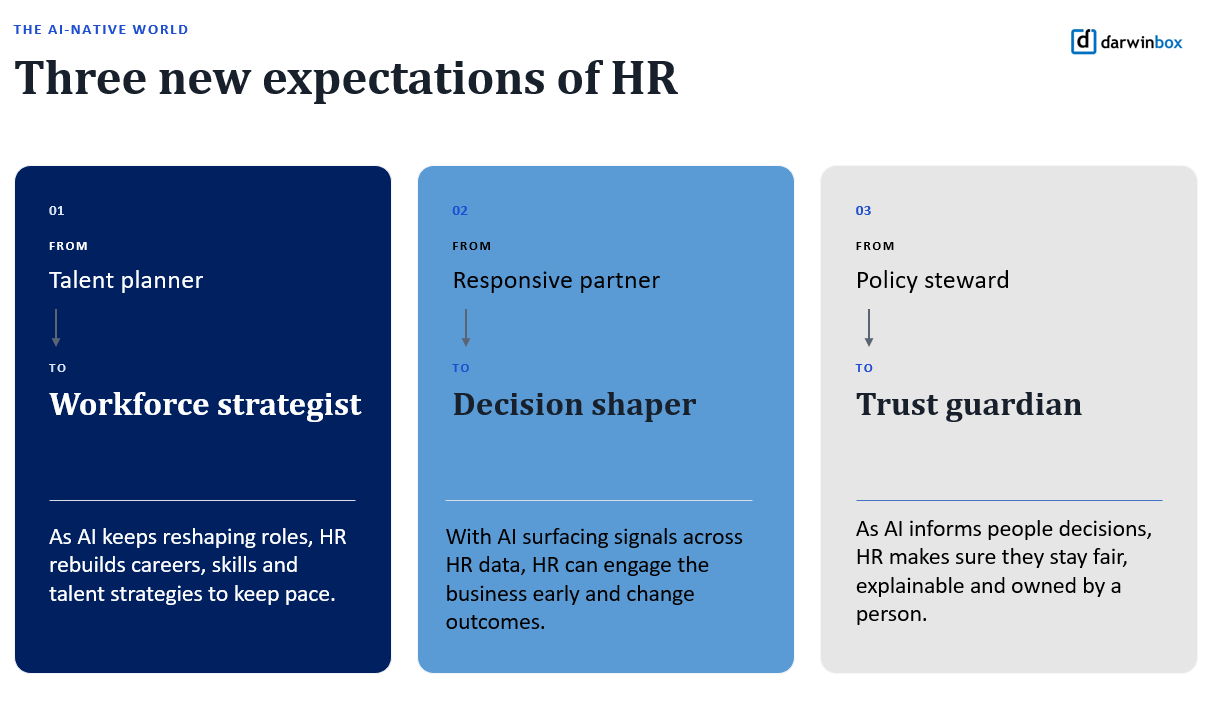
Expectation 1: From talent planner to workforce strategist
The old world. HR has always built talent strategies and closed skills gaps. But those strategies rested on an assumption: roles stayed largely stable, and change arrived at the edges. Even when a new technology, such as the move to cloud, came in, people learned it, and most jobs stayed recognizable. Success meant filling known roles against a known plan.
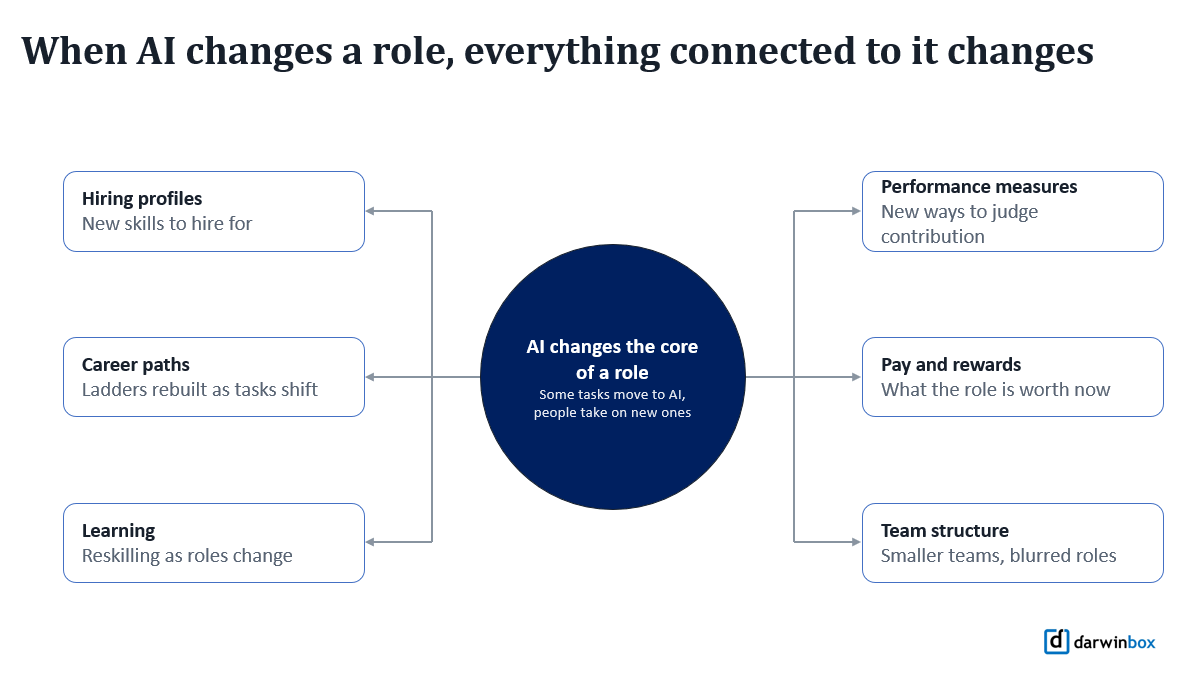
What changes now. AI breaks that assumption by changing the core of roles. Software development shows how far this goes.
AI now writes, tests and reviews a growing share of code, and Gartner predicts that 60% of organizations will adopt smaller software engineering teams at scale by 2029. These "tiny teams" of two to five people pair a product manager, a UX or agent-experience designer and at least one AI-native engineer, who takes on business goals, product design and the oversight of AI agents.
What changes:
how engineering teams are structured,
what the role's skills and career path look like, and
how engineers feel about their work, including what motivates and worries them.
AI keeps improving, so today's redesign is temporary. A gap closed this year can reopen in a different shape next year.
The new expectation from HR as a workforce strategist
Each function owns how its work gets redesigned. HR owns what that means for people. This means
rethinking the talent strategy for every affected role,
how to hire, design roles and reward people to how to keep them motivated and
help them move into new ways of working.
That calls for deeper planning than before, starting from an understanding of work at the level of tasks.
Actions for HR leaders and teams:
Partner closely with each function leader as they map how AI changes their roles, task by task: what moves to AI, what stays with people and what is new.
Build the skills forecast, headcount plan and career paths aligned to the map.
Plan in scenarios, and revisit workforce plans whenever AI capabilities or a function's redesign plans change.
Build internal pathways, such as reskilling, redeployment and new role families, before roles change.
What does success look like
Leaders see workforce readiness as a reason they can move faster.
People whose roles change find a path forward in the organization.
New KPIs for HR
Share of critical future skills with identified internal supply
Share of employees in redesigned roles redeployed internally
Expectation 2: From responsive partner to decision shaper
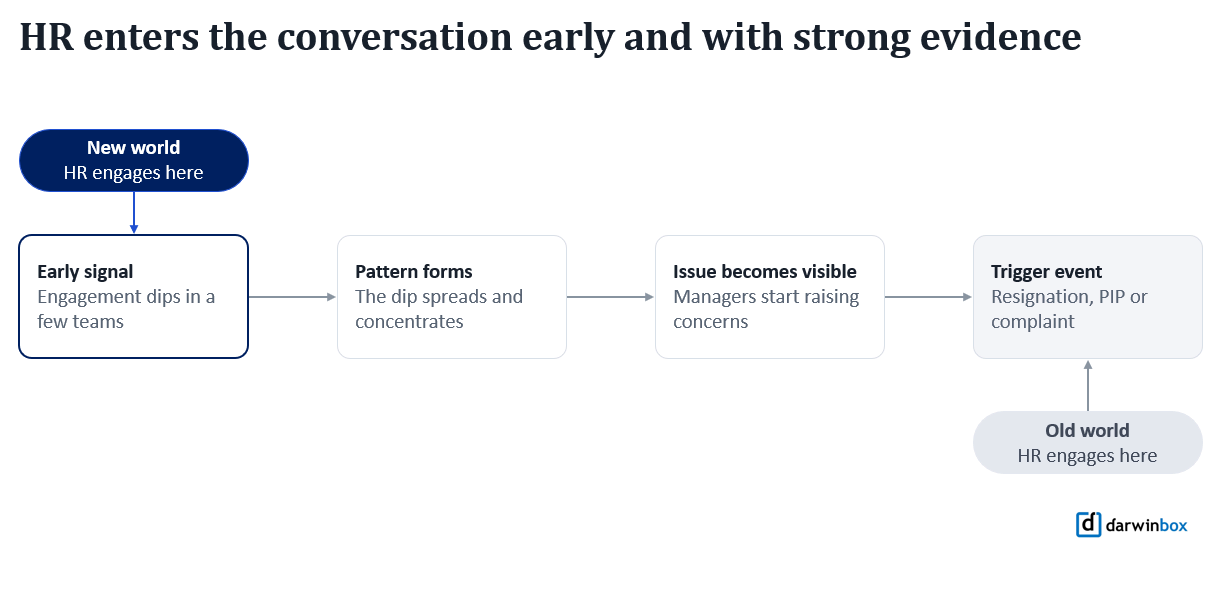
The old world. HR's data was rich but scattered across systems. Dashboards showed what had already happened, and connecting signals into a clear case took hours that urgent work had usually claimed.
HRBPs often sensed something was shifting, but without the time to build the evidence, an early concern was hard to raise with leaders and harder to act on.
So much of their partnership with the business began once an issue had become visible to everyone: a key resignation, a struggling team, a difficult performance case.
What changes now. HR technology is going through its own AI shift. Until now, AI in HR has mostly been bolted onto individual tasks: drafting a job description, answering a policy question, summarizing survey comments.
AI-native HR systems go further. They understand the organization's context: how people, roles, skills, teams and goals connect. They map signals across HR data continuously and spot patterns as they form, giving HR a live view of what is happening in the workforce. They also take routine work off HR's plate.
That removes the constraint that kept HRBPs reactive. HR can now show up when it matters, with the evidence that matters, as often as it matters.
The new expectation from HR as decision-shaper
Leaders still make the business decisions. What changes is when HR joins the conversation and what it brings.
HR is expected to move from responding to a resignation, a performance plan or a complaint to bringing forward early talent risks, along with a plan for early intervention.
An HRBP saying “engagement in the sales team dropped in the two months after the new return-to-office policy, the drop is concentrated among senior account managers owning the largest renewals this quarter.” is a different conversation from "I'm hearing the team is stretched."
It also asks something new of HR: judgment about the evidence itself. Knowing when to trust it, when to test it and when to question it becomes a core skill.
Actions for HR leaders and teams:
Review AI-surfaced signals across your whole span of the business on a regular rhythm.
Bring people evidence into planning, budgeting and org design discussions before decisions are locked.
Put the time AI gives back into advisory work, with clear targets for how HRBPs spend their week.
What does success look like
Leaders seek HR's view before acting.
People risks are raised early enough to change the outcome.
HR's recommendations are acted on because the evidence behind them holds up.
New KPIs for HR
Share of people risks addressed before a trigger event (resignation, performance plan, complaint)
Days from signal flagged to intervention
Share of HR recommendations adopted by leaders
Expectation 3: From policy steward to trust guardian
The old world. HR technology mainly stored information, ran workflows and produced reports. Where it shaped a decision, it followed simple rules anyone could see, like an eligibility check for promotion or filter on job applications.
What changes now. AI is entering the core workflows of HR: hiring, employee service, learning and more. Its influence on decisions varies. Some decisions it handles on its own, many it informs, and some stay fully human. Across all of them, employee trust can't be taken for granted. People need to know what information is used, how it shapes decisions about them and who has the final say.
The new expectation from HR as a trust guardian
Organizations will need to earn employee trust deliberately, and HR will be expected to lead the effort. HR is already accountable for making people decisions fair. In an AI-native organization, that responsibility grows. HR makes sure every AI-informed decision is fair, can be explained and has a person standing behind it. That means communicating openly about how AI is used, putting safeguards in place, championing employees' interests and governing how AI-informed decisions are made.
Actions for HR leaders and teams:
List every place AI touches a people decision, and sort each by risk and by how much AI influences the outcome.
Give each type of decision a named human owner, with the authority to review and override.
Check AI-informed outcomes for bias on a regular schedule, across hiring, pay and promotion.
Educate employees on how AI is used, what data it draws on and how to raise a concern.
What does success look like
Employees understand how AI is used in decisions about them and believe those decisions are fair.
Bias is caught and corrected before it affects outcomes.
The organization's use of AI strengthens its reputation as an employer.
New KPIs for HR
Share of employees who agree AI-informed decisions about them are fair
Adverse impact ratio by group in hiring, pay and promotion outcomes
Where to start: four moves for CHROs
None of this asks HR to abandon what it does well. Sound processes, good judgment and fairness are still the foundation. What matters now is what HR does with the time AI gives back.
Start measuring now. Pick two or three KPIs per expectation from this piece and baseline them before AI-native capabilities scale. Without a baseline, you can't show the shift.
Map the redesign pipeline. List each function's planned AI redesigns for the next 12 to 18 months. Give each one an HR owner and a skills forecast.
Reset the HRBP role. Set clear targets for time spent on advisory work. Invest in three capabilities: business fluency, judgment about evidence and AI literacy.
Put AI governance for people decisions in place early. Build the inventory of AI use cases, name decision owners, set a bias-check rhythm and plan how you'll talk to employees, before AI's role in people decisions grows.
The three new expectations at a glance
| Workforce strategist | Decision shaper | Trust guardian | |
|---|---|---|---|
| What is changing | AI changes the core of roles, and keeps changing them | AI-native systems read signals and context across HR data | AI informs decisions about people |
| What is expected | Rebuild roles, careers and skills as AI changes the core of work | Bring evidence into decisions before they are made | Keep AI-informed decisions fair, explainable and owned |
| Headline KPI | Share of critical future skills with identified internal supply | Share of people risks addressed before a trigger event | Share of employees who agree AI-informed decisions are fair |
Sources
Bain & Company, What Is an AI-Native Enterprise?, August 2026
Gartner, Gartner Predicts 60% of Organizations Will Adopt Smaller Software Engineering Teams by 2029, July 2026