
HR has always been expected to bring judgment to the table: to champion employees and help business leaders make workforce decisions. But the HRBP’s environment rarely lets that judgment develop quickly. Most HRBPs support large employee spans, which makes it hard to keep track of what is happening across the workforce. Their understanding of the organization builds slowly, and often through the loudest signals: resignations, performance improvement plans and employee complaints.
Experienced HRBPs develop judgment through years of piecing these signals together. But what happens to the next generation?
From context gatherers to decision-makers
For most of its history, the HRBP role has been built partly on context gathering. Good HRBPs know which managers are struggling, which teams are stretched and how organizational changes are affecting employees. They assemble this picture from conversations, reports and fragments of information scattered across systems, and their judgment has been shaped by how much context they could gather and how well they could connect the dots.
The AI-native HR operating model that organizations are moving toward changes this equation. In this model, the system continuously senses organizational signals, assembles context, surfaces patterns that might otherwise go unnoticed, offers competing explanations and suggests possible interventions. What once took an HRBP days to piece together is increasingly available on demand.
The HRBP’s work shifts from gathering information to evaluating explanations, weighing trade-offs, influencing stakeholders and deciding what to do.

Types of HRBP Judgement to Build in the AI Era
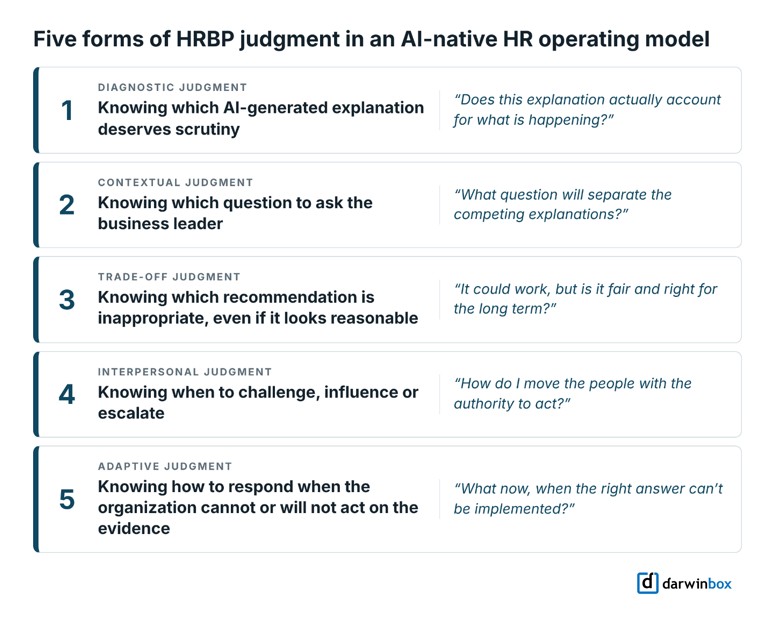
1. Knowing which AI-generated explanation deserves scrutiny
The situation
An AI-native HCM flags an increase in attrition risk among experienced employees in a business unit. It identifies limited career progression as a likely contributor and recommends more frequent career conversations.
The HRBP’s judgment
The HRBP knows that the business unit already conducts regular career discussions. Rather than accepting the diagnosis, they question whether the issue is the frequency of these conversations or the lack of actual advancement opportunities afterward.
Why it matters
More conversations may make little difference if employees see no credible path forward. Acting on an incomplete diagnosis could lead to an intervention that fails to address the underlying problem.
The underlying capability
The AI has surfaced a plausible explanation. The HRBP must assess whether it adequately explains the situation, identify the assumptions it rests on and determine what needs to be validated before acting.
The judgment is not about finding the signal. It is about knowing when the interpretation of that signal is insufficient.
2. Knowing which question to ask the business leader
The situation
The HCM identifies declining engagement and rising attrition risk in a team following a leadership change. It also surfaces deteriorating employee perceptions of the manager.
The HRBP’s judgment
Rather than immediately recommending manager training, the HRBP asks the business leader what has changed in how the team operates. The conversation reveals that a recent reorganization has left employees uncertain about their roles and future prospects.
Why it matters
What appears to be a manager-effectiveness problem may actually stem from organizational uncertainty. Treating the wrong problem could lead to an ineffective intervention.
The underlying capability
The HCM can connect signals and surface patterns, but the HRBP must use business context to identify the questions that will help distinguish between competing explanations.
AI can prepare the HRBP for a conversation. Judgment determines which conversation needs to happen and what to explore within it.
3. Knowing which recommendation is inappropriate, even if it looks reasonable
The situation
The HCM identifies several high-performing employees at elevated risk of leaving and recommends prioritizing them for retention interventions.
The HRBP’s judgment
The HRBP recognizes that consistently prioritizing employees who are already high-performing or highly visible could disadvantage others with comparable potential. It could also reward employees who threaten to leave without addressing broader weaknesses in career progression.
Why it matters
A recommendation that improves short-term retention could create fairness concerns and reinforce behaviours that undermine longer-term talent development.
The underlying capability
The HRBP must weigh competing objectives, consider unintended consequences and assess whether the recommendation aligns with the organization’s broader priorities and principles.
Sound judgment means evaluating not only whether an intervention could work, but also whether it is appropriate, fair and consistent with the organization’s longer-term objectives.
4. Knowing when to challenge, influence or escalate
The situation
The HCM identifies recurring concerns about unclear expectations and declining employee confidence in management. The business leader disagrees with the interpretation, believing employees simply need to adapt to higher performance standards.
The HRBP’s judgment
The HRBP must decide how to challenge the leader’s assumptions, what evidence might be persuasive and whether to involve other stakeholders. A confrontational approach could shut down the discussion, while accepting the leader’s explanation without scrutiny could allow a genuine problem to persist.
Why it matters
Even a well-supported diagnosis has little impact if the people with the authority to act do not accept it. How the HRBP approaches the disagreement can determine whether the issue gets addressed.
The underlying capability
The HRBP must navigate relationships, organizational dynamics and competing perspectives to influence decisions—while recognizing when an issue requires escalation beyond their authority.
The judgment is not just about knowing what should happen. It is about knowing how to influence what happens next.
5. Knowing how to respond when the organization cannot or will not act on the evidence
The situation
The HCM repeatedly surfaces limited internal mobility as a workforce risk. The HRBP raises the issue, but business leaders resist releasing employees to other teams because they are already struggling to fill critical roles.
The HRBP’s judgment
The HRBP must decide how to proceed. They might build a stronger business case, propose a smaller pilot, explore alternative ways to create mobility or escalate the conflict between local and organizational priorities.
Why it matters
Repeating the same recommendation will not resolve a structural constraint. Equally, accepting inaction without considering alternatives could allow the underlying workforce risk to grow.
The underlying capability
The HRBP must adapt their approach to organizational constraints, recognize the limits of their authority and determine when to try an alternative, revisit the evidence or escalate the decision.
The judgment is not about producing the right recommendation once. It is about knowing what to do when reality prevents that recommendation from being implemented.
How should CHROs build HRBP Judgment
AI won’t replace HRBP judgment, but it removes the way judgment used to develop. CHROs now need to build it on purpose:
Make AI recommendations a training ground. Before HRBPs act on a recommendation, ask them to explain why they would accept, challenge or set it aside.
Assess what matters now. Judge HRBPs on the quality of their decisions and the influence they have, not on how much they know about their workforce.
Reinvest the time AI frees up. Spend it on conversations with business leaders rather than on wider spans.